
Urethane cement is applied between about 5 and 35 C, and the limits are not arbitrary comfort margins. They are where both reactions in the material still behave.
Below 5 the cement stops hydrating and the resin barely reacts. Above 35 the working life collapses and the surface skins before it can be closed.
This article explains what each limit protects, how to measure the right number, and what a site can do when the building is outside the window.
The short answer
The floor temperature should be at least 5 C and no more than 35 C at the time of application and for the first 24 hours.
Most manufacturers state a tighter band, often 10 to 30, for full performance rather than for basic cure. Quote and schedule against the tighter band, and treat 5 to 35 as the absolute limit.
Air temperature is secondary. The slab is what the material touches, and a slab can be 10 C away from the room.
That single sentence explains most winter failures. A urethane cement floor placed in a room at 15 C on a slab at 4 has been placed outside its window, whatever the thermometer on the wall says.
A pour booked on the air reading is a pour that may fail on the slab reading.
What the limits are protecting
Two reactions run in this material: the polyurethane resin cross-links and the cement hydrates.
The resin reaction is exothermic and temperature sensitive, and it slows sharply below 10 C.
The cement reaction needs liquid water, and below about 5 C hydration effectively stops.
Above 30 C the resin reaction accelerates to the point where the working life is minutes rather than tens of minutes.
A minimum temperature protects the hydration, and the upper limit protects the placement. Neither is about the comfort of the crew, although both affect it.
The window is therefore the overlap where both reactions proceed usefully and the crew can still place the material.
Cold: what happens below five
At 3 or 4 C the material may still be placeable, and it will look correct for a day.
Then it stops. The surface stays soft, the color stays pale, and a thumb test the next morning leaves a mark.
A floor in that condition may recover if the building warms, and it may not. The cement phase that did not hydrate in the first days rarely catches up fully.
إن curing rate at 3 C is slow enough that the material can be walked on and marked before it has developed any real hardness. A floor marked before it has hardened is a defect with no repair.
A cold weather measure that only heats the air is therefore half a measure. The slab has to be brought up and held, which is a different schedule.
That is why the minimum temperature is a hard limit rather than a target. A cold store pour is a specialist job rather than a winter variant, and any urethane cement pour outside the band is a decision that belongs to the client rather than to the crew. A cold weather measure costs money; placing outside the window costs the floor.
Cold weather measures that work
Heat the building and the slab, in that order, and allow time for the slab to follow the air.
A cold weather measure is usually the largest single item in a winter schedule. It is also the one clients most often try to remove from the quote.
A temporary enclosure with indirect heaters is the standard method, and it needs to run for days rather than hours on a thick slab.
The curing rate also depends on the slab holding its heat. A heater switched off at the end of the shift leaves a slab that cools overnight, and the first twelve hours are the ones that matter.
Precondition the components in a warm store, because cold resin is viscous and mixes poorly.
Do not use direct flame or a hot air lance on the slab, because local hot spots cure the material unevenly.
Measure the slab, not the heater outlet, and keep the reading log with the pour record.
Condensation risk on cold slabs
A cold slab in a warm humid room develops a film of water, and that film is invisible until it is trapped under a floor.
The test is simple: tape a square of plastic to the slab for an hour and look for droplets underneath.
Condensation risk is highest when the slab is below the dew point of the room air, which is the normal condition when a cold store is opened up for work.
A primer applied over a damp film will fail, and the failure appears as large blisters rather than small ones.
Where the risk exists, the slab has to be warmed above the dew point before anything is placed.
Hot: what happens above thirty-five
The working life shortens faster than most crews expect, and a mix that took twelve minutes to place at 20 C may be unworkable at eight minutes.
A hot weather measure that is not planned before the day is usually a decision to place anyway. That decision shows up as a torn surface and a cold joint two batches later.
The surface also skins while the body is still soft, which produces a finish that tears under a trowel and cannot be closed.
Fast setting increases the risk of cold joints between batches, which show as lines across the floor.
A hot weather measure that only shades the crew is not enough. The slab has to be shaded, and the components have to be kept cool before mixing.
At the top of the window the cement also loses water too quickly, which leaves a weak, dusty surface.
None of those is a defect in the material. All of them are consequences of placing outside the window.
Hot weather measures that work
Work in the cooler part of the day, and shade the slab rather than only the crew.
Precondition the components in a cool store, and mix in the shade rather than in the sun.
Keep the mix water cool if the system uses water, and never add extra water to extend the working life.
The most effective hot weather measure is a change of hours, and no other hot weather measure is as cheap: it costs nothing but an early alarm.
A pour that starts at four in the morning is a different job from the same pour at two in the afternoon.
Divide the pour into smaller bays so that each batch is closed before it skins.
Stop when the slab exceeds the limit rather than pushing through, because a torn surface cannot be repaired without cutting it out.
Reading the slab rather than the room
A substrate reading on a shiny or wet surface will read the surface film rather than the concrete, which is why the gun should be aimed at a dull area.
A contact thermometer or an infrared gun on a dull surface gives a usable slab reading in seconds.
Take several readings across the area, because a slab near a roller door can be 5 C cooler than one in the middle.
A substrate reading taken once at the start of a pour is a snapshot. The end-of-shift figure is the one that shows whether the slab held its temperature.
Record the readings at the start and the end of the shift, and note the air temperature alongside.
Take the same substrate reading with an infrared gun set to the wrong emissivity and it will be several C out, so check the instrument against a contact probe once.
The reading log is also the first document we ask for when a urethane cement floor is reported as soft, because it answers the question before anyone starts guessing.
That log is the evidence that the pour was inside the window, and it is worth keeping.
Table 1: What happens at each temperature band.
| Slab temperature | التأثير | Action |
|---|---|---|
| Below 5 C | Hydration stops | Do not place |
| 5-10 C | Slow cure, extended closures | Heat, extend schedule |
| 10-30 C | Normal working window | Proceed |
| 30-35 C | Short working life | Small bays, shade |
| Above 35 C | Skinning, cold joints | Stop or cool the slab |
Mixing temperature and component storage
Resin and hardener should be at the same temperature before mixing, and both should be within the application band.
A cold hardener dosed into a warm resin reacts unevenly, and the mix can show streaks of partly reacted material.
Storage matters as much as the day of the pour. A pallet left outside overnight in February will be at 2 C in the morning even if the building is at 18.
Bring the components into the building the day before, and stack them off the floor rather than on a cold slab.
The mixing temperature of the room matters less than the mixing temperature of the components, and the components are the part a site can control.
Mixing temperature also affects the pot life quoted on the sheet, which is measured at 20 C.
Planning a weather window
In a building with a large roller door, the weather window also depends on the door. An open door on a cold morning can drop the slab reading at that end by 5 C within an hour.
A weather window is the period in which the slab, the air and the components are all inside the band.
In spring and autumn that window may be four hours in the middle of the day, which is enough for a small pour and not for a large one.
In summer the window may be the night shift, and in winter it may require an enclosure and a heater plan.
A weather window named in the schedule also gives the client a reason to accept a delay. A date in the schedule gives them a reason to argue about one.
The schedule should name the window rather than the date, so that a cold snap moves the pour rather than compromising it.
Telling a client the date has to move is easier when the curing rate and the condensation risk have both been explained in numbers rather than in adjectives.
Where a client cannot offer a window, the honest answer is that the material is the wrong choice for that building and that season.
Table 2: Measures by condition.
| الحالة | Measure |
|---|---|
| Cold slab | Enclosure, indirect heat, pre-warm |
| Damp cold slab | Warm above dew point first |
| Hot slab | Shade, night work, small bays |
| Cold components | Move indoors a day ahead |
| Hot components | Cool store, shade, no extra water |
When the window is missed
If the slab is below the limit, the pour stops. No accelerator restores hydration to a slab that is held at 2 C.
If the slab is above the limit, the pour can often continue with smaller bays and shade, but the finish will be harder to close.
If the material has already been placed cold, the options are heat and time, and an honest conversation about the risk.
A urethane cement floor placed outside the band is one of the few failures that cannot be argued with, because the temperature record proves it either way.
What never works is placing and hoping. A floor that cured at 3 C looks fine for a week and fails a thumb test in the second week.
Table 3: What to record for each pour.
| Record | لماذا |
|---|---|
| Slab temperature, start and end | Proves the window |
| Air temperature and humidity | Explains condensation |
| Component storage temperature | Mixing behavior |
| Dew point check | Condensation risk |
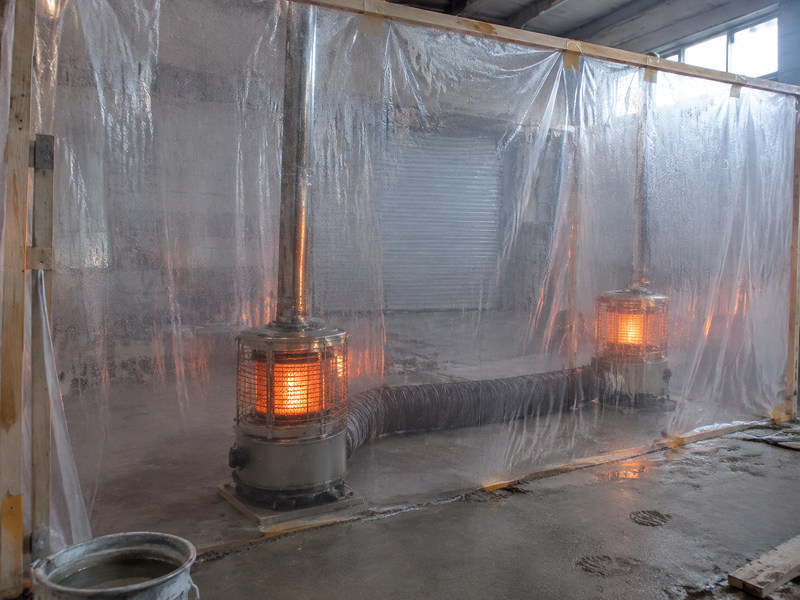
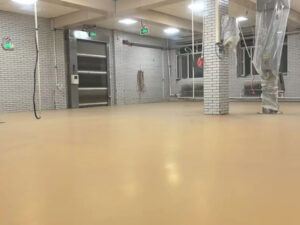
Figure 1: a temporary enclosure with indirect heaters in a production room.
Working next to an open door
Many industrial buildings cannot be closed during a pour, and a door that opens every few minutes changes the conditions at one end of the room.
The slab near the door cools faster, the air near the door is more humid, and the floor there can be 10 C cooler than the floor in the middle of the hall.
The practical answer is to work away from the door and finish at it, so that the coldest area is placed last and closed quickly.
A temporary screen is often enough to hold the conditions at the door end, and it costs a few hours of labor rather than a heating plan.
Where the door must stay open for production, the pour should be split so that the door bay is a separate, smaller operation.
That is a planning decision rather than a product decision, and it belongs in the method statement rather than in the quotation.
A contractor who has not asked about the doors has not planned the pour. Ask how the door end will be handled, and the answer will tell you whether the crew has done this before.
The same question applies to roof lights and glazing, which heat a slab in summer as effectively as a door cools it in winter.
الأسئلة الشائعة
What is the minimum temperature for urethane cement?
About 5 C on the slab. Many manufacturers require 10 C for full performance, and the data sheet governs.
What is the maximum?
About 35 C slab temperature. Above that the working life is too short to place and close reliably.
Does air temperature matter?
It matters for the crew and for condensation, but the slab controls the reaction. Measure the concrete.
Can I apply urethane cement in winter?
Yes, with an enclosure and heat, provided the slab is brought into the band and held there for the first day.
What happens if it is applied too cold?
The cement stops hydrating and the floor stays soft and pale. It may recover partially when warmed, and often does not.
Why does condensation matter?
A cold slab in a warm room collects water. A primer over that film fails, and the failure shows as large blisters.
Can I add accelerator in cold weather?
It does not replace slab heat. Only with the manufacturer’s written approval, and it changes the mix ratio. Heat is the reliable method.
Kaida Paint states the application window for every urethane cement product and will tell you when a building cannot meet it without an enclosure. Send the slab reading, the air reading and the date, and we will say whether the pour is inside the window.





 English
 Spanish
 Portuguese
 Arabic
 French
 Italian
 Russian
 Indonesian
 Swedish