
A polyurethane floor coating does not cure at one moment. It reaches three separate milestones, and each one unlocks a different activity on site.
The walk-on time decides when people can walk on it, the overcoating time decides when the next coat can go on, and the chemical cure decides when it can be cleaned with the chemicals it was specified for.
This article gives realistic numbers for all three at different temperatures, explains what each milestone does and does not mean, and shows how to turn the figures into a downtime cost before the works are booked.
The three milestones, and what each unlocks
Cure is a chemical reaction that proceeds at a rate, not an event with a timestamp. The film hardens progressively, and the site can use it at several points along that curve.
Walk-on is the first. It means the film will carry foot traffic without marking, and it says nothing about resistance to anything else.
Overcoating is the second. It is the period in which the next coat will still bond chemically, and it expires long before the floor is fully hard.
Chemical resistance is the third, and it arrives last. A floor that is walkable on Tuesday may not tolerate a caustic wash until the following week.
Table 1: Three milestones at 20 °C.
| Milestone | Typical time | What it allows |
|---|---|---|
| Tack-free | 2-4 hours | Broadcast, inspection |
| Walk-on | 8-12 hours | Foot traffic, light work |
| Overcoating | 12-48 hours | Next coat, chemical bond |
| Forklift traffic | 24-48 hours | Pallet trucks, light loads |
| Химическая стойкость | 7 дней | Washdown, spills, cleaning |
For a polyurethane floor coating the three milestones are usually 2 to 4 hours, 8 to 12 hours and 7 days. The same three gaps set the screed installation sequence between layers. A specification that quotes only the middle one tells a client nothing about when the floor can be cleaned, so all three belong in the submittal, in that order.
Those figures are for a standard product at 20 °C and 50 per cent humidity. The rest of this article is about what moves them.
Why the numbers move with temperature
The reaction rate roughly doubles for every 10 °C added, and roughly halves for every 10 °C lost. That single rule explains most of the variation between a summer and a winter programme.
Below about 10 °C the reaction nearly stops, and a product that would be walkable in eight hours may still be soft after thirty. Above 30 °C the working life collapses and the film can cure before it has levelled.
Humidity matters less for polyurethane than for epoxy, but it matters at the extremes, and the slab still has to pass a slab moisture test before the first coat. High humidity can cause a surface haze on some products, and low humidity slows the reaction at the surface.
A substrate temperature reading also tells you whether the product is inside its application range at all, which is a different question from how fast it will cure.
Air movement matters more than most people expect. A fan on a fresh floor removes solvent and heat, and it can extend the open time on a warm day or skin the surface on a cool one.
Walk-on time is not traffic-ready time
Walk-on time is measured with a person in clean shoes. A pallet truck applies point loads several times higher, and a forklift applies them through small wheels on a film that is still soft underneath.
That is why a floor can pass a walk-on check in the morning and show wheel marks by the afternoon. The surface is hard enough to resist a shoe and not hard enough to resist a load.
Any walk-on time quoted by a supplier assumes a clean, dry film at a stated temperature. Change any of those and the number is a guide rather than a commitment on a polyurethane floor coating.
Where a client needs vehicles back quickly, the honest answer is usually a longer closure or a different system, not a shorter walk-on claim.
If a load has to move across a fresh floor, put plywood down and keep it to one route. That is a five-minute measure that prevents a permanent mark.
Tack-free time and the broadcast window
Tack-free time is when the film stops being sticky to a light touch. It is the point at which aggregate can be broadcast without sinking, and the point at which the surface stops collecting dust.
Broadcast too early and the grit disappears into the resin. Broadcast too late and it sits on top and brushes off, leaving a floor that looks right and has no slip resistance.
Tack-free time also marks the point where the floor stops being a wet process and becomes a surface that can be inspected without damage.
The window is usually 30 to 90 minutes wide, and it narrows as temperature rises. On a hot day it can be twenty minutes, which is why aggregate work is often scheduled for the cooler part of the shift.
The practical test is a gloved finger rather than a clock. If the resin pulls a thread, it is still too early; if the finger leaves no mark at all, it is too late.
Overcoating time, and what happens when it expires
Overcoating time is the interval in which a second coat will bond to the first by chemical cross-linking rather than by mechanical key.
Inside the window, the next coat bonds well and no abrasion is needed. Outside it, the surface has cured past the reactive stage and must be abraded before overcoating.
A cure test at the end of the overcoating time is worth the two minutes it takes. If the film has skinned, the window has closed and the next coat needs abrasion.
This is the milestone that most often damages a programme, because it expires silently. A crew that finishes the body coat on Friday and returns on Monday has missed it and must grind the whole floor.
The window printed on the drum is measured from the end of the previous coat, not from the start of the shift. Write the actual time on the wall so the next crew knows.

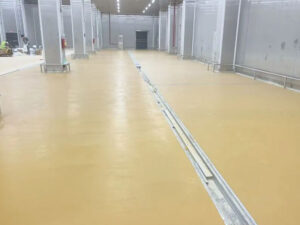
Figure 1: the wet edge is kept between the two rollers, and a strip of tape marks where the bay ends.
Full cure and chemical resistance
Full cure is when the film reaches its specified properties: adhesion, hardness, and resistance to the chemicals in the service environment.
For most polyurethane screeds that is seven days at 20 °C. In a cold building it can be three weeks, and in a hot one it can be four days.
The gap between walk-on and chemical cure is where most complaints originate. A polyurethane floor coating that is walked on too early shows scuffs; one that is washed too early shows a dull, etched surface that never recovers.
The distinction matters commercially because a floor handed over at walk-on is not yet a floor that can be washed with caustic. A plant that starts its normal cleaning regime in week one will blame the coating for a problem it caused.
Where a client cannot wait, ask what the cleaning chemicals are and when the first wash will happen. That conversation is cheaper than the repair that follows a hot caustic wash on a three-day-old floor.
Substrate temperature is the number that governs
Substrate temperature matters more than air temperature, and the two can differ by 10 °C. A slab in an unheated warehouse in February can sit at 6 °C while the air reads 16 °C.
Measure the slab, not the room. A contact thermometer or an infrared gun on a dull surface gives a usable reading in seconds, and it changes the programme.
Record the substrate temperature at the start and the end of every shift. A slab that is warming through the morning will shorten tack-free time and surprise a crew that measured it at dawn.
The same applies in summer. A slab that has absorbed sun through a roof light can be at 35 °C when the air is at 24 °C, and the pot life of the mix will reflect the slab rather than the room.
Most product data sheets give a minimum application temperature, typically 5 °C or 10 °C. That figure is about the substrate, whatever the sheet calls it.
Table 2: How the milestones shift with slab temperature, thin build.
| Milestone | 10 °C | 20 °C | 30 °C |
|---|---|---|---|
| Tack-free | 6-8 h | 2-4 h | 1-2 h |
| Walk-on | 24-30 h | 8-12 h | 5-7 h |
| Overcoating | 36-72 h | 12-48 h | 8-24 h |
| Химическая стойкость | 14-21 d | 7 d | 4-5 d |
Turning hours into downtime cost
Downtime cost is the number a client actually cares about, and it is easy to calculate once the milestones are known: lost hours multiplied by the value of the output that is not happening.
A bottling line that produces 20,000 units an hour at a contribution of five cents each loses a thousand dollars an hour. An extra twelve hours of cure is twelve thousand.
A warehouse is different. If pickers can be rerouted to another aisle, the cost of closing a bay is close to zero until the rerouting itself becomes the constraint.
That difference explains why the same product is specified with a two-shift closure in one building and a five-day closure in another, with no disagreement about the chemistry.

Figure 2: the barrier tape is tied off at waist height, and the coating runs on under it to the doorway.
Testing cure instead of guessing
A cure test is any repeatable check that tells you which milestone has been reached. There are three that work on site, and each answers a different question.
Take the checks in order and record each one. A film that fails a thumb test should not be offered a solvent rub, and a floor that has passed all three is ready for the closure to end.
The thumb test answers whether the film is hard enough to walk on. It is crude, free, and useful only as a first filter.
A Shore D reading answers whether the film has reached its hardness. Take several readings, because a single one can land on a filler particle.
A solvent rub answers whether the film has reached chemical resistance, and an abrasion test result taken before that point describes a softer film than the one in service. Wipe a small area with the solvent the floor will see, wait, and check for softening or colour transfer.
Table 3: Three field checks and what they prove.
| Check | Proves | Limit |
|---|---|---|
| Thumb test | Handling strength | Not traffic strength |
| Шор Д | Hardness development | Local variation |
| Solvent rub | Химическая стойкость | Destructive on a small area |
Where a client disputes a defect, the cure test record and the chemical cure date are the two documents that settle it. Neither takes more than a minute to write down at the time.
Record the readings with the time and the slab temperature. A reading without a temperature cannot be compared with the datasheet or with a later survey.
When the programme is too short
A programme that is too short for the cure schedule has four answers: heat the building, choose a faster product, phase the works, or accept a longer closure.
Heating is the cheapest intervention and the most often overlooked. Raising a slab from 8 °C to 20 °C can halve every milestone in the table above.
Phasing is the second. Half the hall back in service on Monday and half on Wednesday is often better than a whole hall on Tuesday, and it costs nothing in material. It also spreads the cure risk on a polyurethane floor coating, because the second half is applied by a crew that has already seen how the first half behaved in that building.
On a polyurethane floor coating the schedule is a property of the slab as much as the product, and a client who understands that will accept a phased closure that a client who does not will argue about.
A faster product is a design change rather than a scheduling one, and a longer closure is a conversation with production rather than with the contractor.
What does not work is applying thicker, applying hotter, or adding accelerator to a product that was not designed for it. Each of those trades a schedule problem for a film defect.
Writing the cure schedule into the contract
A cure schedule belongs in the submittal, not in a conversation. It should state the milestone, the time at the expected slab temperature, and who is responsible for enforcing it.
For a polyurethane floor coating the useful clause names three closures: no traffic until walk-on, no vehicle traffic until 48 hours, and no washdown until full cure.
Add the measurement basis. A schedule that says 20 °C without saying whether that is air or slab is not a schedule.
The same clause should say what happens if the polyurethane floor coating is walked on early: who records the damage, who pays for the repair, and whether the closure restarts.
Where a client wants to shorten a closure, the request should be in writing with the product manufacturer’s confirmation. That protects both parties when the floor marks.
Часто задаваемые вопросы
How long before a polyurethane floor can be walked on?
Eight to twelve hours at 20 °C. At 10 °C expect 24 to 30 hours, and at 30 °C as little as five.
When can a second coat go on?
Within 12 to 48 hours at 20 °C. Outside that window the surface must be abraded before overcoating.
When is a PU floor resistant to chemicals?
At full cure, typically seven days at 20 °C. Caustic washdown before that can damage a floor that is otherwise sound.
Can I speed up the cure?
Heat the building and the slab. Products can be accelerated only with the manufacturer’s approval, and thicker coats do not cure faster.
Why did my floor mark after forklift traffic?
Walk-on strength is not traffic strength. Vehicles apply point loads several times higher than a person, and a film that passes a walk-on check can still mark.
Does humidity affect polyurethane cure?
Less than it affects epoxy, but extremes still matter. Very high humidity can cause surface haze on some products.
What is the difference between air and slab temperature?
The slab governs the reaction, and it can differ from the air by 10 °C. Measure the floor, not the room.
Почему предприятия пищевой промышленности сотрудничают с компанией «Kaida Paint»
Kaida Paint publishes the three milestones for every polyurethane floor coating at 10, 20 and 30 °C, and states the minimum slab temperature on the datasheet. Send the area, the slab temperature you expect and the hours you can close, and we will return a cure schedule with the closures written in, or tell you honestly that the programme is too short for the system.


 English
 Spanish
 Portuguese
 Arabic
 French
 Italian
 Russian
 Indonesian
 Swedish