Производитель промышленных покрытий и подрядчик по реализации комплексных решений для напольных покрытий
PMMA coating systems — poly(methyl methacrylate) — and MMA (methyl methacrylate) acrylic coatings are cold-applied resin systems that cure in about one hour, so a bridge deck or road marking can return to service the same day. This page covers the full system: PMMA resin, primer, initiator, accelerator, filler and topcoat, supplied as separate components for contractors to mix and apply on site.
Terminology: MMA is methyl methacrylate, the monomer. PMMA is poly(methyl methacrylate), the polymerised resin used in the coating. In the trade both names, and the shorter form “MMA coatings”, refer to the same rapid-cure coating family.
Отображение 1–16 из 21


Choose MMA or PMMA when the area must reopen the same day: MMA cures in hours rather than days and tolerates a wider temperature range during application. Choose epoxy when you need a thick, chemically resistant build and can accept a longer curing window. The table below compares the five chemistries we supply.
| Chemistry | Cure / return to service | Application temperature | Best fit | Main limit |
|---|---|---|---|---|
| MMA / PMMA | Fast — hours, not days | Wide, including cold conditions | Bridge decks, rapid-turnaround decks, road and pavement marking | Strong solvent odour during application; needs trained applicators |
| Эпоксидная смола | 24–72 hours between coats | Moderate; sensitive to low temperature | General industrial floors, chemical resistance, thick builds | Long curing window; yellows under UV |
| Полиуретан | Умеренный | Умеренный | UV-stable topcoats, flexible systems | Moisture-sensitive during cure |
| Cementitious urethane | Умеренный | Умеренный | Wet and thermal-shock areas, food plants | Thicker sections; heavier installation |
| Polyaspartic / polyurea | Fast | Умеренный | Fast-return floors, high-build topcoats | Very short pot life; needs fast application |
A complete MMA or PMMA system is supplied as separate components, mixed on site in the order below. Each stage has its own product code, so a contractor can reorder one component without replacing the whole system.
| Stage | Function | Продукт | Mix ratio / dose |
|---|---|---|---|
| 1. Primer | Seals the substrate, promotes adhesion | Акриловая грунтовка DurAcryl™ P-101 MMA | Single component — no mixing. Coverage 2–3 m²/L (80–125 sq ft/gal); pot life 10–20 min at 20 °C |
| 2. Resin | Main body of the coating | DurAcryl™ G-201 MMA Acrylic Resin · Cove MMA-Based Acrylic Resin | G-201 self-levelling mix: 7 qt (6.5 L) resin to one 40 lb (18.1 kg) bag of filler. Cove: 8–10 linear ft per quart at 1/8″ × 4″ |
| 3. Initiator | Starts the cure reaction | DurAcryl™ Cure MMA Resin Initiator | 1.2–2 % of part B by weight, raised as the temperature falls. Dissolve 15–45 s; working time 15–20 min at 20 °C |
| 4. Accelerator | Sets the cure speed for the ambient temperature | DurAcryl™ LTC MMA Accelerator | 0.5–3.0 oz per US gallon of resin, set by temperature — 0.5 oz (4 mL/L) at 0 °C, 1.5 oz (12 mL/L) at −10 °C, 3.0 oz (24 mL/L) at −18 °C |
| 5. Filler / aggregate | Builds body, adds slip resistance | DurAcryl™ SL Заполнитель MMA Шламовый заполнитель | SL Binder Resin : SL Filler = 1 : 2 by weight. Prime first at 8–10 m²/L |
| 6. Topcoat | Wear layer and colour | DurAcryl™ T-301 · T-303 MMA Topcoat Resin | Coverage 1.5–3 m²/L; pot life 10–15 min; recoat 45–60 min at 20 °C. Hardener ratio: request the TDS |
| ESD variant | Conductive path for electronics areas | DurAcryl™ ESD MMA Resin | Two coats to reach 1×10&sup6;–1×10&sup9; Ω (ASTM F150 / ANSI/ESD S7.1). Coverage 1.8–2.6 m²/L per coat |
| Doses are the manufacturer’s published figures. Coverage varies with surface profile — confirm quantities against your own slab before ordering. | |||
Match the substrate and the traffic it carries to one of the systems below. Each row lists the products we supply for that application; the system can be ordered as a set.
| Приложение | Субстрат | Продукция |
|---|---|---|
| Bridge deck waterproofing | Concrete bridge deck | DurAcryl™ Bridge Deck Waterproofing System (P-101 + G-201 + Cure + T-301) |
| Steel bridge deck paving | Orthotropic steel deck | Система окраски стальных мостовых настилов DurAcryl™ |
| Road and pavement marking | Asphalt or concrete | 2KL Two-Component Road Marking Paint · ColorFuse MMA Spray Marking · ColorMark MMA Colored Marking · Water-based Traffic Paint |
| Non-slip pavement | Asphalt or concrete | BC / TS PMMA Color Non-Slip Pavement Coating |
| Pedestrian deck coating | Concrete or timber deck | DurAcryl™ 075 Эластомерное акриловое покрытие для пола пешеходного класса |
| Polymer concrete repairs | Бетон | DurAcryl™ Tex MMA Полимерный бетон |
| Static-dissipative areas | Бетон | DurAcryl™ ESD MMA Resin |
Applicable range — the figures below are the working limits for our MMA systems. Confirm them against the product TDS for the specific system before you mobilise.
For a formal quotation, send the substrate type, area in m² and required film thickness.
MMA resin cures in minutes to hours, not days. On our sand-broadcast system the wear coat sets in about 40 minutes and the surface is ready for traffic, and the system reaches a fast cure of about 1 hour, with a tack-free time of 30-60 minutes in the technical data. On our spray-applied system the coating cures in about 30 minutes and the area can be taken into service after 1 hour. On gas station forecourts the same 1-hour cure is used so the station stays open during the work.
Application range: -20 °C to +35 °C for our MMA anti-slip systems, and they still cure normally at -30 °C, which is the main reason MMA is chosen for winter work and cold stores. Note the separate limit for the bridge deck waterproofing system: -10 °C to +50 °C, relative humidity up to 85%, and a steel temperature at least 3 °C above the dew point. All MMA application stops during rain, snow or condensation.
MMA is methyl methacrylate, the monomer; PMMA is poly(methyl methacrylate), the polymerised resin used in the coating. Both names refer to the same rapid-cure coating family, and the terms are used interchangeably in the trade.
Choose MMA or PMMA where the deck must return to service the same day and the application window is narrow. Choose epoxy where a thicker, chemically resistant build is required and a longer curing window is acceptable.
Mix in this order. The initiator goes into part B only, never into part A. Dose it at 1.2-2% of part B by weight and adjust within that range for the ambient temperature. Stir part B until the initiator is fully dispersed, then combine A and B at 1:1 by weight. Use three separate mixers for part A, part B and the combined mix, and never share them between components. Mix only what can be applied within the pot life.
Concrete: sweep clean with no standing water, oil, dust or loose material; strip thin repairs of the old material; fill cracks and hollows flush with fast-repair mortar; roll on the primer, which closes the surface capillaries and raises the surface strength. Dry any damp areas with a burner before coating. Asphalt: the same cleaning, then the primer, then set out the lines and tape the boundary. Steel deck: blast to Sa 2.5 with 50-100 micron roughness, then apply the anti-corrosion primer within 3 hours of passing the blast inspection.
MMA is used on parking areas. Our anti-slip system lists parking areas among its applications, and our water-based marking system is specified for underground car parks as well as highways and city roads. For a full multi-storey deck the waterproofing layer must be added beneath the wear course; the layer sequence in this range is the steel bridge deck build, so send us the deck build-up and we will confirm the layer sequence and quantities before you price the job.
Consumption, so you can size the order. Sand-broadcast system: 2.5-3.5 kg/m² overall, of which the base coat alone takes about 2.6-3 kg/m² at 1-2 mm. Spray-applied system: 3-3.5 kg/m². Bridge deck: MMA base coat 2.5-3 kg/m² and a spray texture wear layer of 2-3 mm at 3-3.5 kg/m²; the waterproofing build is Zed S94 at 100-200 g/m², resin waterproof membrane at 2,500-3,500 g/m² to a dry film of at least 2 mm, and Tack Coat N2 at 100-200 g/m². Packaging, minimum order quantity and lead time are confirmed with the quotation.
Not sure which system fits your project?
Send us the substrate, the area in m² and the traffic it will carry — we will recommend the product combination and send the TDS.
KAIDA PAINT® and JINYU PAINT® are brands of the same manufacturing group.
Epoxy resins, curing agents, pigments, fillers and solvents are sourced from established international chemical suppliers. Every incoming batch is inspected and released to production only after it passes the factory’s incoming-material check. Each batch record is filed so that a finished product can be traced back to the materials it was made from.
Formulations are developed and adjusted in the factory laboratory. Each production run is blended to a recorded formula with a fixed mixing ratio and mixing sequence, and the batch is checked for viscosity and gel time before it is released for filling. Formulations are tuned to specific performance targets – adhesion, chemical resistance, abrasion resistance or VOC content – rather than to a single generic specification.
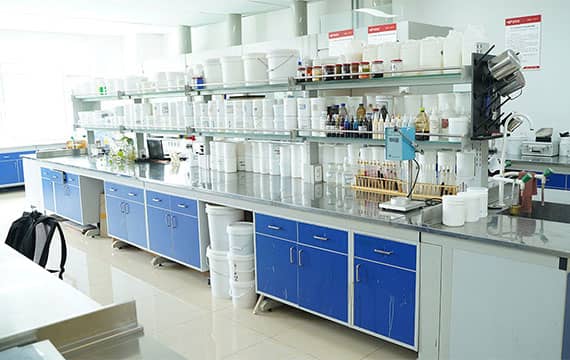
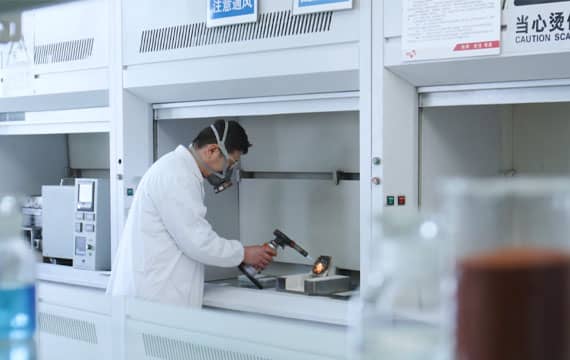
Each batch is tested before packing. Testing covers the properties that determine how the coating performs on site – adhesion, abrasion resistance, hardness, gloss level and solids content – against the product’s technical data sheet. Test reports are issued per batch and can be supplied with the shipment.
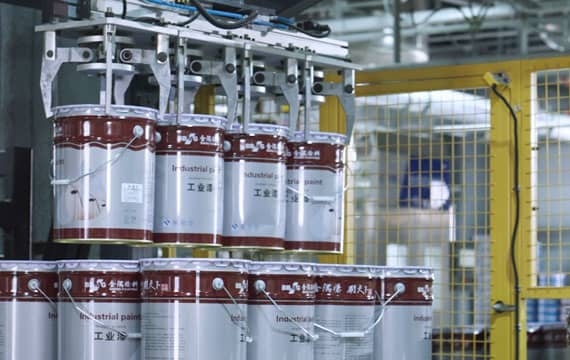
Production runs on the factory’s coating lines, where the coatings are mixed in large batches and filled into pails or drums. Every container is labeled with the product code, batch number and production date, and the label carries the KAIDA PAINT® brand, so a delivered container can always be matched back to its batch record.
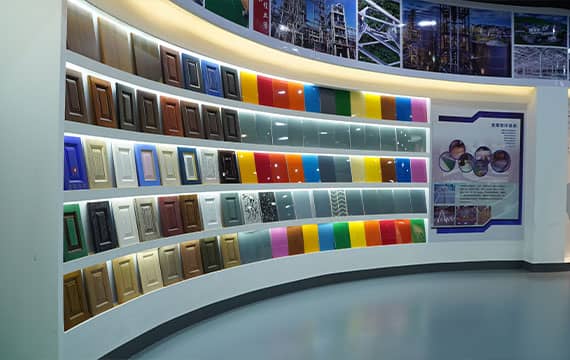
Color matching is carried out in-house against the factory’s standard color range. Where a project needs a specific shade, a color chip is prepared and submitted to the customer for written approval before production starts, so the delivered material matches what was approved.
Water-based and solvent-free systems are formulated to meet the VOC limits that apply in the destination market. The VOC content of each product is stated in g/L on its technical data sheet, so a specifier can check compliance against the regulation for their own project rather than relying on a general claim.

Technical support covers system selection, substrate assessment, application guidance and fault diagnosis – before, during and after delivery. Where a project requires it, application is carried out by installers, and the team that advised on the specification stays involved during application.
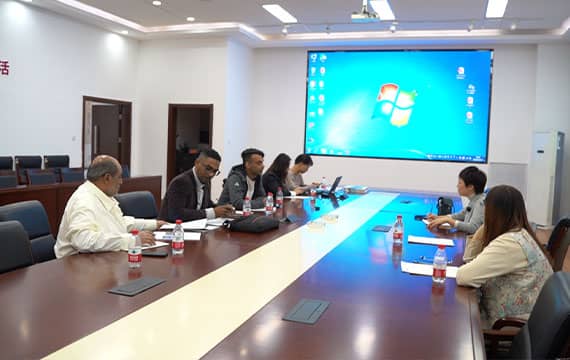
Orders are packed for export with the documents a project needs – technical data sheet, safety data sheet and batch test report. Packing and labeling are adjusted to the requirements of the destination market. Recent projects shipped from the factory include a 10,000 m² food plant floor in Venezuela, an industrial flooring project in Sweden, and a battery plant renovation in Hungary.

Контакт: Г-жа Сабелла Вэй
Телефон: 86-022-83859963
Whatsapp: 15822925523