
A pu screed datasheet that carries CT C35 F10 is telling you three specific things, and none of them is chemical resistance.
The designation is an EN 13813 classification under a harmonised European standard, and it certifies strength, surface hardness and fire behaviour of the material. It does not certify the installed floor.
This article decodes each part of the designation, explains what the letters before the numbers mean, and sets out the claims a supplier can and cannot support with it.
What the standard covers
EN 13813 is the harmonised European standard for screed material and floor screeds. It defines how the material is classified, tested and declared.
It covers cementitious, calcium sulfate, magnesia, asphalt and synthetic resin materials, which is why the designation begins with a binder code rather than a product name.
What it does not cover is chemical resistance, thermal shock, slip resistance, cleanability or adhesion to a specific substrate. Those belong to other tests and, in practice, to the system specification.
The standard also sets out how the EN 13813 classification is declared and how the test results behind it are reported, which is why a datasheet line can be traced back to a laboratory document.
That boundary is where most overclaiming happens. A datasheet can be entirely truthful about its classes and still tell a food plant nothing about whether the floor will survive a caustic wash.
The designation, decoded
A full designation reads as binder code, then compressive class, then flexural class, then optional abrasion and fire classes. Each element is a separate claim with its own test.
The binder code is the part that is most often misquoted. It identifies the family of the material, not the brand, and the letters differ between cement-based and resin-based systems.
Table 1: Each element of a designation and what it certifies.
| Element | Example | Certifies |
|---|---|---|
| Binder code | CT, SR | Material family |
| Compressive class | C35 | Strength at 28 days |
| Flexural class | F10 | Tensile bending strength |
| Abrasion class | AR1 | Surface wear resistance |
| Fire class | A1fl | Contribution to fire |
Read CT C35 F10 as three claims rather than one grade: a cementitious binder, 35 newtons per square millimetre in compression and 10 in flexure. A fourth claim, the fire class, is written as a separate subscript directly after these.
The binder code, and why it matters on a PU datasheet
This is the detail worth checking first, and the aromatic or aliphatic question sits inside each binder family rather than beside it. A cementitious binder code describes a material in which cement is the continuous phase, which includes cementitious urethane systems.
A CT C35 F10 line describes a cementitious system, so a datasheet for a pu screed carrying those letters is describing a hybrid rather than a pure resin product. That is worth knowing before the tender is priced.
A purely resin-based pu screed falls under a synthetic resin binder code instead, and a datasheet that shows a cementitious code for a resin product is either mislabelled or describing a hybrid.
Neither answer is dishonest, but the two products behave differently. A cement-based system is more moisture tolerant and less flexible; a resin system is the reverse.
Ask the supplier which binder the code refers to. A technical desk that cannot answer that question is quoting a template rather than a product.

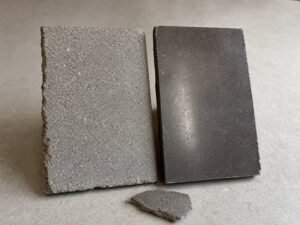
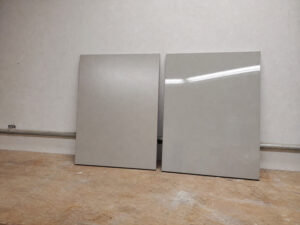
Figure 1: the sheet is held by one corner so it lifts off the floor, and the screed texture stays sharp beneath it.
C35: what compressive strength actually tells you
Compressive strength is measured on a hardened specimen at 28 days, in newtons per square millimetre. C35 means the material reaches at least 35.
That figure matters for point loads and for the durability of the body under a dropped object. It says nothing about adhesion, and nothing about how the material behaves on a flexible slab.
The class is declared on the basis of specimens cured under standard conditions, so a notified body report will show both the mix and the curing regime. A product quoted at C35 from a 28-day wet cure can disappoint on a site where the slab dries out.
For comparison, a structural concrete slab is often C25 to C35, and a good pu screed sits in the same band because it has to carry similar loads through a much thinner section.
Higher is not automatically better. A high compressive strength usually comes with a higher modulus, and a stiff topping on a moving slab cracks rather than flexes.
Table 2: The classes most often quoted for industrial screeds.
| Class | Значение | Typical use |
|---|---|---|
| C20 | 20 N/mm2 | Light industrial |
| C30 | 30 N/mm2 | General industrial |
| C35 | 35 N/mm2 | Heavy industrial |
| C40 | 40 N/mm2 | Severe duty |
| C50 | 50 N/mm2 | Specialist |
F10: flexural strength and what it implies
Flexural strength measures resistance to bending, which is the property that decides how a topping behaves over a slab that moves, deflects or has a joint nearby.
F10 means 10 newtons per square millimetre in tension during bending. It is a healthy figure for an industrial screed and it is the number that correlates with crack resistance in service.
That interaction is why the two classes are read together. A high compressive class with a low flexural class describes a brittle material. A high flexural class with a moderate compressive class describes a tough one, and for flooring the second is usually preferable.
That is why a pu screed can outperform a stronger-sounding concrete topping on a suspended slab, even though its compressive class is lower.
AR: the abrasion class
Abrasion resistance is expressed as AR followed by a number, derived from a standard test on a hardened specimen. Lower numbers mean less material lost.
For a resin floor the class is often AR1 or better, which reflects the toughness of the binder. A cement-based topping typically sits higher unless it has been surface-hardened.
The class is a material property, tested on a specimen rather than on a floor. A pu screed that meets AR1 in the laboratory can still wear quickly in a lane that carries grit.
Where a CT C35 F10 designation carries an AR class, ask which abrasion test method produced it. Different abrasion methods rank the same materials differently, and a class without a method is not comparable with another supplier.
Use the class to compare products, and use thickness and traffic to predict life. The two answer different questions.
Reaction to fire and the fl subscript
Reaction to fire for floorings is classified under the European fire classification system, and the subscript fl marks a flooring product rather than a wall or ceiling material.
Most mineral-based and many resin floor systems achieve a class at the top of the scale, meaning they make a negligible contribution to fire. A1fl and A2fl are the classes usually quoted for inorganic or highly filled systems.
A purely organic resin with a high polymer content will often be Bfl or Cfl. That is not a defect; it is a description, and it matters in escape routes and in buildings where the fire strategy depends on the floor.
Reaction to fire is also tested as part of a system rather than the material alone, and a floor that achieves a class on a non-combustible substrate can behave differently on a timber deck. Check the substrate recorded in the report.
Where a project needs a specific class, ask for the classification report rather than the datasheet line. The report names the tested build and the substrate.
The declaration of performance
Under the European construction products regulation, a declaration of performance is the legal document that accompanies the product and states the declared classes and the standard they come from.
The datasheet is marketing material; the declaration is the document a building control officer will ask for. They should agree, and when they do not, the declaration governs.
Check three things on it: the standard cited, the classes declared, and the intended use. A declaration that lists the product for interior floors does not cover an exterior loading bay.
Keep the declaration with the project file. It is the only document that has legal weight when a dispute reaches the point of asking what was actually supplied.
A notified body is an independent laboratory approved to carry out the tests behind the declaration. For screed materials the assessment is usually based on testing by such a body rather than on continuous factory inspection.
That means the numbers on a declaration describe a type-tested product, not every batch. Production control remains the manufacturer’s responsibility, and the declaration says so.
The notified body signs the report, and that signature is what makes the declared class defensible in front of a building control officer or a client who has read the standard.
It also means a manufacturer cannot invent a class. The test is traceable to a laboratory, and the report can be requested.
Where a client needs batch-level evidence, that is a separate test on a sample from the delivery, and it is worth asking for on a large project.
Reading the test report behind the line
A test report for an EN 13813 classification shows the specimen preparation, the curing age, the test method and the individual results, not just the class achieved.
Look at the age first. A class declared at 28 days cannot be applied to a floor tested at 7, and some resin systems reach their class in a week while cementitious ones do not.
Look at the specimen next. A laboratory plaque is not a site sample, and a pu screed placed by trowel has a different surface and a different filler distribution from a moulded disc.
Then look at the spread of results. A class met by one specimen out of six is a different proposition from a class met by all six, and the report shows which it was.
A report that shows only the final class, with no individual results and no specimen preparation, is a summary rather than a test report. Ask for the full document; a laboratory will release it to the manufacturer on request, and the manufacturer can pass it on.

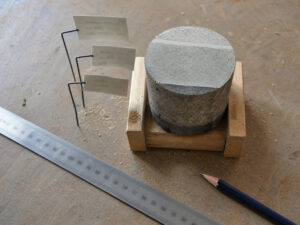
Figure 2: the six are spaced by hand across the bench, with the offcuts pushed to one side.
What the declaration covers, and what it leaves to other tests
The object certified is the material, not the floor. Chemical resistance, thermal shock resistance, slip resistance, adhesion to a substrate and cleanability each need their own test and their own claim.
The installed floor is a separate question. A material that meets C35 in a mould can be installed at half the specified thickness and fail every service expectation.
The unit certified is one product. A primer, a body and a seal are three products, and the declaration on the drum covers the drum.
It does not certify workmanship either, and workmanship is where most floor failures begin. A material that meets every class can be installed over a damp slab, at the wrong thickness, with a missed primer patch, and none of those defects will appear in any document the manufacturer issues.
Table 3: What the standard covers, and what needs other evidence.
| Вопрос | Covered by EN 13813 | Evidence needed |
|---|---|---|
| Material strength | Yes, C and F classes | Declaration, test report |
| Surface wear | Yes, AR class | Test report |
| Fire behaviour | Yes, fl class | Classification report |
| Химическая стойкость | Нет | Immersion test data |
| Installed thickness | Нет | Core sample records |
| Bond to the slab | Нет | Pull-off or knife test |
Where a client needs assurance about the floor rather than the material, the evidence is a core sample, the thickness record and a bond test. Those documents are what a good submittal contains alongside the declaration.
Specifying with EN 13813 without overclaiming
A workable clause names the standard, the required classes and the evidence. It should also state the thickness, because a class without a thickness is a material claim rather than a floor claim.
That evidence chain is what a notified body exists for, and it is what makes a class credible rather than decorative.
For a heavy industrial pu screed, a clause might require a cementitious or resin binder as appropriate, C35 and F10 as a minimum, an abrasion class no worse than AR1, and a declared fire class for the intended use.
Add the evidence: a declaration of performance with the classes, a test report on request, and core samples at the specified thickness after installation. The screed installation sequence is where those thickness records are actually produced.
Where a client is comparing two products with the same classes, ask for the thickness each manufacturer assumes. A CT C35 F10 designation at 3 millimetres and the same designation at 6 millimetres describe different floors.
Write the clause so that a failed result has a consequence. A class specified without a remedy is a preference, and preferences are negotiated away at the first value-engineering meeting.
That combination is defensible in a tender and checkable on site. A designation quoted on its own is neither, however accurate it may be.
Часто задаваемые вопросы
What does CT-C35-F10 mean on a datasheet?
A cementitious binder, 35 N/mm2 compressive strength and 10 N/mm2 flexural strength, classified under EN 13813.
Is EN 13813 a certification of the floor?
No. It classifies the material. Thickness, adhesion and chemical resistance are separate and are not covered.
Why does my PU screed datasheet say CT if it is a resin?
Either the product is a cementitious urethane hybrid, or the binder code has been copied from a template. Ask which binder the declaration refers to.
What is a good abrasion class for an industrial floor?
AR1 or better for most industrial duty. Lower numbers mean less material lost in the standard test.
What is the fl in A1fl?
The subscript marks a flooring product in the European fire classification. It is not a separate class.
Do I need the declaration of performance?
Yes, for any CE-marked product placed on the European market. It is the legal document that states the declared classes.
Can a supplier quote a class without a test report?
Not honestly. The class comes from testing by an approved laboratory, and the report can be requested.
Почему предприятия пищевой промышленности сотрудничают с компанией «Kaida Paint»
Kaida Paint states the binder, the strength classes, the abrasion class and the fire class on every pu screed declaration, and we say which of those apply to the installed system rather than to the drum. Send the tender clause and the intended use, and we will return the declaration, the test report and the thickness that makes the classes meaningful on your floor.


 English
 Spanish
 Portuguese
 Arabic
 French
 Italian
 Russian
 Indonesian
 Swedish