
Slip resistance on a polyurethane floor coating is set by the aggregate and the topcoat, and it is measured by three different tests that do not agree with each other.
This article explains what an R rating measures, when DCOF applies, how PU slip resistance is specified by zone, and why the same floor can pass one standard and fail another.
Slip is a specification item, not a finish
A polyurethane floor coating can be slippery and still meet every other requirement in the document. Grip is a separate line, and if it is not written down with a test method, it will be decided by whoever pours the last coat.
The consequence is asymmetric. A floor that is too rough cannot be cleaned and fails a hygiene inspection; a floor that is too smooth fails a safety inspection, and sometimes an insurance condition.
Both failures are measurable before handover. That is the useful part: slip is one of the few properties that can be tested on the finished floor rather than argued about in a meeting.
Insurers have started asking for the number as a condition of cover in some markets, which has moved slip from a maintenance topic to a procurement one. A slip claim that cannot be backed by a test report is not much use in that conversation.
What does each of the three tests measure?
DIN 51130 uses a person walking up and down a ramp in oil, and it is the shod test; DIN 51097 covers barefoot, and the two are not interchangeable. It classifies the result from R9 to R13. It measures human gait on a contaminated surface, which makes it the closest of the three to a real accident.
The ramp angle is the underlying measurement, and the class is a bin. Two floors in the same bin can differ by three degrees, which is why a PU slip resistance argument is often really an argument about which sample was tested.
DIN 51097 applies the same ramp method with soap solution and bare feet, producing classes A, B and C. It exists because shod and barefoot walking fail in different ways, and a dairy needs both answers.
The coefficient is a dynamic measure of friction taken on a wet horizontal sample, which is what the D in the name stands for. It is the number used in North American specifications, usually with a 0.42 threshold for wet areas.
Table 1: The three classifications side by side.
| Test | Состояние | Footwear | Result scale |
|---|---|---|---|
| DIN 51130 | Motor oil on a ramp | Safety boots | R9 to R13 |
| DIN 51097 | Soap solution on a ramp | Bare feet | A, B, C |
| ANSI A326.3 | Wet, horizontal | Neoprene slider | DCOF, 0.42 threshold |
| Pendulum, BS 7976 | Wet, horizontal | Rubber slider | PTV, 36 threshold |
R ratings explained without the myth
An R rating is not a material property. It is the angle at which a tester in standard boots begins to slip on an oiled ramp, expressed as a class rather than an angle.
R9 to R10 suits dry and lightly wetted areas. R11 is the usual minimum for a wet processing floor, R12 for areas with oil or food waste, and R13 for ramps and dock areas.
The classes are coarse by design. The step between R11 and R12 is about three degrees of ramp angle, which is smaller than the variation between two tiles from the same batch.
Where a client wants a specific number rather than a class, the honest answer is that the ramp method does not provide one. The class is the unit of decision, and the test report is the evidence.
That coarseness is why an R rating alone is a poor specification. It should be accompanied by the intended cleaning regime, because a surface that passes R12 in the laboratory can lose grip once it is coated in protein residue.
Why is the barefoot class so often missed?
Split the specification before you pick a class. A shod zone and a barefoot slip zone on the same site need two test methods, two results and two cleaning assumptions, and one surface rarely satisfies both without a compromise worth pricing. A changing room is the room most often missed. It is specified with the offices, priced with the production floor, and then fails the barefoot test nobody wrote down.
Barefoot slip is a different problem from shod slip. A bare foot has a smaller contact area, a different pressure distribution and no tread pattern, and it fails on soap rather than on oil.
Class A is the entry level and suits changing rooms. Class B is the usual requirement for showers and wash areas, and class C for areas where soap is concentrated, such as a tray wash.
A floor specified only to DIN 51130 can be genuinely dangerous in a barefoot area. We have seen R11 floors fail a class A test, because the aggregate that grips a boot does not grip a heel.
Where a room serves both, the specification needs both results, and the surface usually ends up rougher than the shod requirement alone would suggest.
Changing rooms are where this is most often missed. A barefoot slip requirement appears in the building standard, then disappears from the floor specification because the room was priced with the production areas.
What is the 0.42 threshold actually for?
DCOF at 0.42 is the threshold most North American specifications quote for wet areas. It is a minimum for a specific test method, not a universal safety line.
The number is often copied without the method. A coefficient measured with a different slider, a different speed or a different wetting agent is not comparable, even though the units look the same.
For a polyurethane floor coating in a plant that follows European practice, the coefficient is usually the secondary number, and the ramp classes are the primary ones. Where the client is North American, the order reverses.
The practical advice is to specify the method as well as the value. A test report that names the standard, the slider and the wetting agent can be compared; one that quotes a number alone cannot.
The same discipline applies to aggregate broadcast. A supplier who can name the grade and the broadcast rate can be compared with another; one who says the floor is anti-slip cannot, and the polyurethane floor coating ends up decided on price.
Aggregate choice and what it does to cleaning
Aggregate broadcast is how grip is built into a resin floor. Fused alumina, quartz, silicon carbide and glass bead all behave differently, and the size matters as much as the material.
Hardness decides how long the texture lasts. Fused alumina keeps its edge under abrasion, quartz rounds off sooner, and glass bead is chosen for appearance rather than durability.
A 0.4 to 0.8 mm aggregate gives a finish that grips a boot and can still be squeegeed. Above 1.2 mm the surface becomes difficult to clean and starts to trap food residue.
Sealing is the third variable and the one most often rushed. An aggregate broadcast that is sealed before the grit is fully wetted leaves loose particles on the surface, which reads as roughness on a test and as a foreign body in an audit.

Figure 1: grip and cleanability pull in opposite directions.
The broadcast rate is the second variable. A light scatter gives texture without roughness; a full broadcast that is not sealed properly leaves loose grit, which is a foreign body risk in a food plant.
Where both grip and hygiene are required, the answer is usually a medium aggregate fully sealed, rather than a coarse one partly exposed. The PU slip resistance then comes from the profile of the sealed surface, not from loose grit.
Aggregate grade and film thickness interact, and the interaction is usually missed. A coarser aggregate broadcast on a thin film sits half exposed and sheds grit; the same grade on a thicker film is fully wetted and stays put. That is why two floors with the same test result can behave differently after a year, and why a polyurethane floor coating has to be specified with both numbers together.
Test conditions decide the result
A pendulum test reading changes with the slider, the surface wetness and the temperature. Two laboratories testing the same sample can differ by five points and both be correct.
The pendulum test report should name the laboratory, the date and the sample age. A reading from a panel that has cured for 28 days is not the same claim as a reading from a panel tested at seven.

Figure 2: the ramp measures gait, which is why it predicts accidents better than a coefficient.
A pendulum test result is therefore a statement about a sample on a day, not about a building. The hygiene side of the same decision is settled the same way, by testing the surface as it is cleaned. The reading is useful for comparing two surfaces tested the same way, and weak as an absolute promise about a building.
That is why we test on site rather than only in the factory. A floor that reads 45 PTV when new can read 30 after a year of cleaning with an alkaline detergent that leaves a film.
The most common cause of a falling reading is not wear. It is residue: a surfactant film, a release agent or an excess of sealer, each of which acts as a lubricant.
Where a floor has lost grip without visible wear, clean it with the correct agent and re-test before specifying a new surface. In our experience half the complaints are solved by that step.
Cleaning method is the third input and the one a floor buyer cannot change later without cost. A detergent that leaves a surfactant film lowers a wet reading within months, and no aggregate change fixes it. Where the cleaning contract is fixed before the floor is specified, the specification should be written to the cleaner rather than to the ideal.
Where a polyurethane floor coating is being re-specified after an incident, the pendulum test record from before the event is worth as much as the one after it. A reading that was acceptable 2 years earlier tells you the surface changed rather than that it was always wrong.
For internal floors the same logic applies with a different instrument. A handful of wet readings taken in the same two or three places each year is more informative than one laboratory report commissioned at handover and never repeated. Where a polyurethane floor coating is tested only at handover, the reading describes the day it was cleaned rather than the year that follows it.
Where cleaning does not restore the reading, the surface has genuinely polished. That happens in doorways and turning areas, and it is a maintenance repair rather than a barefoot slip failure.
Cleaning, grip and the trade-off nobody prices
Rougher surfaces grip better and clean worse. That trade-off is real, and it should be decided by the client rather than by the installer’s preference.
In a wet processing room the usual compromise is R11 to R12 with a medium aggregate, cleaned with a foam agent and rinsed. In a dry store, R10 and a smoother finish is easier to sweep.
The cost of getting it wrong appears in different budgets. Too smooth shows up in accident reports; too rough shows up in cleaning time and in audit findings about residue.
A polyurethane floor coating specification that names both the class and the cleaning method forces that conversation early, which is the only point at which it is cheap.
How do you specify slip by zone?
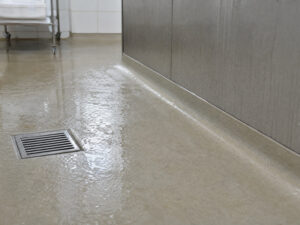
The specification should be a table rather than a sentence. Each zone gets a class, a test method and a cleaning regime, and the contractor prices the aggregate accordingly. Write the class per room into the same schedule as the cleaning method, so DIN 51097 and the method cannot drift apart after handover. Where a trench drain crosses the zone, the gap at the grating is part of the slip surface, so its width belongs in the same schedule.
Table 2: A zone table for a food plant, as issued with our quotations.
| Zone | Shod class | Barefoot class | Aggregate |
|---|---|---|---|
| Dry store | R10 | Not applicable | 0.3 to 0.6 mm |
| Filling hall | R11 | Not applicable | 0.4 to 0.8 mm |
| Wet processing | R12 | B where barefoot | 0.6 to 1.0 mm |
| Changing and showers | R10 | B or C | 0.4 to 0.8 mm |
| Ramps and docks | R13 | Not applicable | 1.0 to 1.2 mm grooved |
Where a zone changes use between seasons, specify the harsher case. Resurfacing a single room later costs more than the aggregate upgrade across the building.
Where a floor is specified for both shod and barefoot use, one surface has to satisfy two tests that pull in different directions. The usual answer is a medium aggregate fully sealed, accepted at an R rating of 11 shod and class B barefoot, with the cleaning method written into the same clause.
Dock ramps and external thresholds deserve their own line. They see rain, grit and braking, and a PU slip resistance that works inside will usually need a coarser grade and a grooved finish outside.
The practical test for a dock area is to walk it in wet weather with the boots the crew actually wear, and traffic in a distribution centre deserves the same walk with a truck rather than a boot. If the surface feels uncertain at the top of the ramp, no laboratory figure will reassure the people who use it every shift. Boots, gradient and water film together decide whether a dock works, and all three are visible on a wet Monday morning without any instrument at all. That is the practical check to run before ordering a test, and it costs nothing but a walk in the rain.
Acceptance testing and what to do when it fails
Slip should be tested at handover, on the finished and cleaned floor, with the method named in the specification. A polyurethane floor coating accepted without that test is accepted on appearance.
Table 3: What a failed reading usually means.
| Reading | Likely cause | Remedy |
|---|---|---|
| Low from day one | Aggregate too fine or over-sealed | Light grind and re-broadcast |
| Falls after 6 months | Cleaning residue film | Correct detergent, re-test |
| Falls in one area only | Local over-sealing or wear | Patch with matched aggregate |
| Passes dry, fails wet | Wrong test condition | Re-test wet, then re-specify |
A failed reading is not automatically a defective floor. It is a measurement that has to be interpreted with the cleaning history, and the answer is sometimes a detergent change rather than a new surface.
Where a floor is accepted on appearance, that conversation never happens. The number is recorded once, filed, and quoted 10 years later as if the floor had not changed, which is the strongest argument for writing an aggregate grade and a re-test interval into the same document. The thickness question underneath is answered there too, because grip and wear are decided by the same topcoat.
Re-testing belongs in the maintenance plan, not only at handover. An annual reading in the wettest two rooms catches a falling trend long before it appears in an incident report or an insurance review.
Retention samples settle arguments that a report cannot. A sealed panel made from the same batch, kept dry and labelled, lets a dispute be tested a year later without lifting the floor. It costs one panel per room and it converts an opinion about grip into a measurement.
Frequently asked questions
What R rating does a wet food area need where the floor is washed down twice a shift?
R11 as a minimum, and R12 where oils or food waste are present. The class should be paired with the cleaning method, because residue changes the result.
Is DCOF 0.42 the same as R11?
No. They come from different tests on different surfaces. A floor can meet 0.42 and sit below R11, and the reverse also happens.
What is the difference between DIN 51130 and DIN 51097 on a floor that is both washed and walked on barefoot?
One tests shod walking on oil, the other barefoot walking on soap. A dairy or a changing room needs both results.
What aggregate size gives good grip without trapping dirt?
0.4 to 0.8 mm for most wet areas, fully sealed. Above 1.2 mm the surface cleans poorly and holds residue.
Why does slip resistance drop after a year?
Usually a cleaning residue film rather than wear. A surfactant layer acts as a lubricant, and the reading recovers once the floor is cleaned correctly.
Can slip resistance be restored?
Often. A light grind and a fresh broadcast restores grip in the affected area, provided the underlying coating is sound.
Should the floor be tested at handover?
Yes, wet, with the method named in the specification and the floor cleaned first. Testing a dusty floor produces a number nobody can use.
Why safety managers work with Kaida Paint
Kaida Paint supplies PU slip resistance by zone, with the aggregate grade and the test method written into the quotation rather than left to site. We will test a sample panel in your cleaning regime before the polyurethane floor coating is ordered, because the number that matters is the one after cleaning, not the one in the catalogue.



 English
 Spanish
 Portuguese
 Arabic
 French
 Italian
 Russian
 Indonesian
 Swedish