
An industrial polyurethane floor coating is a resin floor built up in layers to a stated thickness, and the thickness is what decides whether it survives a forklift, a hot washdown or a chemical spill.
This guide sets out the four systems normally sold under that name, the load classes they can carry, how hardness and abrasion are measured, and the substrate conditions that decide whether any of it works.
What does an industrial floor have to survive before the resin matters?
Most failures we are called to are not resin failures. They are load, heat or moisture arriving in a combination the specified system was never built for, and no coating brand survives a wrong thickness.
Four loads decide the build-up: static rack legs, rolling forklift wheels, thermal shock from washdown, and chemical contact. Each one argues for a different thickness and a different binder.
A specification that lists only a product name leaves all four unanswered. A specification that lists thickness, binder type, aggregate and test values can be priced and compared.
A floor that fails at year three usually fails at specification, not at installation. The traffic was heavier than the sheet assumed, the water came from below, or the cleaning chemistry changed after handover.
An industrial PU floor coating is judged by what it survives, not by the sheet it arrived with. Ask where the same system has run for 8 years under the same traffic. Price per kilogram hides this, because an industrial PU floor coating at 0.4 mm and one at 6 mm can carry the same name.
The four systems sold as an industrial PU floor
The same trade name covers a 0.5 mm seal coat, a 3 mm self-smoothing layer, a 6 mm trowelled mortar and a flexible membrane. They behave differently because the filler load and the binder ratio differ.
Buyers who compare on price per kilogram are comparing four different products. Buyers who compare on installed thickness and binder content are comparing systems, and what the binder actually is decides which of the two they are pricing.
Comparing an industrial PU floor coating with a seal coat on price per kilo is the most common buying error we see. The unit that compares is square metre installed, at a stated thickness, inside a stated PU floor system.
Table 1: The four build-ups, what each one is for, and what it cannot do.
| Система | Installed thickness | Built for | Not suitable for |
|---|---|---|---|
| Seal coat | 0.3 to 0.6 mm | Dust sealing, colour, light traffic | Forklifts, thermal shock, point loads |
| Self-smoothing | 2 to 4 mm | Production areas, trolley traffic, washdown | Steel-wheeled traffic, hot spills |
| Mortar screed | 5 to 9 mm | Racking aisles, wet processing, thermal cycling | Thin build-ups over weak substrates |
| Flexible membrane | 2 to 3 mm | Crack bridging, cold stores, movement | Heavy point loads without a screed |
The table is a starting point, not a catalogue. A 4 mm self-smoothing system on a sound slab is genuinely industrial; the same product over a weak screed is a warranty claim waiting for a date.
Ask every bidder for the same three lines and the differences become visible: preparation method, build-up per layer, and what is excluded from the price. Most tender confusion disappears at that point.
Thickness is a specification item, not a range
When a tender says 3 to 5 mm, the installer will deliver 3 mm and the buyer will have paid for a system that was justified at 5. The range is not a tolerance; it is an invitation. A first build and a retrofit reach the same build-up by different routes. On a new slab the question is what the traffic needs; on a retrofit it is what the floor will accept. Name the worst wheel and the rack leg, then take the thinnest build that clears both.
Screed thickness should be stated as a minimum dry film thickness per layer, with the number of layers and the method of checking. A wet film gauge reading on a trowelled mortar is almost meaningless.
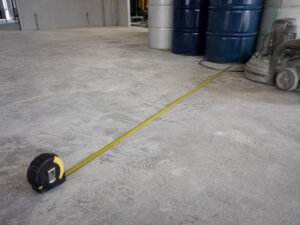
On a pu screed, screed thickness is checked by volume rather than by gauge. A trowelled layer has no uniform wet film to read, so bags consumed over a measured area are the evidence, recorded per room.
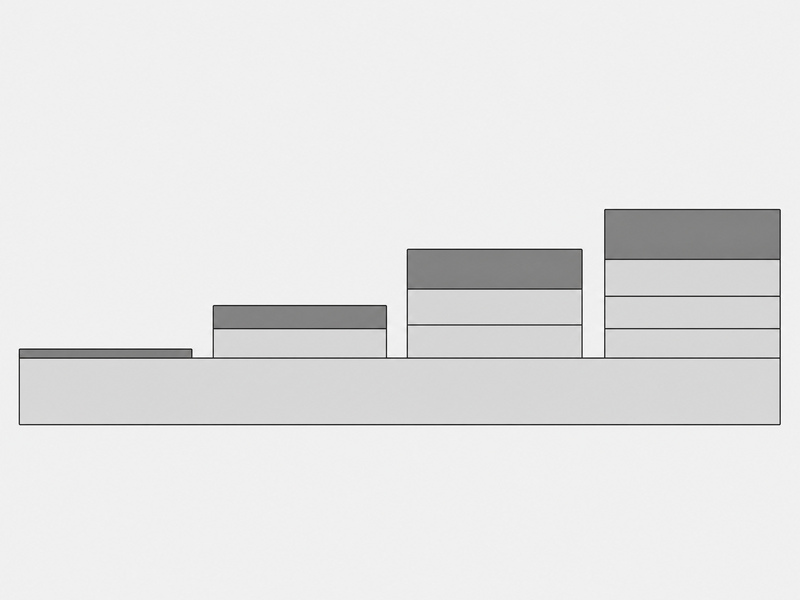
Figure 1: Thickness, not product name, sets the duty of a build-up.
The practical check is a core sample or a wet film reading on the primer plus a volume calculation on the mortar. Both are cheap; neither is done often enough.
That record answers the question 2 years later about why one bay wore faster than the next. Without it, thickness becomes a memory of a conversation on site.
Where the screed thickness cannot be evidenced, the buyer of a PU floor system is buying a promise. Two questions settle it: how many bags went into each room, and who counted them.

Figure 2: Contact pressure, not vehicle weight, sets the build-up.
Load classes: what the number actually promises
A load class describes a combination of wheel load, contact pressure and number of passes. It does not describe a material.
Ask for the wheel load in kilonewtons and the contact area in square millimetres, not the vehicle weight. A label without those two numbers cannot be checked, and three suppliers will read it three ways. Pass count matters as much as load: a route crossed twice a shift and one crossed two hundred times are different floors at the same pressure. An industrial PU floor coating quoted from the label alone is a price for a guess, and abrasion resistance is what pays for the difference.
Two products of the same class can differ by a factor of three in wear life.
For racking, the number that matters is the point load at the leg plus the dynamic factor during pallet placement. For forklifts, it is the contact pressure of a solid tyre, which is far higher than most people assume.
An industrial polyurethane floor coating specification should quote load class with the wheel load behind it. Without the load, the class is a label that three suppliers will read three ways.
The number is worth checking against the building, not only the vehicle. A 2.5 tonne forklift on a solid tyre concentrates more load than a 5 tonne one on pneumatics, which is why fleet lists alone mislead.
Table 2: Reading a load class against the traffic in the building.
| Traffic | Typical contact pressure | Minimum build-up | Watch for |
|---|---|---|---|
| Foot and pallet truck | Under 2 N/mm2 | 2 mm self-smoothing | Dragged pallets, grit |
| Forklift, pneumatic tyre | 3 to 7 N/mm2 | 4 mm mortar | Turning circles, braking zones |
| Forklift, solid tyre | 8 to 15 N/mm2 | 6 mm mortar | Heat build-up at the wheel |
| Rack leg, static | Up to 25 N/mm2 | 6 mm plus plate | Edge loading at the slab joint |
When is a mortar screed the only honest answer?
A pu screed carries load by spreading it, and spreading needs depth. Below about 5 mm there is not enough material to distribute a solid-tyre contact pressure before the substrate sees it.
We treat a heavy duty polyurethane floor as a thickness decision, not a product tier. A 9 mm pu screed over a weak screed still fails, and a 6 mm one over a sound slab outlasts both.
We specify a heavy duty polyurethane floor where three conditions appear together: steel or solid tyres, wet cleaning, and a slab that cannot be replaced. Take away any one and a 4 mm system may be defensible.
The cost difference is real. Going from 4 mm to 6 mm adds material and a day on site, and it is still cheaper than a second shutdown inside 4 years.
Where the slab cannot reach the required profile, the honest answer is a different system rather than a thicker one. Adding depth to compensate for poor preparation is the most expensive way to fail. Where the choice is between binders rather than thicknesses, epoxy against polyurethane on the same slab settles it faster than a datasheet.
There is also a temperature rule. Below about ten degrees the cure slows enough that a pu screed cannot be opened to traffic inside a long weekend, which matters more to the programme than the product choice.
What does Shore D actually measure?
Shore D hardness is a hardness reading on a cured sample. It tells you how the surface resists indentation at room temperature, and nothing about adhesion, elongation or wear. A Shore D hardness reading describes the surface of a sample, so it cannot stand in for a build-up decision.
A higher reading is not better. A very hard coating transmits impact to the bond line; a slightly softer one absorbs it. The right value depends on whether the threat is point load or thermal movement.
Shore D hardness also drifts with cure. A reading at 7 days is not the reading at ninety, and quoting the later number is not dishonest, only selective.
Compare readings taken at the same age and temperature, or the comparison is noise. Two suppliers quoting 82 and 78 Shore D may be describing the same product on different days.
An industrial polyurethane floor coating that hides shore d hardness behind a single digit is asking for trust rather than offering evidence. Ask for the reading, the age and the temperature on one line, and the comparison becomes possible.
Ask for the reading plus the test temperature. A number quoted without a temperature is not comparable across suppliers, and the difference between 20 and 40 degrees is often five points.
What actually wears an industrial floor out?
Abrasion resistance testing puts a sample under a rotating wheel with grit. It is useful for ranking materials and poor at predicting a building, because real wear is a mix of grit, water and tyre scrub.
In our experience the wear pattern tells you the cause within a minute, which is why the warehouse load case is worth reading before an aisle thickness is fixed. Polished wheel tracks mean abrasion; crescent cracks at a turn mean point load; a ring around a drain means chemical or thermal attack.
In our surveys, abrasion resistance loss starts where the wheels turn. If the wear ring sits at a turning circle rather than at the door, contact pressure is the cause and grit is not.
That distinction decides the next specification. A pressure problem is answered with thickness or a different traffic route, while a grit problem is answered with a harder surface and better cleaning.
Abrasion figures are meaningless without the load class they were measured under. A system that passes on a light wheel can fail on a solid tyre, and the abrasion resistance value will look identical in both cases.
That matters for specification: abrasion resistance is the wrong lever if the failure is thermal shock, and buying a harder product will simply move the failure to the bond line.
Substrate and primer: where the system is decided
A PU floor system is only as good as the bond under it. Moisture, laitance, oil and dust all sit between the resin and the slab, and all four are invisible once the floor is down.
The primer choice follows the substrate, not the topcoat. A moisture-tolerant primer on a dry slab is money wasted; a standard epoxy primer on a damp slab is a blister in 18 months.
An industrial polyurethane floor coating is only as good as the three values recorded against it: moisture content by the correct method for the slab, surface profile, and a pull-off test on any coating that is being overcoated.
Two junctions are priced but rarely specified: floor to drain, and floor to threshold. Both are where a 6 mm build quietly becomes a 2 mm patch.
Record each of the three as a number with its method, not as a tick. Moisture goes down as a value with its test method. Profile goes down as a grade on that method’s own scale. Adhesion goes down as a pull-off value with the failure mode named. That name is the column that predicts the future blister, because an adhesive failure at the primer is a slab problem in a coating’s clothes.
A PU floor system also has to absorb the slab’s own movement. Construction joints, shrinkage cracks and bay edges concentrate stress exactly where the coating is thinnest, and detailing those three is cheaper than adding thickness everywhere.
Where the load asks for a heavy duty polyurethane floor, soundness is tested first, because screed thickness cannot rescue a hollow base. Drag a chain across the slab and listen for the hollow note that marks a debonded screed, then tap the same line and mark where it changes. An industrial polyurethane floor coating at 6 mm over a hollow patch behaves like one at 1 mm.
Specifying so three quotes are comparable
An industrial polyurethane floor coating specification that can be priced needs six lines: substrate preparation, primer, build-up per layer, aggregate, test values with methods, and the acceptance criteria.
Add the programme and the conditions. A supplier who is told the plant runs 6 days a week will price a different sequence from one who assumes an empty building.
The last line is the one buyers forget: what happens if a test fails. A specification without a remedy clause is a description, not a contract.
An industrial polyurethane floor coating that cannot be priced by a competent contractor is not a specification. It is a description with numbers attached, and the gaps will be filled by whoever is cheapest.
Table 3: The six lines a comparable specification needs.
| Line | What to state | Why it changes the price |
|---|---|---|
| Подготовка | Method and profile grade | Diamond grinding and captive shot blasting differ by a third |
| Грунтовка | Product type and coverage rate | Moisture-tolerant primers cost more but remove a risk |
| Build-up | Minimum thickness per layer | The single largest driver of material cost |
| Aggregate | Grade, broadcast rate, sealer | Determines slip and cleanability |
| Testing | Value, method, frequency | Adds supervision time |
| Remedy | What happens if a test fails | Converts a description into a contract |
What we do not claim
We do not claim a product suits every load class, and we do not sell a 1 mm coating as an industrial floor. Thickness is the variable that cannot be argued with later.
We also do not claim that a certificate replaces a site test. Certificates describe a sample; the slab decides the outcome.
What we can do is state the build-up, the test values and the conditions in writing, and price the thickness that the load actually needs.
Where the load asks for a heavy duty polyurethane floor, supplying a thin coating to win the order is not a saving. It is an industrial polyurethane floor coating that will be replaced inside one budget cycle, and the second purchase is never competitive.
There is no best industrial PU floor coating in the abstract. The question only has an answer once the PU floor system envelope is fixed: traffic, cleaning chemistry, thermal range and the condition of the slab.
Frequently asked questions
How thick does an industrial polyurethane floor need to be under a solid-tyre forklift?
It follows the traffic. 2 to 4 mm for trolleys and foot traffic, 5 to 9 for solid-tyre forklifts and racking, and a flexible membrane where movement has to be bridged.
Is a thicker floor always better?
No. Above the thickness the load needs, extra material adds cost and stress from its own shrinkage. The useful target is the minimum that carries the load with margin.
What does Shore D tell a buyer?
Surface hardness at a stated temperature. It says nothing about adhesion or wear, so it should never be the only number in a comparison.
Can a thin coating be upgraded later?
Sometimes, if the existing layer is sound and the profile can be restored. Where the failure is at the bond line, an upgrade means removal, and that is a different budget.
How is thickness verified on site?
Wet film readings on the primer, a volume calculation for trowelled material, and destructive core samples on a sample area. The last one settles arguments.
Can load classes from two suppliers be compared when neither states the wheel load?
Only if the underlying test is the same. Ask for wheel load, contact pressure and pass count rather than the class label alone.
What shortens the life of an industrial PU floor most?
Water under the slab, thermal shock from washdown, and point loads on a build-up that was specified for foot traffic. Resin choice comes fourth.
Why plant engineers specify Kaida Paint systems
Kaida Paint manufactures the four build-ups described here, from a 0.5 mm seal coat to a 9 mm trowelled mortar, and states the class each is intended to carry. We publish installed thickness and test values rather than a range, because the range is where projects go wrong. Send the wheel load, the cleaning method and the substrate condition, and the reply is an industrial polyurethane floor coating specification with its thickness, test method and acceptance criteria on one page.



 English
 Spanish
 Portuguese
 Arabic
 French
 Italian
 Russian
 Indonesian
 Swedish