
Deskripsi
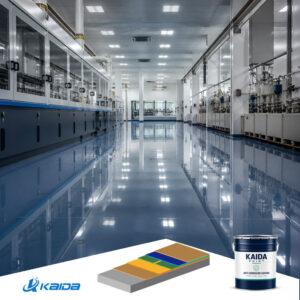
Fiberglass reinforced epoxy flooring is an epoxy resin floor with glass cloth laid into the build, and adding that cloth is what turns a coating that cracks into a floor that spans cracks. ACF-EP-3F5C is built at 2–5 mm, declared against 35% sulfuric acid and 25% hydrochloric acid, with a quoted life of 5–8+ years. Choose epoxy where the acid stays inside that envelope and the surface has to be seamless and glossy; change the resin, not the thickness, above it. The ACF-EP-3F5C system bonds three layers of glass cloth into epoxy resin, builds a mortar body and finishes with an epoxy self leveling topcoat at 2–5 mm. This page sets out which media the system suits and which it does not, how the layers work together, how it is installed, and the point at which a buyer should specify vinyl ester instead of epoxy.
| Item | Spesifikasi |
|---|---|
| Sistem | 3-cloth 5-coat fiberglass reinforced epoxy corrosion-resistant flooring |
| Model | ACF-EP-3F5C |
| Resin | Epoxy throughout — primer, laminating resin, mortar and self leveling topcoat |
| Penguatan | 3 layers glass fiber cloth / mat |
| Finished thickness | 2–5 mm (0.08–0.20 in) |
| Selesai | High gloss, seamless; satin grade for heavy machinery areas |
| Service life quoted | 5–8+ years in the duty it was specified for |
| Application method | Hand lay-up and roller application, ambient cure, no hot work |
What is fiberglass reinforced epoxy flooring, and when is it enough?
Epoxy on its own is a strong, well-bonding coating, but it is brittle under movement: a slab that deflects or a joint that opens will crack a 1 mm film without much provocation. Glass cloth in the build changes the mechanics, because the reinforcement carries tensile strain and keeps cracks closed.
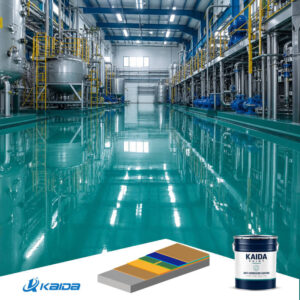
So fiberglass reinforced epoxy flooring is specified where three things are true at once: the chemical load is moderate, the mechanical duty needs more than a coating, and the budget does not stretch to vinyl ester. That describes a large share of real projects — electroplating shops, PCB plants, battery assembly halls, chemical warehouses, hazmat storage rooms.
Where it stops being enough is equally clear. Epoxy is attacked by strong mineral acid at concentration, and it does not belong under permanent immersion of aggressive liquor. Where the medium is a 75% sulfuric stream, a solvent, or a permanent tank of process liquor, the resin has to change, not the thickness.
Which media is ACF-EP-3F5C declared against?
The values below are the manufacturer’s declared 7-day immersion results for the cured system.
| Sedang | Konsentrasi | Hasil |
|---|---|---|
| Sulfuric acid | 35% | No change after 7 days |
| Hydrochloric acid | 25% | No change after 7 days |
| Nitric acid | 5% | No change after 7 days |
| Acetic acid | 10% | No change after 7 days |
| Sodium hydroxide | 20% | No change after 7 days |
| Phosphoric acid | 80% | No change after 7 days |
Read those figures against the vinyl ester range before assuming epoxy is the cheaper equivalent: the acid concentrations here are roughly half of what a vinyl ester system is declared against, and that gap is the honest measure of what the lower price buys.
For hydrofluoric acid duty, specify the vinyl ester high-build mortar with a non-siliceous aggregate. HF attacks both the silica fillers used in epoxy mortars and the resin itself, so an epoxy mortar is the wrong build regardless of thickness; the vinyl ester mortar changes the filler as well as the resin — in this range, the vinyl ester high-build mortar system. Any quotation that offers an epoxy floor for an HF stream should be questioned on the filler before it is accepted. For the record, the manual’s resistance table does list a 65% hydrofluoric acid figure for this system; we do not publish that row, because an epoxy mortar with silica aggregate cannot deliver it in service.
Where epoxy beats its own acid envelope: caustic service
The declared acid figures make epoxy look like the weaker resin, and for acid it usually is. On caustic the ranking changes: an epoxy system tolerates sodium hydroxide at 20% against 35% sulfuric acid, a narrower gap than the acid numbers alone suggest, and caustic is the governing medium in bottle-washing halls, detergent plants and caustic wash-down areas.
What that means in selection terms. A floor in a caustic wash-down area is not automatically a vinyl ester job. Where caustic governs and the acid load is incidental, an epoxy build can be both the correct specification and the cheaper one — the same 2–5 mm build, the same glass reinforcement, a different chemistry of exposure.
The limits sit where they always sit for epoxy: hot caustic, alternating caustic and concentrated acid, and permanent immersion all move the decision back to vinyl ester. The point is not that epoxy is better; it is that the resin is chosen against the medium that governs, not against the strongest chemical on the site list.
The systems above and below this envelope are compared in corrosion resistant flooring by acid envelope.
How is the build assembled?

- Concrete substrate — diamond ground, sound, with voids and cracks opened and filled.
- Epoxy penetrating primer — low-viscosity resin that anchors the system; the bond line that governs the floor’s life.
- Glass fiber cloth × 3 in epoxy resin — the structural layer, fully wetted and de-aired.
- Mortar body — thickness, compressive capacity and impact resistance.
- Grinding and putty — the mortar is ground to plane and the surface closed.
- Epoxy self leveling topcoat — the chemical barrier and wearing surface, poured and de-aired for a uniform gloss.
Because every layer is chemically bonded and the reinforcement is continuous, the floor has no joints to fail. The gloss topcoat also makes spills visible and cleanable, which is why pharma and food-adjacent plants choose it over a textured finish.
For the vinyl ester version of this build, see vinyl ester flooring.
What are the mechanical properties?
| Test item | Unit | Hasil |
|---|---|---|
| Kekuatan tekan | N/mm² | ≥ 60 (8,700 psi) |
| Pencil hardness | H | ≥ 2H |
| Abrasion loss (750 g / 500 r) | g | ≤ 0.02 |
| Ketahanan benturan | Kg/cm² | ≥ 80 |
For a 2–5 mm reinforced floor these values cover pallet trucks, drum handling, jig trolleys and daily wash-down. They do not cover steel-wheeled forklifts, hot slag or impact beyond normal drum and pallet handling — those duties need a mortar-based heavy-duty build with a thicker body.
Where is fiberglass reinforced epoxy flooring specified?
- Electroplating and anodising shops, including drag-out and rinse zones
- PCB and circuit board plants
- Battery assembly and formation halls
- Hazardous chemical workshops and storage rooms
- Pharmaceutical and fine chemical production areas needing a cleanable gloss surface
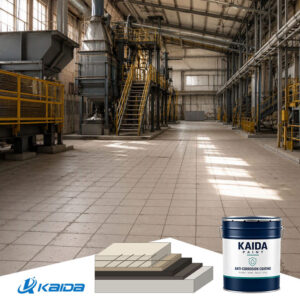
- Chemical warehouses and drum decanting areas
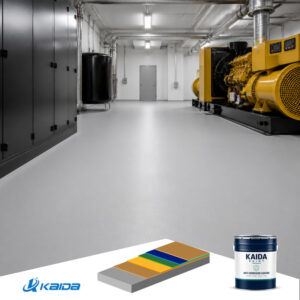
- Machinery assembly halls where oil, coolant and mild chemicals meet load

How is it installed?
- Persiapan — grinding, crack and void repair, dust removal, moisture and dew-point check.
- Priming — epoxy penetrating primer to saturation.
- Lay-up — three glass cloth layers impregnated and rolled out, lapped to the method statement.
- Grinding — cured laminate ground flat.
- Mortar and putty — mortar screeded to level, putty applied and inspected.
- Self leveling topcoat — poured, spread to thickness, de-aired with a spike roller.
- Cure and handover — dry, off-traffic cure window, then joint inspection against the specification.
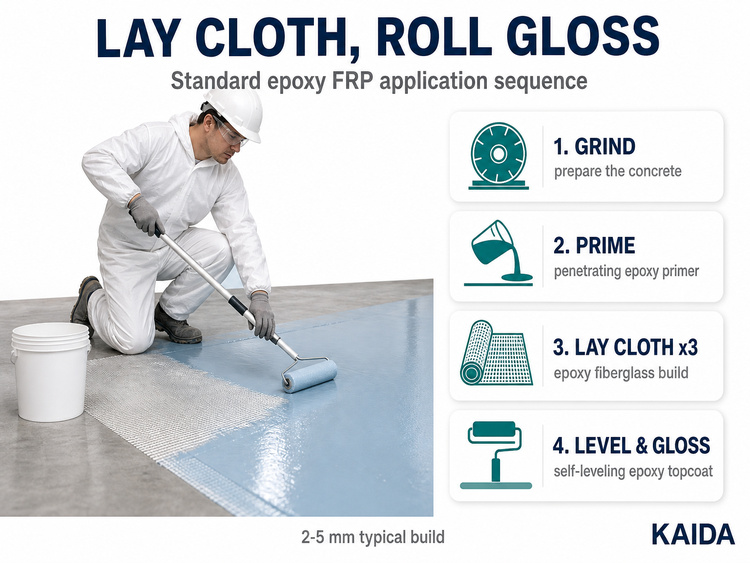
The two site conditions that decide the outcome are the same on every resin floor: slab moisture and dew point. Primer on a damp slab will not anchor, and a topcoat poured outside the dew-point window will haze regardless of mixing discipline.
For steel-wheeled forklift traffic, see steel mesh reinforced heavy-duty system.
Build options, service life, and when to change resin
The standard build is 2–5 mm with three cloth layers; thinner lay-ups are available where the duty is lighter. Quoted service life is 5–8+ years, conditional on the medium matching the specification, a dry and properly prepared substrate, and the maintenance regime in the handover document.
| Kondisi | Recommended system |
|---|---|
| Dilute to moderate acid, caustic wash-down, phosphoric acid, moderate load | Fiberglass reinforced epoxy flooring (this system) |
| Concentrated mineral acid, permanent immersion, tanks and pools | Vinyl ester 3-cloth system or tank lining |
| Hydrofluoric acid, solvent contact, concentrated acid with abrasion | Vinyl ester high-build mortar system |
| Forklift traffic and impact with chemical exposure | Steel mesh reinforced heavy-duty system |
What does it cost, and how is it quoted?
A fiberglass reinforced epoxy floor is priced from measured area, lay-up and thickness, substrate condition and access. It is generally the least expensive reinforced system per square meter (sq ft), because epoxy resin costs less than vinyl ester and the build is thinner than a mortar floor.
Where a quotation looks unusually low for the stated build, check two things: whether the glass cloth is actually three layers, and whether the primer is specified. Those are the two items that get trimmed first and fail first.
Pricing is per square meter (sq ft), FOB or CIF. The minimum order is tied to crew mobilisation rather than to resin volume, and lead time runs as a working-day range from sample approval and substrate sign-off.
Pertanyaan yang Sering Diajukan
Is fiberglass reinforced epoxy flooring the same as an epoxy coating?
No. A coating is a 0.3–1 mm film that relies on the concrete for strength; this system carries glass reinforcement and a mortar body, so it spans cracks and resists impact. The price difference is roughly the difference between maintaining a surface and rebuilding it.
Can it be installed over an existing epoxy floor?
Sometimes — over a sound, well-bonded floor with no blistering or trapped moisture, after abrasion and an adhesion test. Where the existing coating is lifting or damp underneath, it has to come off, because the new build would inherit the same defect.
How soon can the area be used?
Light foot traffic once the topcoat resists marking; full chemical service after the complete cure window in the method statement. Epoxy cures slowly in the cold, so a winter installation needs a longer window planned into the schedule rather than discovered at handover.
Why is the acid resistance lower than a vinyl ester floor?
Because the resin is different. Epoxy’s backbone contains more ester groups that acid and water can attack, so its declared immersion envelope is narrower — 35% sulfuric against 75% for vinyl ester. The epoxy floor is cheaper and perfectly adequate inside its envelope; it is not a substitute outside it.
Why projects specify Kaida Paint for fiberglass reinforced epoxy flooring
Kaida Paint supplies primer, laminating resin, mortar, putty and self leveling topcoat as one system, so intercoat adhesion and cure behavior are predictable rather than a chemistry experiment between three suppliers. The technical file states the cloth count, the build thickness and the media the system was selected against, so the floor can be checked at handover against what was quoted.
Where a project sits near the edge of the epoxy envelope — hot process liquor, mixed acid drag-out, solvent wash — we say so before the order rather than after the first blister. Batch records and a material declaration ship with the material, and the method statement fixes substrate moisture, dew point and cure windows.
Send the medium and concentration, the area, the load and the substrate condition. We will confirm whether epoxy is the right resin for your duty, or recommend the vinyl ester build if it is not.
-
Penulis: Kaida Paint Technical Team — flooring systems engineering, anticorrosive resin flooring Last updated: 13 November 2026

 English
 Spanish
 Portuguese
 Arabic
 French
 Italian
 Russian
 Indonesian
 Swedish