
Deskripsi
Chemical resistant mortar flooring is a resin-bound aggregate floor built thick enough to take both severe chemical attack and heavy mechanical abuse, and it is the specification used where a thin coating or a 3-cloth laminate would be under-built. ACF-VE-MR-HB is built from 5 mm to 20 mm and declared against 95% sulfuric acid and 35% hydrochloric acid. Choose the high-build vinyl ester mortar when the acid is concentrated and the floor also has to take abrasion. The ACF-VE-MR-HB system uses vinyl ester primer, vinyl ester mortar with graded aggregate, and a vinyl ester self leveling topcoat, built from 5 mm to 20 mm. This page sets out why thickness matters chemically as well as mechanically, which media the system resists at what concentration, and how to decide between a mortar floor and a laminate.
| Item | Spesifikasi |
|---|---|
| Sistem | High build vinyl ester chemical resistant mortar flooring |
| Model | ACF-VE-MR-HB |
| Isi | Vinyl ester penetrating primer, vinyl ester mortar with graded silica aggregate |
| Selesai | Vinyl ester self leveling topcoat; matte to satin |
| Build range | 5–20 mm (0.20–0.79 in) mortar body, plus topcoat |
| Service life quoted | 5–10+ years in the duty it was specified for |
| Application method | Trowel-applied mortar and poured topcoat, ambient cure, no hot work |
| Terbaik untuk | Hydrofluoric acid, concentrated acid, solvent contact, heavy abrasion |
Why does thickness matter for chemical resistance, not only for strength?
A resin floor protects concrete by keeping aggressive liquid away from it, and liquid reaches concrete by diffusion through the resin, not only through pinholes. Diffusion is slow, but it is continuous, and the time it takes to cross a layer scales roughly with the square of the thickness — doubling the thickness does not double the protection time, it increases it several-fold.
A mortar floor is specified for hydrofluoric acid, concentrated sulfuric acid and solvent-bearing streams where a 0.5 mm coating would be permeated within a season. The mortar body also gives something a thin film cannot: sacrificial depth. When a mortar floor is eventually damaged, there is material beneath the damage, so the concrete is still protected while the repair is planned.
The second reason is mechanical. Aggregate-filled vinyl ester mortar resists abrasion and point loads at a level a laminate cannot reach, which is what a smelting or plating floor actually experiences.
Which chemicals does ACF-VE-MR-HB resist?
The values below are 7-day immersion results on the cured system, with no change. Note the two figures that separate this product from the standard laminate: 95% sulfuric acid and 55% hydrofluoric acid.
| Sedang | Konsentrasi | Hasil |
|---|---|---|
| Sulfuric acid | 95% | No change after 7 days |
| Hydrochloric acid | 35% | No change after 7 days |
| Nitric acid | 55% | No change after 7 days |
| Acetic acid | 40% | No change after 7 days |
| Sodium hydroxide | 50% | No change after 7 days |
| Hydrofluoric acid | 55% | No change after 7 days |
| Phosphoric acid | 80% | No change after 7 days |
Hydrofluoric acid deserves a note of its own. HF attacks silica, so any aggregate-filled system has to use a filler that is not silica-based in the exposure zone — otherwise the aggregate itself is consumed and the floor becomes porous from the inside. Where HF is present, the aggregate selection and the topcoat are specified together, and this is a question to raise at enquiry rather than at installation.
Where the acid runs above this ceiling, the alternatives are compared in chemical resistant flooring at 95% acid.
How is chemical resistant mortar flooring built up?

- Concrete substrate — ground, structurally sound, moisture verified. Cracks and joints are treated before the mortar goes down.
- Vinyl ester penetrating primer — anchors the mortar to the slab; a scratch coat is added where the substrate is rough.
- Vinyl ester mortar — resin mixed with graded aggregate, trowelled to the specified thickness in one or more passes.
- Grinding — the cured mortar is ground to plane, closing trowel marks and opening the surface for the topcoat.
- Putty where required — a thin fill pass on mortar that has surface porosity.
- Vinyl ester self leveling topcoat — the barrier and wearing surface, pigmented, matte to satin, with an anti-slip grade available.
Because the mortar is aggregate-filled, the finished surface is matte even under a gloss topcoat. That is a property of the build, not a defect, and it is why this system photographs differently from a 3 mm self leveling floor.
For the 3-cloth laminate on the same resin, see vinyl ester flooring.
What are the mechanical properties?
| Test item | Unit | Hasil |
|---|---|---|
| Kekuatan tekan | N/mm² | ≥ 60 (8,700 psi) |
| Pencil hardness | H | ≥ 2H |
| Abrasion loss (750 g / 500 r) | g | ≤ 0.02 |
| Ketahanan benturan | Kg/cm² | ≥ 80 |
At 5–20 mm these values translate into a floor that takes drum handling, scraping, pallet trucks and abrasive spillage without wearing into the reinforcement. It is not a substitute for a structural slab: if the concrete beneath is cracked and moving, the mortar will follow it, and joints have to be carried through the floor rather than covered.
Where is chemical resistant mortar flooring specified?
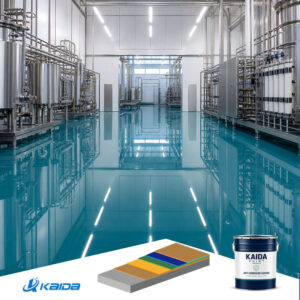
- Chemical workshops handling concentrated acid, fluorine-containing chemicals or strong solvents
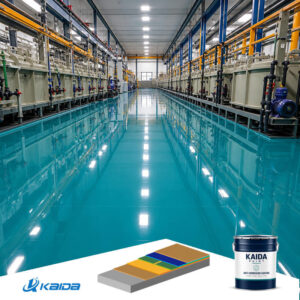
- Electroplating, anodising and surface treatment plants
- Smelting and metal refining areas with abrasive spillage and heavy loads
- Fluorine chemical plants and HF handling areas
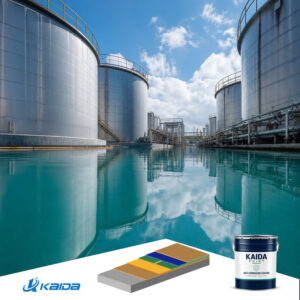
- Tank farm curbed areas and containment yards, including outdoor exposure
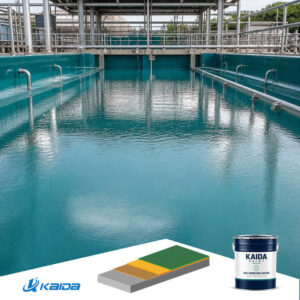
- Wastewater treatment plant wet wells and chemical dosing rooms
- Mineral processing and materials handling floors under abrasive duty

For steel mesh reinforcement under heavy wheel loads, see steel mesh reinforced heavy duty flooring.
Mortar floor or 3-cloth laminate — which one?
This is the question most enquiries actually ask, and the answer is decided by four inputs rather than by preference.
| Consideration | 3-cloth vinyl ester laminate | High build mortar (this system) |
|---|---|---|
| Ketebalan | 3–5 mm | 5–20 mm |
| Chemical severity | Acid, alkali, brine, immersion | Concentrated acid, HF, solvent contact, permeation-critical duty |
| Mechanical duty | Trolleys, foot traffic, wash-down | Heavy loads, abrasion, impact, scraping |
| Repair | Local patch, same sequence | Local patch; depth allows repeat repair |
| Relative cost | Lebih rendah | Higher, driven by aggregate volume and thickness |
Where the medium is aggressive but the mechanical load is light, a laminate with the right topcoat is the economical answer. Where the floor is being eaten from both sides — chemically and mechanically — the mortar is the only build that survives the full service window.
For immersion in pools and tanks, see chemical resistant tank lining.
Installation and schedule
- Persiapan — grinding, crack and joint treatment, moisture and dew-point check.
- Priming — vinyl ester primer, with a scratch coat on open substrates.
- Mortir — trowelled to thickness in passes, with edge forms set to the specified level.
- Grinding — after cure, ground to plane.
- Putty and topcoat — fill pass, then vinyl ester self leveling topcoat.
- Cure and handover — cure window, inspection against the specification, maintenance briefing.

A 10 mm mortar floor cures and grinds in stages, so a large area is planned in bays. Access dates, not material supply, usually set the schedule.
Service life and cost
Chemical resistant mortar flooring is quoted at 5–10+ years of service life. At the full build in the duty it was designed for, mortar floors are commonly the longest-lived resin floor on a chemical site, because there is depth to lose before the concrete is exposed.
Chemical resistant mortar flooring is priced by thickness and aggregate volume more than by resin price, so the per square meter (sq ft) figure rises close to linearly with build. Two items are worth separating in a quotation: substrate repair, and the treatment of joints and penetrations. A quotation that assumes a sound slab and then discovers 30% of the area needs repair is not a cheap quotation, it is an incomplete one.
Quotations are per square meter (sq ft) of mortar body, FOB or CIF named port. Minimum order is set by the smallest area a crew can place in one continuous operation, and lead time is a working-day range from sample approval.
Pertanyaan yang Sering Diajukan
Can chemical resistant mortar flooring be used outdoors?
Yes, within the limits of the topcoat. Vinyl ester resists UV better than epoxy but is not a decorative exterior finish; where the floor is exposed to sunlight and weather, a UV-stable topcoat grade is specified. Freeze-thaw exposure is acceptable provided the slab is sound and water cannot get behind the floor at joints and edges.
How is a damaged mortar floor repaired?
The damaged area is cut back square to sound material, cleaned, primed and rebuilt with mortar and topcoat in the same sequence. Because the build is thick, a repair can be repeated over the life of the floor without the patch becoming a thin spot.
Can it be laid over an existing resin floor?
Occasionally, over a sound and well-bonded system that has been tested for adhesion. More often the existing floor is removed, because a 10 mm mortar body needs a stable substrate and cannot be used to bridge a failing layer.
Is there a slip-resistant option?
Yes. Mortar floors are naturally matte, and an anti-slip topcoat or a broadcast aggregate finish can be specified for ramps, wash-down areas and outdoor yards. The corrosion performance is unchanged; only the surface profile differs.
Why projects specify Kaida Paint for chemical resistant mortar flooring
Kaida Paint supplies the vinyl ester primer, the mortar resin and aggregate, and the self leveling topcoat as one system, so the aggregate grading and the resin are matched rather than combined on site. For HF and concentrated acid duty, the filler selection is confirmed in writing against the medium, because a silica-based aggregate in an HF exposure zone is a specification error that only shows up in service.
Each project file records the medium and concentration, the build thickness, and the aggregate grade supplied. Batch records and a material declaration ship with the material, and the method statement fixes substrate moisture, dew point, joint treatment and the cure window between mortar and topcoat.
Send the chemical list with concentrations, the area, the mechanical duty and the slab condition. We will return a build thickness, an aggregate recommendation and a quotation against those inputs.
-
Penulis: Kaida Paint Technical Team — flooring systems engineering, heavy duty anticorrosive resin flooring Last updated: 13 November 2026

 English
 Spanish
 Portuguese
 Arabic
 French
 Italian
 Russian
 Indonesian
 Swedish