Urethane cement chemical resistance is not a single property. It is a surface in three dimensions, and a chart that shows one of them is a chart that will mislead.
That is the single sentence to carry into a supplier meeting about urethane cement chemical resistance, because it converts an argument about brands into a question about conditions.
The three axes are concentration, temperature and contact time. Change any one and the answer changes.
This article explains how to read a resistance table properly, what a soak test actually proves, and how to write a resistance brief that a supplier can answer without guessing.
The short answer
A tick against a chemical name means the material survives some concentration at some temperature for some duration.
A useful entry states all three, plus the effect observed: mass change, hardness change, blistering or color shift.
Where any of the three is missing, treat the entry as unproven rather than as favorable.
A buyer comparing urethane cement chemical resistance between two suppliers is therefore comparing test conditions as much as products, and the conditions are usually the part that differs.
The practical consequence is that two products can both be listed as resistant to the same acid and behave completely differently in the same room.
Why a tick is not an answer
A resistance chart is usually built from a standard immersion testing regime at a fixed concentration and a fixed temperature for a fixed period.
The chart then compresses that result into a symbol, and the symbol loses the conditions.
That is the core problem with urethane cement chemical resistance data in the market. The chart exists to sell a product, and the conditions exist to protect the client.
A plant that spills 30 percent acid at 60 C, once a week, is not described by a tick earned at 5 percent and 20 C.
A urethane cement chemical resistance claim is only as good as the conditions attached to it, and those conditions are almost always absent from a marketing page.
That is why the first question to ask about any resistance claim is not whether the material resists, but under what conditions.
Concentration: the first axis
The first axis is the one most often quoted and least often qualified: the strength of the chemical as it actually reaches the floor.
Weak acids behave differently from strong ones, and the same acid at two concentrations behaves like two chemicals.
Lactic acid at 3 percent, as found in a dairy, is a mild organic acid that most products handle for years.
The same acid at 80 percent is a different proposition, and it is used in some cleaning products.
A concentration limit also depends on how the chemical is applied. A foam that clings for twenty minutes is a longer exposure than a rinse that passes once.
A concentration limit quoted without a temperature is half a limit, and the two are usually written together in a proper table.
The concentration limit worth quoting is the strongest dilution the plant actually uses, because it is the one number a buyer can check against the bucket in the cleaning cupboard.
Where a plant uses a product at several dilutions, the specification should name the strongest, not the typical.
Temperature: the second axis
Chemical attack accelerates with temperature, and as a working rule, the attack rate roughly doubles for every 10 C.
That means a floor that survives a chemical at 20 C for a year may see the same damage in a month at 50 C.
Washdown is where this bites. A cleaning chemical at 70 C is far more aggressive than the same chemical at ambient, and the floor sees it nightly.
Hot walls and hot vessels also radiate heat onto the floor beneath them, which creates a local zone with a different exposure from the rest of the room.
That local zone is the temperature effect in practice, and it is why a floor can fail at one square meter under a tank while the rest of the room is sound.
Where a plant has several hot vessels, the drawing should show the temperature effect around each one, and the build should follow the drawing.
The temperature effect is therefore a spatial question as well as a chemical one, and it belongs on a drawing rather than in a table.
Time: the third axis
A splash and an immersion are different events with different failure mechanisms.
A splash wets the surface and evaporates, leaving a concentrated residue that may be more aggressive than the original liquid.
That residue is why a splash zone can be more demanding than it looks. The exposure time is short, but the concentration at the end is higher than at the start.
A splash zone that is never cleaned becomes an immersion zone by default, which is how a bund that was designed for occasional spills fails in a year.
An immersion keeps the surface saturated, and the attack proceeds continuously rather than in cycles.
That is why a bund is specified to the immersion standard even when the tank has never leaked. The purpose of containment is the event that has not happened yet.
A week-long spill under a leaking tank is an immersion event that nobody planned, and it is the classic cause of a floor that fails at one square meter.
A written spill response is the cheapest chemical protection available, and it is the one item that no floor product can substitute for.
Contact time is therefore the axis that plant operations control, and the one that a spill response addresses. A weak acid left for a week can do more than a strong one rinsed in a minute.
Splash zone and immersion zone
Any urethane cement chemical resistance assessment should therefore start with a plan showing where liquid stands, not where liquid is used.
A splash zone is an area, not an event: most of a plant floor is a splash zone, with occasional contact followed by cleaning or evaporation.
A small area is an immersion zone: inside a bund, under a valve, around a decanting point, or beneath a tank outlet.
The two need different specifications, and specifying the whole floor to the immersion standard is expensive and sometimes technically wrong.
The same response-time logic decides the bund fitting: a drain valve rather than a pump. A valve closes the exposure, and it closes it in seconds. A pump takes minutes, needs power, and fails when the power is off, which is exactly when a spill happens.
The practical approach is to mark the immersion areas on a layout and specify a heavier, more resistant build inside them.
A containment curb is the cheapest way to make that boundary physical rather than notional, and it also keeps the immersion area small.
Where the boundary is unclear, the safe answer is to move it to a joint rather than to average the two requirements.
What a real resistance chart contains
A resistance chart that is two pages long is usually a chart built from real testing. One that is one line long is a summary of a summary.
A proper chart has a row per chemical, a column per concentration, and a value per temperature, or a note that says tested at one set of conditions.
It should also state the duration of the test, because 24 hours and 168 hours are different claims.
The effect observed matters as much as the verdict. A material that loses 30 percent of its mass and one that changes color slightly are both listed as affected, and only one of them is still usable as a floor.
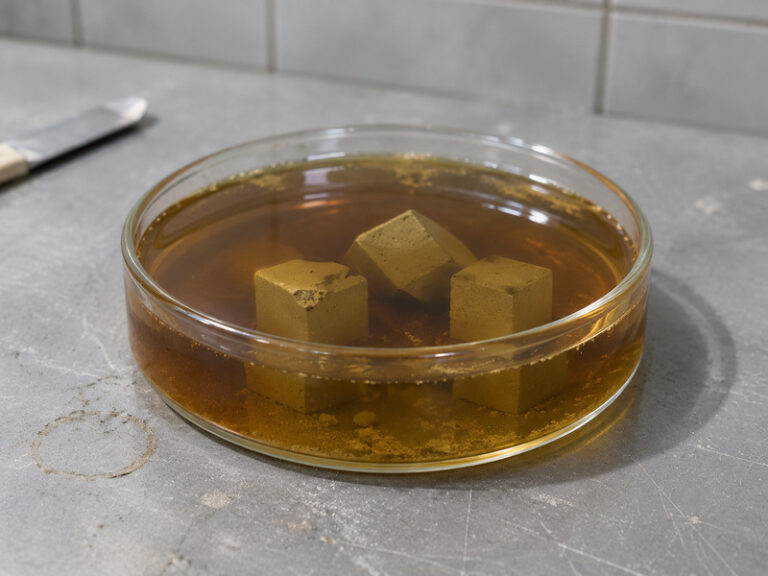
A sample testing schedule on site is the fallback. Two cured discs in the actual liquid, weighed weekly, tell you more than any chart entry for a similar chemical.
Where a supplier cannot produce a chart at temperature, the answer is that the product has not been tested at temperature.
That is a fact worth having before the order rather than after the spill.
Table 1: The three axes and how each changes the answer.
| Axis | Effet | Where to check |
|---|---|---|
| Concentration | Attack rate rises with strength | Cleaning chemical dilution |
| Température | Roughly doubles per 10 C | Washdown and process heat |
| Contact time | Splash vs immersion | Spill history and bunds |
Immersion test and sample testing
An immersion test places a cured sample in the chemical at the stated concentration and temperature for a stated period.
An immersion test on a urethane cement sample also reveals the failure mode, which matters more than the pass or fail. A sample that swells will lift in service; one that chalks will simply dull.
The sample is weighed before and after, and examined for blistering, softening, color change and loss of adhesion where a coated substrate is used.
That is also where a plant learns its own exposure time, because a test that runs for a month reveals what a spill does when nobody clears it up.
Sample testing on the actual process stream is more useful than a chart entry for a pure chemical, because a process stream is usually a mixture.
That test takes a few weeks and costs little compared with a failed floor, and it is the only way to answer a question about an unusual exposure.
Testing the process stream rather than a pure chemical has saved more floors than any product change we have recommended, because the cleaner is often stronger than the chemical it is meant to remove.
Where a plant has a proprietary cleaner, test the cleaner rather than the acid it contains. A cleaner that foams and clings stays in contact far longer than its label suggests, so compare the label contact time with the time the cleaning method actually allows.
Spill procedure beats resistance
A floor rated for a chemical at 20 C will still fail if a hot spill sits on it overnight.
Every spill procedure should name the chemical it covers, because a generic kit is a kit that is used wrongly on the one chemical that matters.
The most effective chemical protection in a plant is a spill procedure that removes the liquid within the hour, not a floor that resists it for a week.
That means a spill kit, a trained responder and a drain that can be closed.
The floor specification should assume that some spills will not be dealt with promptly, and the build should reflect that assumption.
That is the honest summary of urethane cement chemical resistance: the material buys you time, and the plant decides how much time it needs.
The same logic applies to a washdown schedule. A rinse that follows the foam within twenty minutes is a different exposure from one that follows it the next morning.
Designing for the worst hour is cheaper than designing for the worst week.
Where the material fails chemically
Urethane cement fails in strong mineral acid, where the cement phase is attacked directly.
It fails in some solvents, particularly aggressive aromatic and chlorinated products, where the resin phase swells.
It fails under direct steam, where the temperature exceeds the resin’s tolerance regardless of chemistry.
It also fails where a chemical is allowed to dry and concentrate on the surface, because the residue can be stronger than the original liquid.
A urethane cement chemical resistance failure is visible for a month before it becomes a hole, because it begins as a dull patch and progresses over weeks; a monthly walk catches it while a patch is still possible.
The exposure time that matters most is therefore the time nobody is watching, which is overnight and at weekends.
Table 2: Where the boundary sits.
| Exposure | Verdict |
|---|---|
| Lactic acid, 3-10%, 20 C | Bon |
| Acetic acid, 2-5%, 20 C | Bon |
| Caustic, 1-3%, 80 C | Bon |
| Strong mineral acid | Not suitable |
| Chlorinated solvent | Not suitable |
| Direct steam | Not suitable |
A dilute mineral acid is not covered by that row, so it needs a test at the process concentration before it is specified.
Specifying resistance for a plant
Write the exposure as a list: chemical, concentration, temperature, frequency and contact time.
Ask for the resistance chart at those conditions, and for the test report behind it.
Ask for the exposure time as well. A supplier who receives a chemical, a concentration, a temperature and a duration can answer in a day; one who receives a chemical name can only guess.
Where the exposure is a mixture, ask for a sample test on the mixture.
State the spill procedure and the response time that the specification assumes, so that the floor is not asked to compensate for a slow response.
Then specify the build by zone, with the immersion areas marked on the layout.
Table 3: What to send a supplier.
| Objet | Example |
|---|---|
| Chimique | Sodium hydroxide |
| Concentration | 2 percent |
| Température | 70 C |
| Frequency | Nightly washdown |
| Contact time | 20 minutes, then rinse |
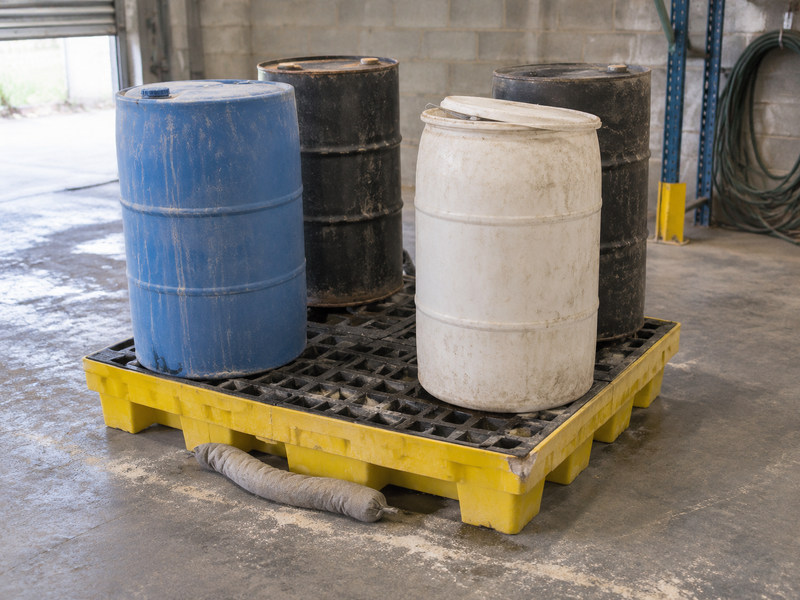
Figure 1: plastic and steel drums standing on a bunded pallet in a plant store.
Foire aux questions
Is urethane cement resistant to acid?
To organic acids such as lactic and acetic at working concentrations. Strong mineral acids attack the cement phase and are outside its range.
What concentration can it take?
It depends on the acid and the temperature. Ask for a chart with both, and treat any entry without them as unproven.
Does temperature matter that much?
Yes. Attack roughly doubles for every 10 C, so a chemical at 70 C is far more aggressive than the same chemical at 20 C.
What is the difference between a splash and an immersion?
Frequency and duration. A splash evaporates and leaves a residue; an immersion keeps the surface saturated and attacks continuously.
Can I test my own process chemical?
Yes. An immersion test on a cured sample with the actual stream is the most reliable evidence you can hold.
How long does a spill have to sit to cause damage?
Depends on the chemical, but a hot concentrated spill left overnight can damage a floor that would survive a week of splashes.
What protects a floor better than resistance?
A spill procedure with a response time of under an hour, a spill kit on site and a drain that can be closed.
Kaida Paint supplies urethane cement chemical resistance data with concentration and temperature stated, and will arrange an immersion test on a client’s process stream where the exposure is unusual. Send the chemical list with concentrations and temperatures, and we will return the boundary in writing.



 English
 Spanish
 Portuguese
 Arabic
 French
 Italian
 Russian
 Indonesian
 Swedish