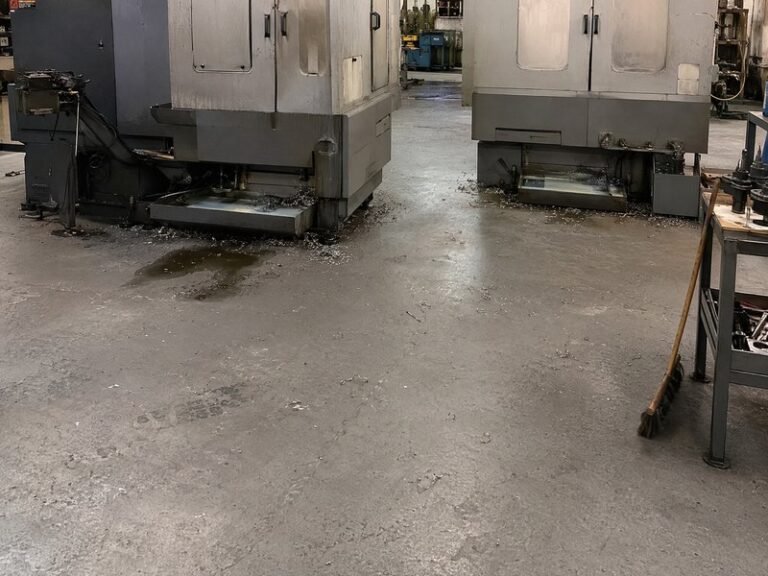
Machine shop flooring is chosen for three things: it resists oil, it takes an impact, and it can be swept.
Everything else is secondary. A workshop floor is not a showroom, and a specification written for appearance will be ruined in a month by cutting fluid and steel.
This article sets out what each attack does, which build suits which bay, and the details around machine bases that decide whether the floor survives its first year.
What a machine shop does to a floor
أن طلاء الأرضيات من البولي يوريثين الصناعي is specified for a workshop because the room combines four loads that most coatings meet one at a time, and the specification has to name all four.
A workshop floor is attacked by fluid, by heat, by weight and by edges. All four arrive in the same square metre, usually without warning.
Machine shop flooring in polyurethane handles that combination better than epoxy, mainly because it is more flexible and less brittle under impact.
It is not indestructible. A 200 kilogram casting dropped from a crane will damage any floor, and the honest answer is a landing mat rather than a thicker coating.
The impact resistance that matters in practice is the everyday kind: a workpiece knocked off a bench, a pallet corner, a hammer.
Judged on that standard, a 3 to 4 mm mortar outperforms a 0.5 mm coating by a wide margin, at a cost that is recovered the first time something heavy falls.
Cutting fluid is the persistent attack
Water-miscible coolant is the most common fluid on a machine shop floor. It is mostly water, it is mildly alkaline, and it carries biocides and tramp oil.
The water evaporates and leaves a concentrated film. That film is far more aggressive than the diluted product in the sump, and it sits on the floor overnight.
Machine shop flooring in polyurethane resists it well. An epoxy softens, and a bare concrete floor absorbs it and then dusts for years.
Machine shop flooring at 3 mm also gives the machine foot something to bear on, which matters more than most clients expect when a five tonne machine is bolted to a 0.5 mm film.
Neat cutting oil is a different problem. It penetrates porous surfaces and swells some resins, and it makes a floor slippery in a way that water does not.
Where a machine uses neat oil, the floor beneath it should be built heavier and the oil resistance should be stated for that specific oil rather than for oil in general.
Hydraulic oil, drips and the long soak
Hydraulic oil does not leak in one place. It drips from a hose, a gland, a fitting or a cylinder, and the drip moves as components are replaced.
Hydraulic oil is designed to cling, which is exactly what makes it hard on a floor. It stays where it lands and it wicks into any open joint.
Over months the pattern becomes a permanent dark patch that no cleaner removes, because the oil has reached the substrate rather than the surface.
Machine shop flooring slows that process but does not prevent it indefinitely. Joints and cracks are the routes, and sealing them is the real defence.
Put a drip tray under every machine with a known leak and empty it weekly. It costs less than a square metre of coating and it does more for floor life than any change of product.
Where a bay has a history of leaks, photograph the floor before coating and again at twelve months. The comparison shows whether the fluid is being managed or merely tolerated.
Hot work, sparks and weld spatter
Welding and grinding throw hot particles across a wide area, and a resin floor is an organic material that will burn or pit where they land.
Weld spatter leaves a crater with a hard rim, and each crater becomes a place where oil and swarf collect.
Where the machine base sits on a levelling pad, the pad should be grouted to the slab before the floor is laid. A pad packed afterwards is a stress riser sitting on a flexible film.
Where a welding bench is fixed, the area around it should be built in a darker colour and with a slightly heavier seal, because that is where the particles land and where the damage is concentrated.
The mitigation is procedural rather than chemical. Weld screens, a fire blanket under the work, and a sweep after each session remove most of the risk.
Where welding is continuous, a sacrificial steel plate or a fire-retardant mat under the bench is cheaper than replacing a floor every three years.
Machine shop flooring in a light colour shows weld spatter damage immediately, which is useful: the maintenance team can see where the work is happening.
Impact, point loads and the machine footprint
A machine tool is heavy and its feet are small. A 5 tonne machine on four 100 mm pads puts more pressure on the floor than a loaded forklift.
Impact resistance and point-load capacity are different properties, and a floor can be good at one and poor at the other.
A 3 mm mortar spreads a point load over a wider area than a 0.5 mm coating, which is why machine bays are usually built heavier than aisles. The coating thickness and DFT in a quote is a wet-film figure unless it says otherwise.
Where a machine is installed on levelling pads, the floor beneath the pad sees a stress concentration that no coating is designed for.
That is a machine base question rather than a coating question, and it should be resolved with a grout or a steel plate before the floor is laid.
Fixings, bases and the holes we drill
Most workshop floors are sealed while the machines are standing on them, which is why the first installation matters so much: a floor laid before the machine arrives can be detailed properly.
Every machine is fixed down, and every fixing is a hole through the membrane.
An anchor bolt set into a drilled hole with resin is a durable fixing and a permanent breach of the floor’s continuity.
Where a machine has to be moved later, the fixing is cut out and the floor is repaired. A patch done properly lasts the life of the floor; a patch filled with mortar becomes a soft spot within a year.
The detail matters more than the product. Drill, clean, set the bolt, and seal the annulus with a flexible resin compatible with the floor.
Where an anchor bolt is later removed, the hole must be filled and capped rather than left open. An open hole is a route for oil into the slab.
Plan the machine base layout before the floor is laid, and cast or grout the bases first. Retrofitting a base through a finished floor is always a repair.
Chips, turnings and the cleaning routine
Swarf is the main reason a workshop floor dulls in the traffic lanes within a year: metal turnings are sharp, heavy and hot, they embed in a soft surface, and they are hardest to sweep from a textured finish.
A smooth finish also makes the floor easier to survey. A defect on a flat surface is visible from a distance, while the same defect on a rough one is only found by touch.
A smooth finish with a light aggregate sweeps clean; a heavily broadcast surface traps chips and holds them against the film.
A weekly wash with a neutral detergent also removes the fine film of fluid that a broom leaves behind, and that film is what makes a workshop floor feel permanently tacky.
Magnetic sweepers are standard in machine shops for a reason. A weekly pass removes the fine steel that a broom leaves behind and that boots then grind in.
Where chips are wet with cutting fluid, it should be collected before it dries. A dried chip bonded to a floor is removed by scraping, and scraping removes floor with it.
Oils, water and the slip question
A workshop floor is usually wet with something, and the something is often a mixture of water and oil that is far more slippery than either alone.
Slip resistance on an oily floor is difficult to achieve and difficult to maintain, because the texture that provides grip also traps chips.
A workshop that is swept daily and washed weekly is a different proposition from one that is swept at Christmas, and the specification should say which it is.
The practical compromise is a medium texture in walkways and a smooth finish under machines, with the boundary at a painted line rather than at random.
Where a floor is chronically contaminated, a rougher surface is the intuitive answer and the wrong one: texture that holds chips also holds the fluid that makes them slippery.
Test the walkway wet with the fluid it will actually see. A reading taken with water on an oil-wet floor describes a condition that never occurs.
Paint a walkway line and maintain it. Line markings are the cheapest way to keep clean traffic away from the oil, and they also show where the surface is wearing.
Where a bay is chronically oily, the answer is containment and drainage rather than a rougher surface. A floor that drains and is cleaned beats a floor that grips and is not.
Build by bay, not by building
A machine shop is a set of different floors under one roof. A CNC bay, a welding bay, a paint area and an aisle have four different requirements.
Machine shop flooring at 0.5 mm suits an aisle and a light assembly area, and it is the wrong choice under a 5 tonne machine.
A 3 to 4 mm mortar suits machine bays, and a 6 mm screed suits a forge or a heavy press area where impact resistance is the governing property.
Where a hydraulic oil leak is known, put a 2 mm bund or a drip tray under the machine rather than thickening the whole bay.
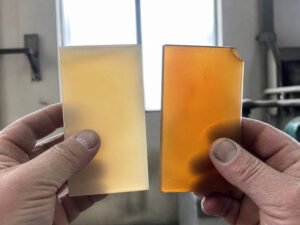
Where a machine is replaced, the floor under it is usually the only part of the bay that needs attention. A zone plan makes that a small local job rather than a hall-wide closure. A bay lit by roof lights needs a uv stable polyurethane topcoat, because an ambered floor in a machine shop reads as oil.
A zone plan also makes the tender comparable. Three contractors pricing the same four zones produce three numbers that can be read; three contractors pricing a building produce three guesses.
Draw the zones and price them separately. A single figure for the building always produces a floor that is too thin where it matters and too expensive where it does not.
Table 1: Build by bay type.
| Bay | Build | Governing property |
|---|---|---|
| Aisle and walkway | 0.5 mm | Abrasion, slip |
| CNC and lathe bay | 3 mm mortar | Coolant, point load |
| Welding bay | 3 mm, dark colour | Hot particles |
| Press and forge | 6 mm screed | Impact, heat |
| Stores | 0.5 mm | Abrasion |
Where workshop floors fail
The first failure is under the machine, where a leak has been running since installation and nobody has looked.
The second is at a fixing, where an anchor bolt was set without sealing the annulus and oil has tracked into the slab.
The third is at a joint, where a rigid fill has cracked and the crack has become a collection point for swarf and fluid.
Keep a record of every repair with its date, material and location. Over five years that log shows which bay is failing and whether the cause is fluid, impact or traffic, which is the information a maintenance budget needs.
The repairs themselves should be planned rather than improvised, so that a client holding a repair kit and the original batch number avoids a colour mismatch every time.
The fourth is thermal, in a welding bay where hot particles have pitted the film until the surface is a mosaic of small craters.
Table 2: Four failures, four causes.
| Failure | Cause | إصلاح |
|---|---|---|
| Dark patch under machine | Long-term drip | Drip tray, local repair |
| Oil at a fixing | Unsealed annulus | Ream, seal, cap |
| Cracked joint | Rigid fill | Flexible insert |
| Pitted surface | Hot particles | Screens, local recoat |
Table 3: Fluid exposure and the property it tests.
| Fluid | Exposure | الممتلكات |
|---|---|---|
| Water-miscible coolant | Daily, drying | Alkali resistance |
| Neat cutting oil | مستمر | Oil resistance |
| Hydraulic oil | Drips, pooling | Oil resistance |
| Way oil | Thin film | Surface swelling |
| Solvent degreaser | Occasional | Solvent resistance |
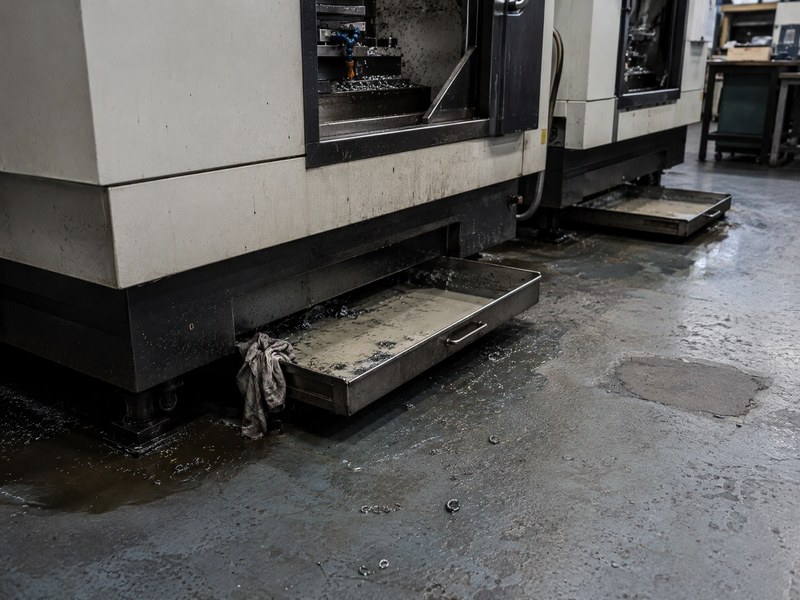
Figure 1: CNC machines on the coated bay, with drip trays under the working area.
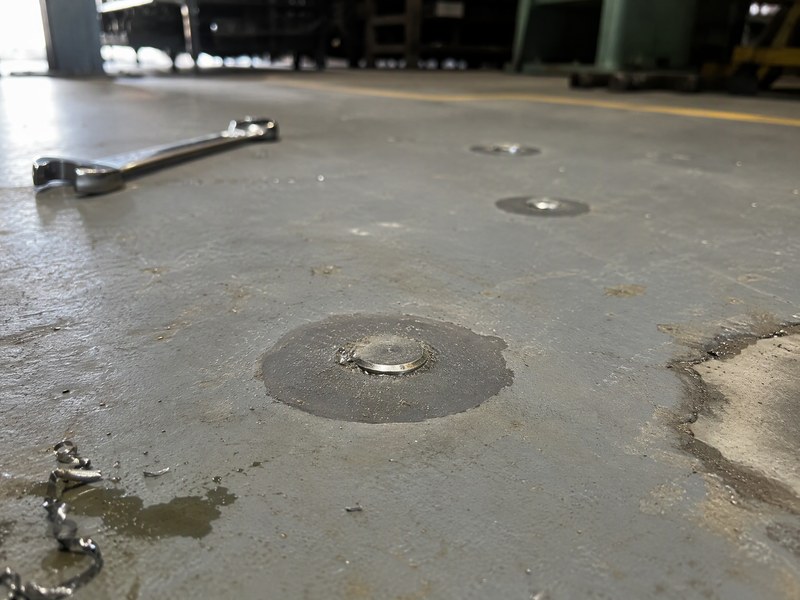
Figure 2: a bolt set in a resin collar, cut back flush with the floor.
Frequently asked questions
Is polyurethane better than epoxy for a machine shop?
Usually yes. It is more flexible, so it takes impact better, and it resists cutting fluid and oil for longer at the same thickness.
What thickness for a CNC machine bay?
A 3 mm mortar is typical, because the machine feet create point loads that a thin coating cannot spread.
Will coolant damage a resin floor?
Water-miscible coolant is tolerated well when it is cleaned. The concentrated film left by evaporation is more aggressive than the diluted product.
How do I stop oil reaching the slab at fixings?
Seal the annulus around every anchor bolt with a flexible resin after setting, and cap any fixing that is later removed.
Can a welding bay have a resin floor?
Yes, with screens and a mat under the work. Hot particles will pit any organic coating if they land on it.
How do I deal with metal chips on the floor?
Smooth finish, weekly magnetic sweep, and collect wet swarf before the fluid dries and bonds the chips to the surface.
Can a damaged workshop floor be repaired?
Generally yes, locally, if the same material is retained. Repairs in a smooth finish blend better than in a heavily textured one.
Why food plants work with Kaida Paint
Kaida Paint supplies machine shop flooring systems by bay rather than by building, with the fluid list and the machine loads stated in the quote, so two identical bays can be compared line by line. Send the machine layout, the fluids and the heaviest item that could fall, and we will return a zone-by-zone build with the fixing and joint details drawn.


 English
 Spanish
 Portuguese
 Arabic
 French
 Italian
 Russian
 Indonesian
 Swedish