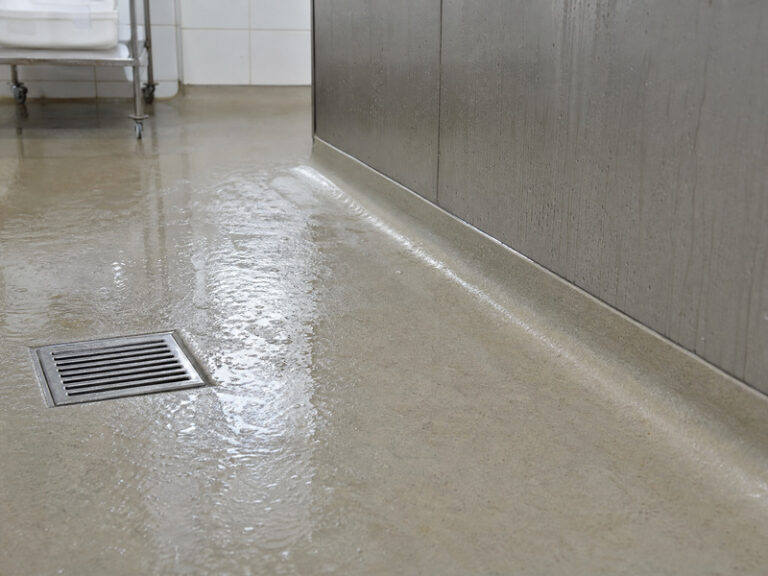
Food grade polyurethane flooring is a seamless resin floor that can be cleaned to a microbiological standard, tolerate hot washdown, and be documented well enough to survive an audit.
This article covers what an auditor actually inspects, why thermal shock floor cracks appear at joints, what cleanability means in practice, and where certification claims stop being true.
What does food grade actually mean for a floor?
No certificate declares a resin floor food grade. The term describes a set of properties: seamless, impervious, cleanable, resistant to the cleaning chemistry, and detailed so that liquid cannot collect.
A food grade PU floor earns that description through installation and detailing, not through a logo on the drum. Two plants can buy the same product and end up with one floor that passes audits and one that produces findings.
The chemistry sets the limits, and the hygienic design decisions decide whether you stay inside them. That is why the drawing matters as much as the datasheet.
A food grade polyurethane flooring also has to survive the plant, not just the standard. Where a room is cleaned with a foam agent at 70 degrees every night, the resin that passes a 24 hour spot test may still be the wrong one.
The order of the questions matters. Ask what the room is cleaned with, then what it is cleaned at, then what it stores. A specification written in that order usually gets the binder right on the first attempt.
HACCP and the floor: what gets inspected
HACCP is a management system for identifying hazards. It does not approve materials or certify floors. What it does is force an auditor to ask how the floor contributes to contamination risk.
A HACCP flooring review looks at four things: whether the surface is intact, whether joints and coves are sealed, whether drainage works, and whether the cleaning method matches the material.
Findings are usually recorded against the condition of the floor rather than its specification. A well-specified floor patched badly fails the same clause as a cheap one.
We ask for the last audit report before quoting. The findings describe the failure the floor is actually producing, which is more useful than any product comparison.
Audit findings are usually written against a clause, and the clause is rarely about the resin. A finding at a doorway is a threshold detail; a finding under a rack is a cleaning access problem; a finding at a drain is a fall or a flange. Reading the last three audits by location rather than by date turns a floor replacement into three small repairs, and it is the cheapest survey a food grade polyurethane flooring project can run.
It is worth saying plainly what a HACCP flooring document is not: it is not a product approval. The same clause can be satisfied by several systems, and the auditor is looking at the floor in front of them.
A useful preparation step is to walk the room with the maintenance log. The areas that appear most often are the ones where a food grade polyurethane flooring is being asked to do something it was not designed for.
Why do food floors crack at the joints?
A thermal shock floor failure is mechanical. Hot water on a cold slab expands the surface faster than the body can follow, and the strain concentrates at the nearest restraint, usually a joint or a fixed plinth.
Below about 60 degrees the effect is small for most resins. Between 80 and 95 degrees, which is normal for a food plant wash, a rigid film accumulates damage with every cycle.
Table 1: Strain per washdown cycle by binder, 6 mm build on a 10 degree slab, at 90 C with one wash cycle per shift.
| الموثق | Elongation | Typical life at 90 C | Failure sign |
|---|---|---|---|
| إيبوكسي قياسي | 2 to 6 per cent | 1 to 2 years | Crescent cracks at joints |
| Aromatic PU | 20 to 60 per cent | 5 to 8 years | Ambering, then wear |
| اليوريثان الأسمنتي | 10 to 20 per cent | 8 to 12 years | Surface erosion |
| Aliphatic PU | 30 to 80 per cent | 6 to 10 years | Colour change, then wear |
The practical conclusion is that a food grade PU floor belongs in the rooms where the wash is hot, and that the joints still need detailing for movement even when the resin can flex.
Where a thermal shock floor failure has already happened, the repair is rarely a patch. Cracks that radiate from a joint usually mean the whole bay has lost bond, and a patch placed over them will lift within a season.

Figure 1: the crack pattern points at thermal movement, not at the resin.
The remedy is usually a movement joint filled with a flexible material, cut at the restraint and carried through the finish. That is a detail to design at specification stage rather than discover later.
Cleanability is a geometry problem
Cleanability is not a surface property alone. A surface is cleanable when a cleaning solution can reach every part of it at the right concentration and temperature, and then drain away.
That definition rules out several floors that look acceptable. A 3 mm texture that traps flour, a cove with a square internal corner, or a drain set below the surrounding fall will all fail a swab test.
Our rule of thumb is that if a squeegee cannot pass over a detail in one movement, cleaning will be done twice as often and still be less reliable.
The same logic explains why cleanability is better on a lightly textured finish than on a deep broadcast. Grip matters, but it should come from the aggregate size rather than from a coarse surface that holds residue.
Testing is the only way to settle it. A protein swab on a dry surface tells you more about the food grade polyurethane flooring than any brochure, and most plants already run those swabs for other reasons. The grip class that matches the cleaning regime is measured on the same finished surface.
Where a plant has no swab programme, the practical alternative is a visual and fingertip inspection after cleaning. If a white cloth dragged across the surface picks up residue, the surface is not cleanable at the current regime. That test takes 2 minutes and settles arguments that a datasheet cannot. Repeat it in the same three places each week and the trend is visible before a finding appears. Most of the floor problems we are called to were visible as a dull patch, a lifted edge or a soft joint for months before anybody wrote them down in a maintenance log or an audit file.
Cove detail: where most hygiene findings begin
A cove detail is the junction between floor and wall, formed as a radius rather than a right angle. It exists because a square corner cannot be cleaned and will hold water against the wall. Where the audit finding is at a drain, the repair is usually a flange or a fall rather than a resin. A drain that sits proud of the floor leaves a lip the squeegee cannot cross, and product collects under it.
The radius matters less than the continuity. A cove applied as a separate skirting bead shrinks away from the wall within a year, and the gap that opens is invisible until an auditor runs a finger along it.
Where the wall is clad in panels, the hygienic design answer is to carry the cove up behind the cladding rather than terminate it at the panel edge. That single detail removes the most common finding we see.

Figure 2: continuity, not radius, is what survives an audit.
The cove detail also has to survive cleaning. A cove formed from a flexible sealant will move with the wall and stay watertight, while one formed from a rigid resin will crack at the thinnest point where it meets the panel.
Drain connections belong in the same conversation. A gully set into a resin floor needs a flange, a sealant compatible with the resin, and a fall that reaches it without a flat spot.
What does each washdown regime demand?
The cleaning method decides more about the floor than the industry does. A dry bakery and a wet dairy can sit in the same building code and need completely different systems.
Changeover cleaning is the regime nobody writes into a food grade polyurethane flooring specification. An allergen changeover uses a harder chemistry than the daily wash, and it happens on the same surface. Write that step into the cleaning table and test the floor against it, not against the average of the week.
A washdown regime with hot caustic at 80 degrees demands a flexible binder, a fully sealed detail set, and a fall that clears the water inside a shift.
Table 2: Four cleaning regimes and the floor each one requires.
| Regime | درجة الحرارة | Floor requirement | Risk if ignored |
|---|---|---|---|
| Dry brush and vacuum | Ambient | Sealed, joint-free, dust free | Dust as a foreign body |
| Low-pressure hose | 30 to 45 C | Sealed surface, coved edges | Water under the cove |
| High-pressure, hot | 60 to 80 C | PU or cementitious urethane, 6 mm | Thermal cracking at joints |
| Steam or chemical foam | Above 90 C | Cementitious urethane, sealed details | Blistering and delamination |
Where the plant uses two regimes in one room, the floor has to satisfy the harsher one across the whole area. Partial specification is how a floor fails in one corner and looks fine everywhere else.
Where the plant runs a dry regime in one room and a wet one next door, the wall base is the weak point rather than the floor. A cove carried at 100 mm on the wet side and terminated at the dry side leaves a horizontal ledge at the door, and that ledge collects what the wet room washes towards it. Carrying the cove through the doorway, at the same radius, removes the ledge and one recurring finding with it.
Temperature is not the only variable. Pressure, detergent type and contact time all change the demand, and a food grade polyurethane flooring that is right for a low-pressure rinse may be wrong for a foam applied with a lance.
Food contact rules: what EU 10/2011 does and does not cover
EU 10/2011 regulates plastic materials intended to contact food. A floor is not normally a food contact material, so the regulation is usually cited for the wrong purpose.
Where EU 10/2011 is relevant is at the interface: a cutting surface, a conveyor belt or a tray. The floor’s job is to be cleanable, not to be compliant with a food contact standard.
That distinction matters commercially. Suppliers who imply an EU 10/2011 approval for a floor are either misunderstanding the scope or overstating it, and an auditor who knows the difference will notice.
There is a legitimate use for the standard in a plant: it tells you what documentation a supplier of a conveyor belt should hold. Applying the same test to a food grade polyurethane flooring is a category error, and an expensive one if it drives the specification.
The honest claim is narrower and more useful: the floor is seamless, resistant to the declared cleaning agents, and detailed so that it can be cleaned. That is what a HACCP flooring review is actually testing.
How do hygienic design principles apply to a floor?
Hygienic design is a discipline with published principles: avoid crevices, avoid horizontal surfaces, make cleaning accessible, and separate wet from dry. Floors break all four when they are treated as a finish.
The practical translation is a set of details rather than a product. Coving, plinth collars, drain flanges, sealed joints and a fall that reaches the outlet are the five that matter most.
A food grade PU floor that gets all five right will outperform a better resin that gets three. That is not a sales position; it is what the audit findings in our own project files show.
The same five details appear in every cove detail drawing we issue, because they are the ones that generate findings when they are missed. None of them is expensive; all of them are easy to leave out of a price.
Bacterial harbourage is a geometry question before it is a chemistry question. A crack narrower than a cleaning brush cannot be cleaned, whatever the resin; a joint filled flush and finished smooth can be. That is why the joint schedule belongs in the specification beside the binder, and why a floor replaced without changing the joint detail produces the same findings 2 years later.
The specification checklist we use
Every food plant floor we quote goes through the same seven lines. When a client has them, the tender becomes comparable and the arguments move to price rather than to scope.
Table 3: Seven lines that make a food floor specification auditable.
| Line | What to state | Why it matters |
|---|---|---|
| Binder and build | Chemistry, thickness per layer | Thermal and load performance |
| Cleaning agents | Actual chemicals, concentration, temperature | Resistance cannot be judged without them |
| Cove | Radius, height, continuity | Most audit findings start here |
| Drains | Type, flange detail, fall | Standing water and biofilm |
| Joints | Location, filler, movement capacity | Crack initiation points |
| Slip | Class, method, test condition | Safety versus grip |
| Acceptance | Tests, sampling, remedy | Converts a description into a contract |
The cleaning agents line is the one most often left vague, and it is the one that decides whether a hot cleaning regime will destroy the floor in 3 years or ten. The cleaning chemistry itself is worth testing on a coupon before the binder is fixed.
What we will not claim
We will not tell you a food grade polyurethane flooring is approved by a food safety body, because no such approval exists for a floor. We will tell you what it is tested against and what it is not.
We will not claim antimicrobial performance from an additive. Silver ion products exist, and their effect on a floor that is cleaned twice a day is small compared with the effect of removing a crevice.
What we can do is document the build, the detailing and the test values, and put a named engineer behind them. That is the part an audit can actually use.
Where a floor is being replaced rather than repaired, the specification should carry the audit history forward as a requirement. Naming the three findings that triggered the replacement turns the next tender into a test of whether those three details changed. That is more useful to a plant working to HACCP flooring requirements than a general statement that the floor must be hygienic.
Where a plant cannot name its cleaning chemistry, the floor specification is being written blind.
That matters most when a thermal shock floor question comes up after handover. A supplier who documented the wash temperature at specification stage can say whether the plant changed its cleaning regime, and the conversation stays technical. Why a floor lifts at the cove is usually the same conversation a year later.
Frequently asked questions
Is there such a thing as food grade polyurethane flooring?
As a description, yes: seamless, impervious, cleanable and resistant to the plant chemistry. As a certificate, no. No body approves resin floors for food contact.
Does HACCP certify a floor, or does it only require you to prove the detail?
No. HACCP is a management system. It requires the floor to be maintained and cleanable, and an auditor records findings against its condition rather than its specification.
Why do food plant floors crack around drains and joints?
Because that is where movement is restrained. Hot wash expands the surface, the strain concentrates at the nearest fixed point, and a rigid binder cracks there first.
What washdown temperature can polyurethane take?
Standard grades handle 60 to 70 degrees routinely. Above 80, a flexible grade or a cementitious urethane is the safer choice, particularly where the cycle repeats every shift.
What radius should a cove be built to where the wall base meets a stainless panel?
Typically 50 to 75 mm, formed in the same material as the floor and carried continuously behind wall cladding.
Is EU 10/2011 relevant to a floor?
Rarely. It covers plastic food contact materials. A floor is not one, so the standard applies to work surfaces and conveyors rather than to the resin underfoot.
How often should a food plant floor be replaced?
8 to 12 years for a well-detailed polyurethane in wet service, provided the cleaning chemistry was declared at specification stage.
Why food plants work with Kaida Paint
Kaida Paint supplies food grade PU floor systems with the detailing drawn as part of the quotation: cove height, drain flange and joint layout on one sheet. We ask for the cleaning chemistry and the audit history before recommending a build, because a HACCP flooring question is answered by the plant, not by the catalogue. Where the audit history shows repeated findings at coves, the answer is usually a detail change rather than a different resin.



 English
 Spanish
 Portuguese
 Arabic
 French
 Italian
 Russian
 Indonesian
 Swedish