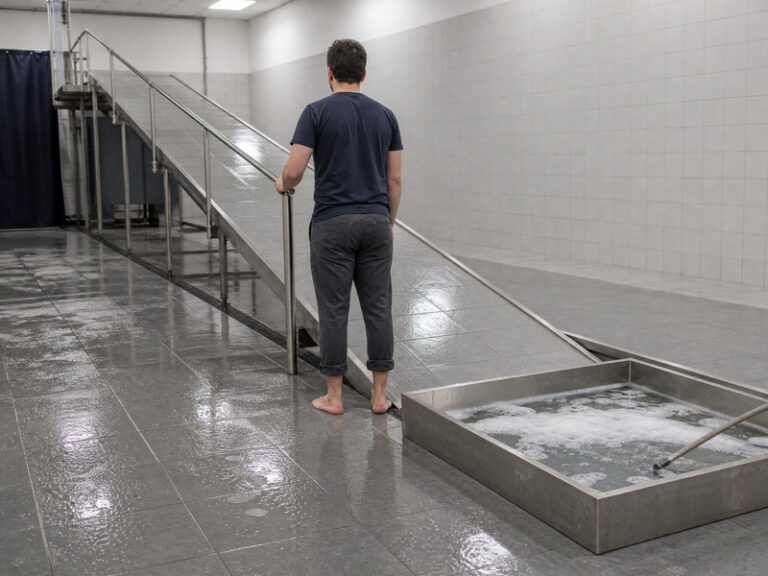
DIN 51097 is the barefoot counterpart to the shoe-tested ramp standard: a person walks a soap-wet ramp barefoot, and the angle at which they slip places the surface in class A, B or C.
It exists because a shoe test cannot describe a changing room, a shower or a footbath. The barefoot slip resistance of a surface is a different property from its grip under work boots, and a specification that uses one number for both will be wrong in one of the rooms.
This article sets this standard against ANSI A326.3 and the shoe standard, shows where each class belongs in a food plant, and explains why the DCOF 0.42 threshold is not a class at all.
Why DIN 51130 is not enough
DIN 51130 is tested with shoes and motor oil on a ramp. It answers a question about work boots in a contaminated production area, and it answers it well: R9 to R13 is a usable classification for a process floor.
It says nothing about a surface walked on with bare feet and covered in soap. A floor rated R12 under boots can be uncomfortably slippery to a bare foot, because the contact area, the pressure and the contaminant are all different.
That is why this standard exists separately rather than a clause in the first one. The test changes: barefoot slip resistance is measured barefoot with a soap solution, and the ramp is walked rather than stepped.
A changing room, a footbath and a pool surround are walked barefoot, so a shoe-tested class says nothing useful about them. Within fifty metres of a production hall, both standards can apply: the hall needs the shoe classification, the room that opens off it needs the barefoot one.
Table 1: Three slip standards, three different questions.
| قياسي | Footwear | Contaminant | النتيجة |
|---|---|---|---|
| DIN 51130 | Standard test shoes | Motor oil | R9 to R13 |
| DIN 51097 | Bare feet | Soap solution | A, B or C |
| ANSI A326.3 | Standard sole | المياه | DCOF value |
DIN 51097: barefoot, soap solution, classes A, B and C
The test is a ramp, a soap solution and a barefoot operator, and it is the only route to a three slip classes. The angle at which the operator slips is recorded, and the result is placed into one of three bands.
Class A covers 12 to 18 degrees, class B covers more than 18 up to 24, and class C covers more than 24. Below 12 degrees the surface is not classified, which is why an untreated tile floor cannot claim a class at all.
The bands are narrow in practice. A floor at 19 degrees is class B and a floor at 17 is class A, and the two look identical in a photograph. That is the reason a barefoot slip resistance claim must come with a test angle, not only a letter.
The soap solution matters. It is a surfactant, not water, and it reduces friction more than clean water does. A surface that passes with water may fail with soap, which is exactly the condition in a washroom or a changing area.
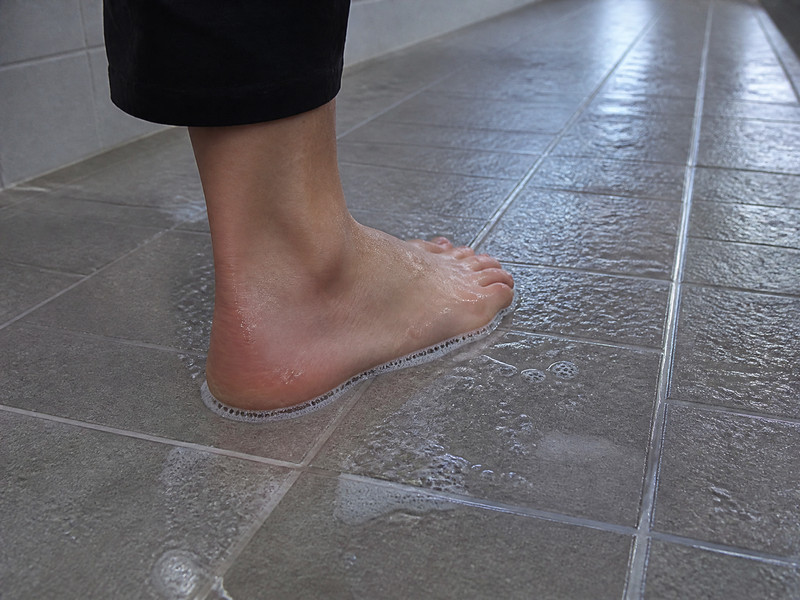
Figure 1: The barefoot ramp test. The angle is recorded, and the class follows from the angle band.
One practical consequence: the class is a property of the finished surface, not of the tile or the resin in the bag. Two floors from the same product can land in different classes if the aggregate rate or the seal coat differs, which is why the specimen has to match the installation.
Where a plant has a wet boot-wash station or a footbath at a barrier, the floor there is a wet barefoot area in practice. It needs food-grade flooring for wet rooms rather than a production standard, even if it sits inside a production building. Classify it with the barefoot standard rather than borrowing the production R number.
Where A, B and C apply in a food plant
Class A suits the edges: a corridor to the showers, a dry side of a barrier, and the first three slip classes most visitors see. The surface is wet some of the time and the traffic is slow and shod in socks or bare feet.
Class B suits a shower area, a boot-wash tray or a footbath, where the second three slip classes applies and where soap and water are present continuously and people move with less care than on a dry floor. A pool surround deck at a staff facility is the same case, even with no food nearby.
Class C is for the most demanding barefoot locations: pool surrounds, plunge baths, and any area where soap stays on the surface. In food plants it is relatively rare, but it appears in staff facilities and in some hygiene barriers.
The classification should be written per room, with the class and the test angle. A changing room floor specified only as “non-slip” invites whatever product is on the van, and the difference between class A and no class is invisible until someone falls.
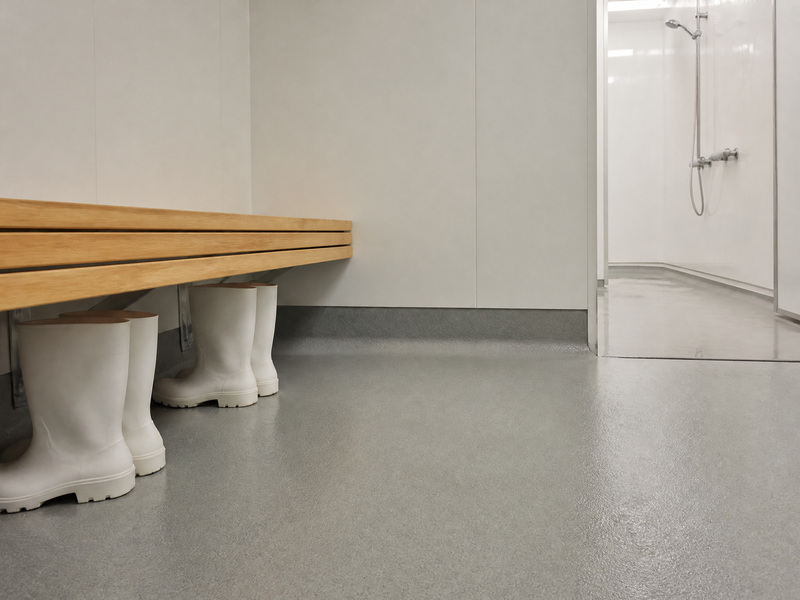
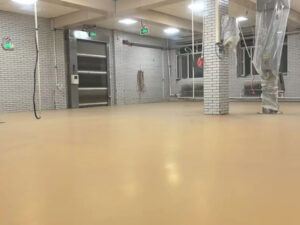
Figure 2: A changing area needs the barefoot class, a cove and a fall. It is judged as a wet room, not as a corridor.
Table 2: Applying the classes room by room.
| Room | Class | Angle band | Detail |
|---|---|---|---|
| Changing room, dry side | A | 12-18 degrees | Cove 50 mm, fall to gully |
| Shower and boot wash | B | over 18-24 degrees | Cove 75 mm, linear drain |
| Footbath and barrier | B or C | over 18 degrees | Ramp edges, sealed joints |
| Pool and plunge area | C | over 24 degrees | Cove, deck drain, grip finish |
ANSI A326.3: DCOF 0.42 and what it measures
The AcuTest method measures a coefficient of friction with a standard sole and water, and reports a number rather than a class. That makes DIN 51097 and the American method cousins rather than equivalents. The familiar threshold is a DCOF 0.42 for level interior floors that may be walked wet.
The number is a measurement, not a grade. A surface at 0.45 passes, one at 0.40 does not, and both may perform identically under a different contaminant or a different sole. That is the weakness of a single threshold.
The standard replaced the older DCOF appendix in the tile standard, and it applies to level surfaces rather than ramps. Using a DCOF 0.42 value to sign off a ramp is a category error, and it is common in specifications copied between projects.
For a European or Middle East project, the R and A/B/C system is normally what the tender asks for. For a US project, an AcuTest reading is the reference, and the two are not convertible: there is no accepted formula that turns an R12 into a DCOF.
Where a project spans both, specify each surface against the standard of its location and accept that the two tests measure different things. A single number carried across a mixed specification is where disputes start.
The three standards side by side
All three use a ramp or a sled, a contaminant and a person or a machine. What changes is the footwear, the fluid and the output, and those three changes explain why the results cannot be exchanged.
DIN 51130 gives a class for shod traffic in oil. DIN 51097 gives a class for barefoot traffic in soap, and barefoot slip resistance is the only one of the three that assumes bare feet. The AcuTest method gives a number for shod traffic in water. A specification needs the one that matches the room, not the one that is easiest to quote.
There is also a practical difference in repeatability. The two ramp standards rely on a human operator and are usually repeated to confirm the angle; the DCOF test uses an instrument and reports a value with less operator judgement.
None of the three is a site test in the sense a plant manager expects. Each is a laboratory classification, tied to a specimen and a date. The installed floor can differ in profile, thickness and cleanliness from the specimen that was tested.
Table 3: What each standard can and cannot tell you about an installed floor.
| قياسي | Tells you | Cannot tell you |
|---|---|---|
| DIN 51130 | Class for oil-wet shod traffic | Barefoot or greasy-fat behaviour |
| DIN 51097 | Class for soap-wet barefoot traffic | Boot grip on a process floor |
| ANSI A326.3 | DCOF value on a level wet surface | Ramp performance or class equivalence |
Testing on site: what is possible
Neither ramp standard used for DIN 51097 is a reliable site test. Both need a controlled specimen, a trained operator and a repeatable contaminant, and none of those exist in a working plant during a shift.
The practical site tool is a pendulum test, which gives a British Pendulum Number on a small area. It is useful for comparing two locations on the same floor, and it is a substitute for neither a class nor an AcuTest value.
Use the pendulum to answer questions like “has the changing room floor become more slippery than it was”, not “what class is this floor”. The second question needs a laboratory and a specimen cut from the floor.
A wet barefoot area that fails an inspection is usually identified by observation, not by instrument: ponding, soap residue, worn profile. Fix the drainage and the cleaning before commissioning a test that cannot change the design.
Where a dispute is heading to a claim, cut a sample and send it for the ramp test. A laboratory result on a specimen is defensible; a pendulum test reading taken by an interested party is not.
Writing the right standard into the right room
The rule is one line: match the standard to the footwear and the contaminant. Shod production areas take the R class and barefoot areas take the A/B/C class. A changing room floor takes the barefoot class even inside a production building, and a US project takes the DCOF value on level floors.
Then write the number, not the adjective. “Class B, tested at not less than 19 degrees” is checkable; “non-slip” is not, and it will be answered with whichever product is nearest the contractor’s van.
Add the detail that supports the class: coved skirting at a wet wall base, a fall, a drain type, a cleaning method. A changing room floor at class B with a flat floor and a single gully will pond, and ponding undoes the class within a year.
Where a pool surround or a shower is in scope, check whether the tender also requires a pool standard. A pool surround deck is a different specification from a class B shower, and the two are often confused in staff facilities.
Finally, record the test angle and the test date in the handover file. A slip certificate without an angle tells an auditor that a test happened, not what the floor is.
Common mistakes in mixed specifications
- Converting between systems. There is no accepted conversion from an R class to a DCOF value, and any table that offers one should be treated as marketing.
- Applying a shoe class to a barefoot area. An R11 tile in a shower can be class A or unclassified, so the specification has not controlled the risk.
- Specifying a class without the surface that delivers it. A DIN 51097 requirement on a smooth sealed floor is unachievable, and a contractor who accepts it will deliver a floor that fails on first contact with soap.
- Testing after handover rather than at the mock-up. A specimen tested before the pour can still change the specification; a floor tested after handover can only generate a claim.
- Forgetting the cleaning regime. A class B floor cleaned with a film-forming detergent becomes a class A floor in a month, and no certificate reflects that change.
- Recording the class without the angle, the test date and the laboratory. A certificate that cannot be traced is treated as no evidence at the next audit.
Keep a copy of the test report with the specification rather than in a project folder. The next refurbishment then starts from a known class instead of a guess about what was installed.
Each of these is cheap to avoid at specification stage and expensive to resolve afterwards. The standard is not the difficult part; matching it to the room, the footwear and the cleaning method is.
Frequently asked questions
What does DIN 51097 measure?
It measures barefoot grip on a soap-wet ramp, and the angle at which the operator slips places the surface in class A (12-18 degrees), B (over 18-24) or C (over 24).
Is DIN 51097 the same as DIN 51130?
No. DIN 51130 tests shod traffic in oil and returns an R class; DIN 51097 tests barefoot traffic in soap and returns A, B or C. Neither substitutes for the other.
What is DCOF 0.42?
A threshold used in ANSI A326.3 for level interior floors, measured wet. It is a measured value, not a class, and it does not apply to ramps.
Can I convert an R rating to a DCOF value?
No. The tests use different footwear, contaminants and outputs, and there is no accepted conversion. Specify each surface against the standard used in its market.
Which class does a staff changing room need?
Usually class A, rising to class B where showers or boot-wash trays are in the same room. Specify the class and the test angle, not the word non-slip.
Can slip resistance be tested on site?
Only as a screening comparison. A pendulum test gives a number for a location but not a class. Classification needs a specimen and a laboratory ramp.
Why does a floor lose its slip class over time?
Because the profile fills or polishes, or because cleaning leaves a film. In a wet barefoot area, a film-forming detergent can drop the effective class within weeks.
Why food plants work with Kaida Paint
Kaida Paint manufactures epoxy, polyurethane, cementitious urethane and MMA systems for food and beverage plants, and supplies them as finished systems or as OEM and private-label production for distributors. Each batch ships with a certificate of analysis and a batch record, and TDS and SDS documents are issued in the buyer’s language. For staff facilities and hygiene barriers we will state the barefoot class and the test angle for the system proposed, rather than a generic non-slip claim, and we will show which surface finish delivers it.
Send the room list with the footwear and the cleaning method, and the reply gives a class per room with the finish that achieves it.


 English
 Spanish
 Portuguese
 Arabic
 French
 Italian
 Russian
 Indonesian
 Swedish