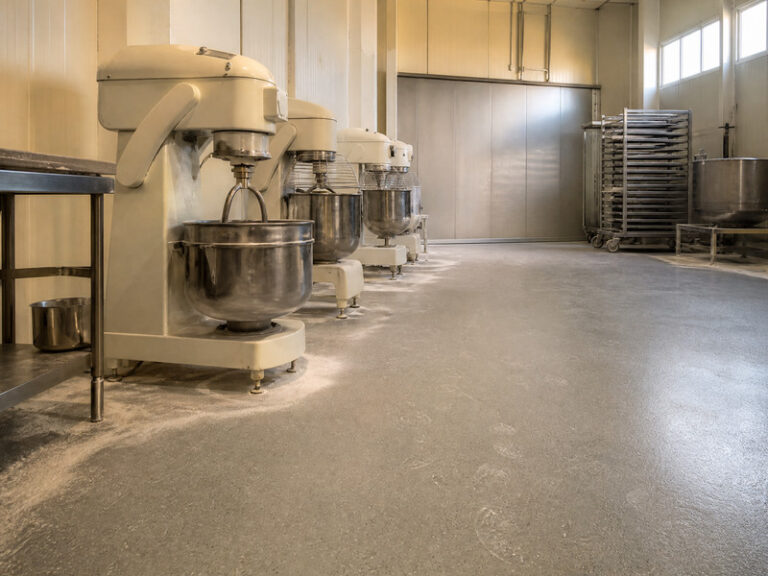
Bakery flooring is usually specified as if the plant were wet, and then fails for reasons that have nothing to do with water. A bakery is a dry process with dust, heat and crumbs, and each of those sets a different requirement.
Three things decide the system: how much flour and sugar dust settles on the floor, how much radiant heat reaches it near the ovens, and how the area is cleaned. Washdown resistance, the usual metric, matters least. For bakery flooring the usual answer is a 0.5 to 1.0 mm epoxy in the hall and a 2 to 3 mm polyurethane at the oven line.
This article sets out the dust and heat loads zone by zone, the ignition question that anti-static floors are bought for, and where a wet-area system is simply the wrong purchase.
Why a bakery floor is a dry area problem
In a wet process plant the floor is judged by what the chemicals do to it. In a bakery the floor is judged by what settles on it, how it is removed, and whether the surface survives the cleaning method.
A flour dust floor carries fine flour that behaves like a lubricant when it is wet and like a slip hazard when it is dry and polished. A floor that resists caustic but holds a flour film is the wrong floor for the room.
That is why bakery production flooring is often specified at 0.5 to 1.0 mm rather than 6 mm. The load is abrasion and dust, not chemistry and thermal shock, and a thick system adds cost without adding life.
In bakery flooring, the cleaning method reads the floor more harshly than the product does. A brush, a scraper and a vacuum are abrasive tools, and a surface that was specified for chemical resistance may have no answer to them.
The exception is the area around the ovens and provers, where radiant heat and spillage change the picture. A bakery is usually two specifications, not one, and the boundary is the oven line.
Table 1: What a bakery floor is asked to do, compared with a wet process floor.
| Load | Bakery | Wet process |
|---|---|---|
| المواد الكيميائية | Low, mostly detergent | High, caustic and acid |
| Thermal | Radiant heat near ovens | Hot water washdown |
| Abrasion | Moderate, sugar crystals | Moderate to high |
| Cleanability | Dry removal of dust and crumbs | Wet removal of films |
Flour and sugar dust: slip, explosion risk and cleaning
On a smooth floor, flour dust is a slip hazard that gets worse as it is walked in, which is the first thing bakery flooring has to answer. On a textured floor it fills the profile, which removes the grip the texture was meant to provide and makes the surface harder to clean.
Sugar dust adds a second problem. Both are combustible dusts, and the standards that govern them sit with fire and explosion prevention rather than with food hygiene; NFPA 61 is the usual reference in North America, and DSEAR in the UK. Below a certain dust layer thickness the risk is housekeeping rather than conductivity, which is why most bakeries need cleanability before they need a resistance specification.
For the floor itself, that means avoiding ledges, avoiding open joints, and specifying a surface that can be cleaned by vacuum rather than by washing dust into a drain. A flour dust floor that traps material is a dust reservoir.
The dust also tells you where a flour dust floor is failing. Material that collects in a line along a joint shows a depression or a lifted edge, and the pattern repeats in the same place every week.
The practical detail is the perimeter. Dust accumulates at the wall junction and under equipment, so a cove is as useful in a bakery as in a wet room, even though the room is dry.
Table 2: Cleaning method against the surface it needs.
| Method | Surface requirement | Detail |
|---|---|---|
| Brush and vacuum | Tight, sealed, fine profile | Cove 50 mm, formed plinths |
| Scraper | Abrasion resistant, hard binder | Cove 75 mm, no open joints |
| Machine scrubber | Radius the machine can follow | Cove 75-100 mm, sealed edges |
| Local washdown | Fall and drain at that point | Collar formed, kerb at wall |
Oven and proofer heat loads
Radiant heat from an oven deck reaches the floor in front of it, and the surface temperature there can be far above the ambient reading in the room. A thin epoxy in that position will discolour and eventually crack.
Oven radiant heat is therefore a local specification. The floor does not need to be heat resistant everywhere; it needs a system in the two metres in front of each oven that can take the radiant load and the occasional spill.
Oven radiant heat also explains why a bakery specification should not be written as one rate for the hall. The heat load is local, the failure is local, and the repair is local; a single rate spreads the cost of the ovens across every square metre.
Proofers add moisture rather than heat. The floor at a proofer door sees condensation, sugar and flour together, which is the one place in a bakery where a slightly thicker system earns its cost.
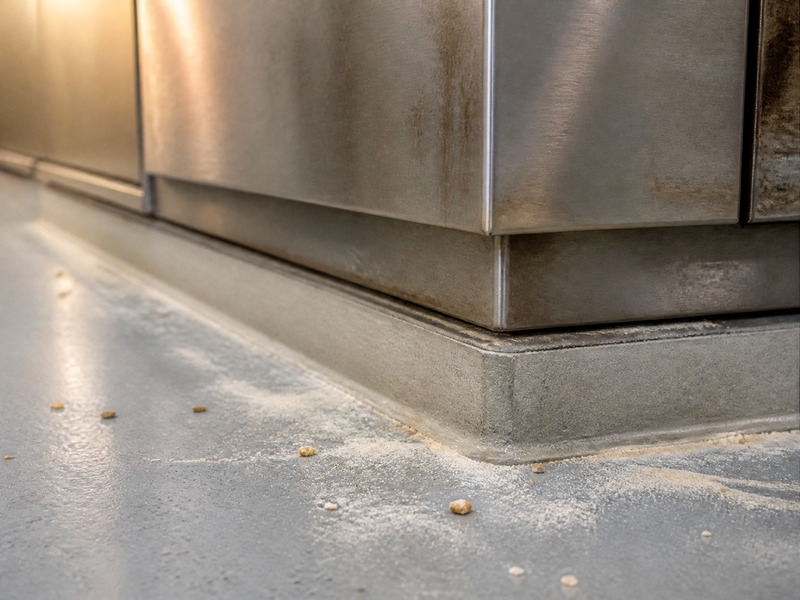
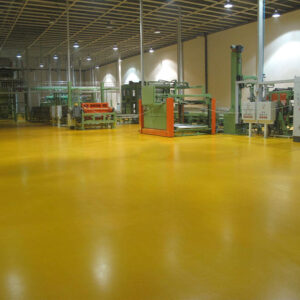
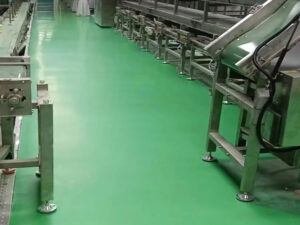
Figure 1: The two metres in front of an oven are a different specification from the rest of the hall.
Crumb ingress at mixers and dividers
Mixers, dividers and moulders drop material continuously. The floor under them collects crumbs, and any joint or crack in that area fills within a shift.
Crumb ingress is the reason equipment bases should be formed rather than bolted onto a finished floor. A plinth cast before the resin lets the floor run up to it and seal; a base fixed afterwards leaves a gap that no brush reaches.
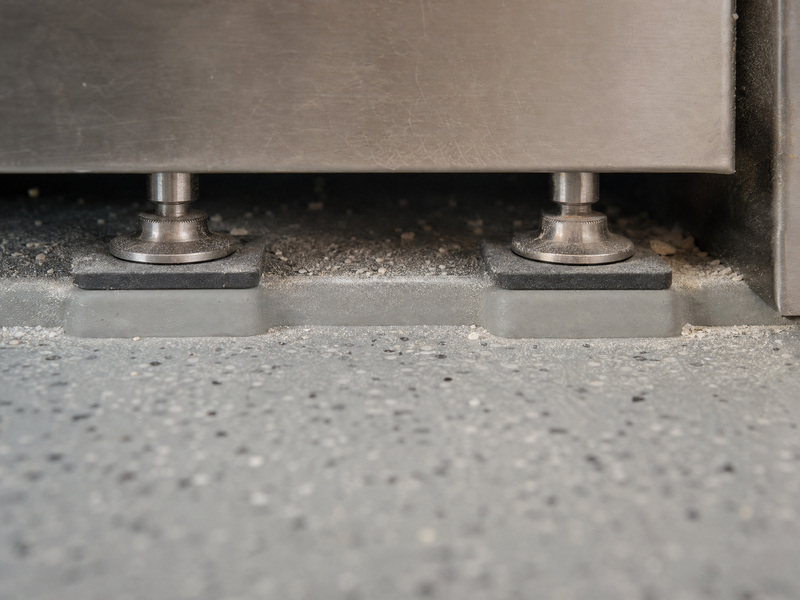
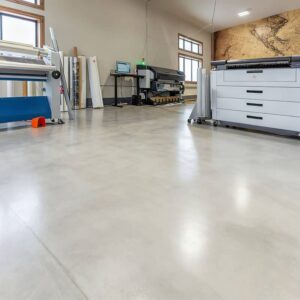
Figure 2: A formed plinth and a sealed cove. The gap under a bolted base is where crumb ingress starts.
The same logic applies to cable ducts and floor boxes. Every penetration in a bakery is a crumb trap, and the count of penetrations is a better predictor of cleaning difficulty than the floor finish is.
A bakery production flooring that specifies a sealed surface and ignores the penetrations has solved the easy half of the problem.
Dry cleaning versus washdown
Most bakery areas are cleaned dry: brushes, vacuums and scrapers, with a damp mop at most. That changes the requirement from chemical resistance to abrasion resistance and edge detail.
Dry cleaning is harder on edges than washing is. A brush works at the cove and the plinth, and a poorly bonded edge lifts within a year in a way that a wet process room would never reveal.
The cleaning method also sets the cove height. A dry brush reaches a 50 mm radius easily; a scraper works better against a 75 mm cove, and a dry cleaning routine that uses a machine needs a radius the machine can follow.
Where a washdown does happen, it is usually local: a mixer area, a proofer floor or a spill. The specification should name those locations rather than assume the whole hall is washed.
This is also why a dry area resin floor can be thin and still last: the wear is mechanical and the surface is not being cycled thermally. What it cannot tolerate is a soft binder that marks under a scraper.
Anti-static and dust ignition considerations
An anti static floor is bought for one of two reasons: to protect sensitive equipment, or to reduce static discharge in an area with combustible dust. In a bakery the second reason dominates, and it is a system decision rather than a coating additive.
An anti static floor is also sensitive to wear. As the surface polishes, the conductive network can be exposed unevenly, and the resistance reading drifts; the test should be repeated annually, not only at handover.
A genuine anti-static floor needs a conductive path to earth, tested and recorded. A floor described as anti-static without a resistance reading and an earthing plan is a marketing term.
Where the risk assessment calls for it, the specification should state the resistance range and the test method, and the installation should include the earthing connections at fixed intervals.
The question usually arrives after a dust incident rather than before one, and for bakery flooring the answer is a risk assessment rather than a floor. An anti static floor reduces one ignition route; it does not remove the dust.
For most bakeries the practical answer is housekeeping and ventilation, with an anti-static system only where a dust cloud can form in an enclosed space. A sugar dust hazard assessment decides that, not the flooring supplier.
System choice for dry production
For bakery flooring, the default in a dry production hall is a 0.5 to 1.0 mm epoxy with a fine aggregate, sealed and smooth. It resists abrasion, cleans with a brush and vacuum, and costs less than a wet-area system.
A bakery production flooring schedule should show the change at the oven line rather than describe it in a note, because the boundary is where the quantity surveyor prices the job. Two rates on one drawing are clearer than one rate and a caveat.
Near ovens and at proofer doors, a 2 to 3 mm polyurethane or a thin cementitious system handles the local heat and moisture better. That is where oven radiant heat and condensation meet, and where a thin epoxy discolours first.
A dry area resin floor in a dry hall is also easier to repair than a thick system. A patch is mixed, applied and back in service within a shift, which matters in a bakery running three shifts with no shutdown window.
The split in a bakery production flooring project usually falls at the oven line and at the proofer door, and it is worth drawing on the plan rather than describing in a note. Contractors price what they can see.
Table 3: Bakery flooring by zone, with the build-up that suits each one.
| Zone | النظام | السُمك | ملاحظة |
|---|---|---|---|
| Dry production hall | Epoxy, fine aggregate | 0.5-1.0 مم | Brush and vacuum cleaning |
| Oven line | البولي يوريثين | 2-3 mm | Radiant heat and spillage |
| Proofer door | البولي يوريثين | 2-3 mm | Condensation and sugar |
| Mixer and divider bases | Epoxy, sealed | 1.0 mm | Formed plinths, no gaps |
| Dispatch and dry store | إيبوكسي | 0.3-0.5 mm | Traffic only |
Whatever the system, specify the cove and the plinth detail with it. A dry area resin floor that stops at the wall base and leaves the equipment sitting on an unsealed edge has left the crumb traps in place.
Where a wet-area system is the wrong buy
A 6 to 9 mm cementitious urethane in a dry packing hall is money spent on chemical resistance a dry area does not need, and it raises the floor at every door and drain in the process. It also cures more slowly than the thin system the area actually needs.
A dry area resin floor chosen for a wet room will also hold flour in its profile, and a floor that holds flour is harder to clean than the thin system it replaced. The specification has to match the cleaning method, not the group standard.
The mistake usually comes from a corporate standard written for the wettest room in the group and applied to every site. A flour dust floor in a dry bakery does not need the same system as a dairy.
Where a dry area resin floor has already been installed across a dry hall, the usual complaint is cleaning time rather than wear. The surface holds flour in its profile, the brush cannot lift it, and the answer is a thin recoat rather than a new floor.
The same applies to slip class. A dry hall with polished flour needs a textured surface and disciplined cleaning, not an R12 wet-area specification that will fill with dust and become harder to clean.
Where a bakery has one wet room, usually a tray wash or a staff facility, specify that room properly and keep it out of the flooring specification for a bakery. One wet room is not a reason to over-specify the hall.
The useful test is the cleaning method. If the area is brushed and vacuumed, the floor needs abrasion resistance and tight edges; if it is hosed, it needs a fall, a drain and a wet-area system.
Frequently asked questions
What flooring is best for a bakery?
A thin epoxy with a fine aggregate for dry production halls, and a 2 to 3 mm polyurethane near ovens and proofer doors. A thick wet-area system is usually unnecessary in a dry bakery.
Is flour dust a slip hazard on a resin floor?
Yes. Dry flour polishes under foot traffic and wet flour behaves like a lubricant. Cleaning frequency matters more than the slip class in a dry hall.
Do bakeries need anti-static floors?
Only where a dust cloud can form in an enclosed space and the risk assessment calls for it. A genuine anti-static system needs a resistance reading and an earthing plan, not just a label.
How hot does the floor get in front of an oven?
Far above room temperature from radiant heat, which is enough to discolour and eventually crack a thin epoxy. A polyurethane in that local zone is the usual answer.
Can I wash down a bakery floor?
Locally, yes: mixer areas, proofer floors and spills. A whole-hall washdown is unusual and changes the specification to a wet-area system with falls and drains.
Why does the floor fail at equipment bases?
Because crumbs collect in the gap between a base and an unsealed floor. Forming plinths before the resin, and running the floor up to them, removes the trap.
How thick should a bakery floor be?
0.5 to 1.0 mm in dry production, 2 to 3 mm near heat and moisture. Thickness follows the local load, not the size of the building or the group standard. Splitting the schedule by zone is the cheapest decision in the project.
Why food plants work with Kaida Paint
Kaida Paint manufactures epoxy, polyurethane, cementitious urethane and MMA systems for food and beverage plants, and supplies them as finished systems or as OEM and private-label production for distributors. Each batch ships with a certificate of analysis and a batch record, and TDS and SDS documents are issued in the buyer’s language. For bakery flooring we will separate the dry hall from the oven line on the drawing, and state the local system at each oven and proofer rather than one rate for the building.
Send the layout with oven and proofer positions, and the reply is a zone table with thicknesses and the detail at each equipment base.


 English
 Spanish
 Portuguese
 Arabic
 French
 Italian
 Russian
 Indonesian
 Swedish