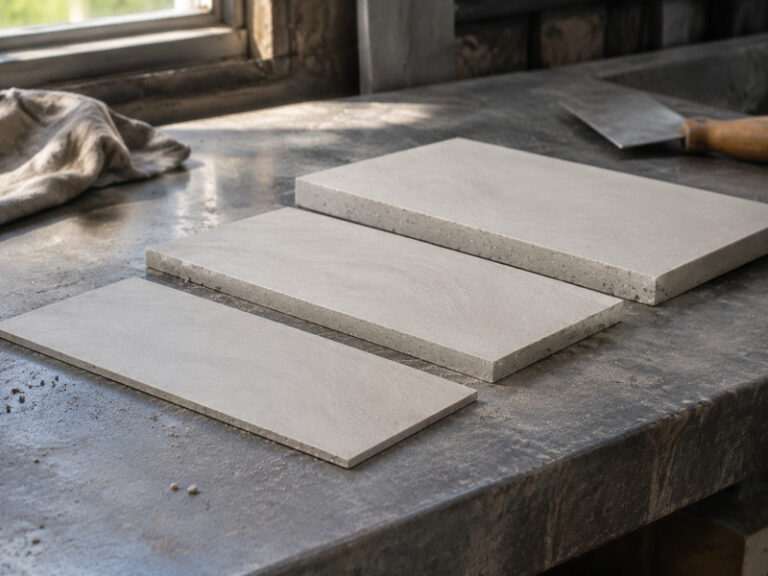
The urethane cement vs polyurethane question is not a chemistry question. It is a naming problem, and it costs buyers money every week.
The same material is sold as cementitious urethane, PU concrete and polyurethane mortar, depending on which side of the market the supplier comes from. A buyer comparing three quotes often compares three different builds with three different words for the same binder.
The three names usually describe one cement-and-polyurethane binder. What separates the products is thickness, aggregate and placement, not vocabulary.
This article sets out what each name actually describes, where the terms genuinely differ, how the naming confusion shows up in a tender, and how to write a specification that cannot be gamed.
What the three quotes actually say
The trap runs in two directions. On the buyer side, three quotes for one room arrive under three names. On the supplier side, a distributor lists a resin screed and a cement-based product in one catalogue as if one could replace the other.
A buyer asks three contractors to price a floor for a washdown room. One quotes a cementitious urethane, one a PU concrete, one a polyurethane mortar. The three documents use different words, different thicknesses and different units.
In most cases all three are pricing a cement-and-polyurethane hybrid applied at 4 to 9 mm. The words differ because the supply chain differs, not because the floors do.
The naming confusion becomes expensive in two ways. The buyer may accept a quote that is 30 per cent cheaper because it is 30 per cent thinner, and never notice the difference in the documents.
Or the buyer may reject the correct quote because it uses an unfamiliar word, and end up with a product that does not suit the service.
Neither outcome is the fault of the material. Both are the fault of a market that never agreed what to call it.
What each name actually describes
A cementitious urethane names the chemistry: a cementitious binder modified with polyurethane resin. It is the most accurate of the three names and the least used commercially. The definition of urethane cement covers the binder itself and the point where it stops working.
PU concrete names the placement. Concrete contractors use the term for material placed at a stated thickness and finished by trowel or screed, not for a coating applied in coats.
Polyurethane mortar names the finish. Resin contractors use it for a thinner placed build, typically 3 to 6 mm with a fine aggregate, troweled and often self-smoothing.
All three can be the same drum. None of them states the thickness, the aggregate or the grade, and those three numbers decide how the floor performs. The table below is the only reference chart this article needs.
Table 1: The three names, what they imply, and what to ask.
| Name used | Usually implies | Ask |
|---|---|---|
| Цементно-уретановый | Chemistry, umbrella term | Which build, in mm? |
| PU concrete | Heavy build, placed | Aggregate grade? |
| Polyurethane mortar | 3-6 mm, troweled | Is it self-smoothing? |
| Resin screed | Trade term, any build | Resin only, or hybrid? |
| Brand name | A specific system | What is the generic equivalent? |
Where the answer is washdown, the urethane cement vs polyurethane question is settled by thickness and chemistry, not by vocabulary.
Two checks settle which family a quote belongs to. The first is whether the document gives a placed thickness in millimeters rather than a number of coats.
The second check is the safety data sheet. A hybrid carries cement in the formulation and declares an alkaline component, while a resin system does not, and that single line settles which family you are buying.
That is the first rule of reading a quote: the name tells you almost nothing, and the build tells you almost everything.
Why the market ended up with three names
The material was commercialised through concrete repair and heavy industrial flooring, where contractors think in placed thickness and aggregate blends.
It was later adopted by resin flooring contractors, who think in coats and millimeters, and who already sold epoxy and polyurethane systems under their own vocabulary.
A resin screed and a heavy aggregate build are therefore the same family of product described by two trades with different habits, and neither trade has an incentive to adopt the other’s word.
The result is that a search for one name returns the other, and a buyer who reads three pages comes away with three definitions and no way to choose between them.
Add the branded systems, which are sold under trade names rather than generic descriptions, and you have four vocabularies for one material.
The naming confusion is structural rather than accidental, and it will not be resolved by a glossary. It has to be resolved in the specification.
The chemistry all three names share
Every product in this family combines a cementitious binder with a polyurethane resin. The resin is what gives the material its trowel grade behavior and its chemical resistance.
The cement phase gives it moisture tolerance that a pure resin cannot match. The material can be applied to a green or damp slab without a moisture barrier in many cases.
The resin phase gives it flexibility and resistance to thermal shock, which is why the family dominates washdown rooms and freezer areas.
Order the three families on moisture tolerance and the cementitious binder sits highest, the hybrid in the middle and the pure resin lowest. Order them on chemical resistance and the sequence reverses.
That compromise is worth stating plainly in a quote, because a buyer who expects resin behavior from a hybrid will be disappointed on the first hot washdown.
Chemical resistance, moisture tolerance and flexibility are the reason the material exists. If a quote does not deliver all three, it is not the same product whatever it is called.
The urethane cement vs polyurethane comparison only makes sense once you see that this is not a polyurethane with filler. It is a different binder system that happens to contain polyurethane.
Where the names genuinely differ
The real differences inside the family sit on two axes that buyers routinely merge into one.
The first axis is the build: what the material is and how it is placed. The second axis is the duty: what the room does to the floor every day.
Table 2: The build axis, three builds rather than three products.
| Build | Typical thickness | Aggregate | Placement and finish |
|---|---|---|---|
| Self-smoothing | 3 to 6 mm | Fine | Poured and flowed, light trowel to close |
| Steel trowel, trowel grade | 4 to 9 mm | Средний | Screed rail, steel trowel, holds on a fall |
| Heavy aggregate | 6 to 12 mm | Coarse | Straight edge, power float |
A self-smoothing build at 3 to 6 mm suits a light production room or a kitchen with a shallow threshold. A steel trowel build at 4 to 9 mm is the version most washdown rooms are priced on. A heavy aggregate build at 6 to 12 mm is what pallet traffic or a hot caustic spill pushes a buyer toward.
Cementitious urethane is the umbrella term, and a supplier who uses it should be able to state which build the quote covers before the room conditions are known.
The duty axis is a separate decision, and thickness selection is decided room by room rather than product by product.
Table 3: The duty axis, read separately from the build axis.
| Room | Build | Life |
|---|---|---|
| Dry, light | 3–4 мм | 3-5 лет |
| Wet process | 4-6 mm | 7-12 years |
| Hot wash, caustic | 6-9 мм | 10-15 лет |
| Freezer, heavy | 9-12 mm | 10-15 лет |
The build axis and the duty axis answer two different questions: the build says what the material is, and the duty says how long it is expected to serve.
That gap is where most of the money in a urethane cement vs polyurethane comparison sits, and it is invisible in three quotes that each state only the product name.
How the confusion costs money
All five losses happen on the quotation rather than on site, and none of them is a product failure. Two are pricing errors, two are scope errors, and one arrives after handover, which is why the table below is the one page worth attaching to a tender.
A trowel grade product specified by name and priced as a thin coating is the substitution we are asked to arbitrate most often, and the documents rarely show it. The wrong system delivered is the same error one step further on, where a contractor who won on a resin screed price delivers a coating instead of a placed build.
Table 5: The five losses caused by naming confusion.
| Loss | Mechanism |
|---|---|
| Thin floor accepted | Price compared across thicknesses |
| Wrong system delivered | Trade term taken as specification |
| Barrier paid twice | Hybrid mistaken for resin |
| Preparation skipped | Hybrid mistaken for concrete |
| Wrong cleaning chemistry | Hybrid floor cleaned as a resin floor |
The urethane cement vs polyurethane vocabulary gap also reaches maintenance, where a plant that thinks it has a resin floor cleans it like one and the surface dulls within a season. That is the fifth loss, and it is the only one that arrives after the invoice is paid.
Reading three quotes side by side
Read the three quotes against one list rather than against each other, and the list is the one in the next section: binder and thickness, aggregate and finish, chemicals and primer, washdown condition, and the acceptance tests.
Consumption belongs under the first item, because it is how thickness is verified rather than a sixth number to collect. Three figures that must agree are far harder to fake than one product name.
Ask each bidder to state the wet consumption per square meter. Two quotes for the same thickness should show similar consumption, and a quote that shows less is a quote for a thinner floor.
Take a 6 mm build cut to 4 mm. That is a third less thickness, so roughly a third less material. A price that looks 30 per cent cheaper per square meter is buying two thirds of a floor.
Wet consumption per square meter also exposes a substitution after the event. A floor that used two thirds of the material specified is a third thinner, and a core sample will show it within a fortnight of handover.
Where a bidder cannot state the consumption, the price cannot be compared, and a thermal shock claim in the same document should be treated with the same caution.
Ask for the thickness in two clauses rather than one. The tender states the nominal thickness with a tolerance, for example 6 mm with minus 10 per cent. The acceptance test states a core sample frequency and a floor on every reading.
A nominal 6 mm with a 10 per cent tolerance is a workable tender clause only when the acceptance test sits beside it. On its own, the same clause accepts a 5.4 mm floor and the saving stays with the contractor.
Ask which aggregate is used and at what grading. A placed mix with a 0.5 mm top size and one with a 3 mm top size behave differently under load.
Ask whether the moisture tolerance of the slab was tested and what the primer is. That single question separates a considered quote from a template. If the bidder cannot answer it, check the data sheet fields before the price is discussed.
Put three real quotes side by side and the arithmetic takes a minute. Quote A prices 6 mm at a rate of 100. Quote B prices 4 mm at 85. Quote C gives a trade name and no thickness at all. Normalized per millimeter of build, A is 16.7 and B is 21.3, so B is the more expensive floor per unit of material even though its headline rate is lower. C cannot be ranked until the thickness is stated, and saying so is the answer to the buyer who asks which quote in a urethane cement vs polyurethane tender is cheapest.
Writing a specification that cannot be gamed
A specification should name the binder, the build, the aggregate, the primer and the test. It should not stop at a trade name or a brand.
A binder clause in a tender also protects the client against a substitution at delivery, because the chemistry is named independently of the trade vocabulary.
Write the binder as a cementitious polyurethane hybrid, then state the thickness range and the tolerance. That wording is neutral between the three vocabularies.
State the chemical exposure by chemical, concentration and temperature. A hybrid that resists 5 per cent lactic acid at 20 °C may not resist 2 per cent at 60.
State the thermal shock condition, such as washdown at 80 °C, because that is the requirement that separates one build from another in a food plant.
Then set the remedy as well as the test. A core that reads below the floor needs a stated consequence, or the clause is only a preference.
Those five lines are the whole specification, and they are short enough to send as a list. One: a cementitious polyurethane hybrid, placed at a stated thickness in millimeters with a stated tolerance. Two: the aggregate grading, and whether the finish is troweled, seeded or broadcast. Three: the chemical list with concentration and temperature, and the moisture tolerance of the slab with the primer proposed for it. Four: the thermal shock condition, including washdown temperature and frequency. Five: the acceptance tests, being thickness by core, adhesion by pull-off and slip by pendulum in wet conditions.
Table 3: Five lines that make three quotes comparable.
| Line | Settles |
|---|---|
| Binder and thickness | The 4 mm versus 9 mm gap |
| Aggregate and finish | Slip and durability |
| Chemicals and primer | Barrier or no barrier |
| Washdown condition | Build selection |
| Acceptance tests | Proof at handover |
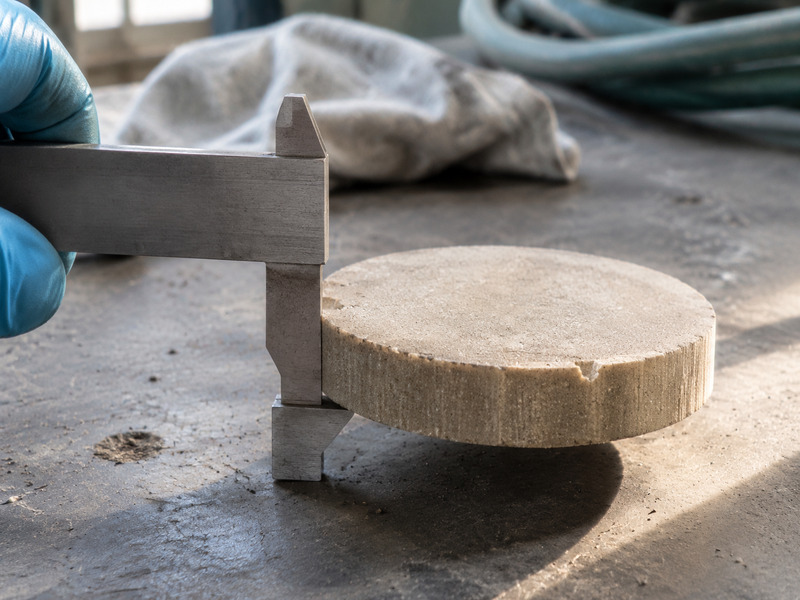
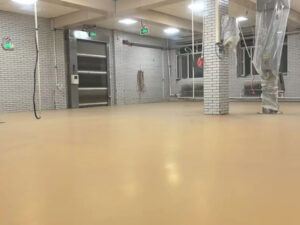
Figure 1: the thickness is measured on a core, not argued from a document.
Часто задаваемые вопросы
Is urethane cement the same as polyurethane?
No. It is a hybrid in which a cementitious binder is modified with polyurethane resin. The resin content gives it chemical resistance, but the binder behavior is closer to concrete.
Why is the same material called PU concrete and polyurethane mortar?
Two trades named it. Concrete contractors describe the placed build, resin contractors describe the surface. Both names can refer to the same drum.
Which name should I put in a specification?
Cementitious polyurethane hybrid, followed by the thickness in millimeters, the aggregate grading and the acceptance tests. That wording is neutral between the trades.
Is urethane cement more expensive than polyurethane?
Per kilogram, usually yes. Per square meter the comparison depends entirely on thickness, which is why quotes must be normalized before they are compared.
Does urethane cement need a moisture barrier?
Usually not, because it tolerates a damp substrate. Some primers and some very wet slabs still need one, so the slab should be tested.
Can a resin contractor install urethane cement?
Yes, if they are set up for placed material rather than coatings. The mixing, the pot life and the finishing are different skills.
What thickness should a washdown room have?
Six to nine millimeters for regular hot washdown. Three to four millimeters suits dry or light-wet duty, and the difference is where most budget is won or lost.
Working with Kaida Paint
Kaida Paint supplies cementitious polyurethane systems and states the build in millimeters on every quote, so a urethane cement vs polyurethane comparison can be made on the same basis. Send your three quotes and the room conditions, and we will translate each one into a binder, a build and a test, then tell you whether they are pricing the same floor.


 English
 Spanish
 Portuguese
 Arabic
 French
 Italian
 Russian
 Indonesian
 Swedish