Fast cure flooring is a resin system specified against three fixed milestones, so a line can be back in production in 24, 48 or 72 hours rather than in days.
The choice usually sits between MMA (methyl methacrylate), polyaspartic, polyurethane and cementitious urethane, and each of them reaches walkable, loadable and washable at a different hour. A credible return to service date is built backward from those hours, with the slowest milestone as the anchor.
This page is written for plant engineers, maintenance managers and the consultants who write their floor specifications. After reading it you can compare five systems on one clock, cost a shutdown in margin rather than in square meters, and defend the schedule you hand to production.
1. What does a stopped line really cost?
The first number to establish is the value of an hour of production, not the price of the floor, because that number decides which system is affordable.
Downtime cost is the lost contribution per hour multiplied by the hours stopped, plus restart losses and waste. Contribution is revenue minus variable cost, so it sits below sales and above profit. A line that loses an hour loses the margin on every unit it did not make.
Take a line making 8,000 units an hour at a 12% contribution margin. Each hour down costs 960 units of margin. Sixty hours down costs 57,600 units of margin, which is the figure that makes a 30% material premium irrelevant, whatever the product.
Table 1. Downtime cost worked example for a line making 8,000 units an hour at a 12% contribution margin
| Line | Значение | Примечание |
|---|---|---|
| Units per hour | 8,000 | Rated output of the line |
| Contribution margin | 12% | Revenue minus variable cost, not profit |
| Margin lost per hour stopped | 960 units | 8,000 x 12% |
| 24 hours stopped | 23,040 units | One compressed weekend |
| 48 hours stopped | 46,080 units | Two-day changeover |
| 60 hours stopped | 57,600 units | Worked example above |
| 72 hours stopped | 69,120 units | Standard three-day changeover |
| Restart losses | Not in the hourly figure | Ramp-up waste, inter-floor cleaning, catch-up overtime |
Table 1 also runs as a downtime loss calculator in Excel: line rate, margin and hours stopped in, each shutdown length out. Keep a separate sheet per line, because a plant-wide margin figure hides which line is losing the hours. We send it on request.
Hourly margin is only part of the loss. Restart adds its own bill: product scrapped during ramp-up, cleaning between the old floor and the new one, and the overtime that pulls the schedule back. Those items are why a plant remembers a floor project as a bad month rather than a bad week.
2. Walkable, loadable and washable are three different dates
A supplier who quotes one hardening window is quoting one milestone and leaving the other two to be discovered on site. Walkable, loadable and washable are different states of the same floor. On fast cure flooring the gap between them is measured in days, not in hours.
- Walkable. Foot traffic and inspection. The surface takes a boot, a ladder foot and a knee without marking.
- Loadable. Pallet trucks, racks and equipment move back in. Point loads and turning wheels are the test, not a boot.
- Washable. Water, detergent and cleaning chemicals at temperature; data sheets also call it in service.
Only the washable state matters to a hygiene schedule. A floor walkable at eight hours can still be marked by caustic at 1-3% NaOH and 70-80 °C. A mark left by a washdown is a nonconformance waiting for an auditor. Washdown water reaches the floor at 50-60 °C at the nozzle, and steam cleaning puts 100-120 °C at the surface.
The middle state is the one that damages floors rather than schedules. A rack leg set down on a topcoat that is still soft leaves a mark that no cleaning removes, and the acceptance walk records it as a defect. Repair cuts back to sound material.
Quotes should state all three times in hours from the end of the topcoat, and they should name the milestone that handover depends on. A return to service schedule built on the walkable figure alone will be wrong by days, and it will be wrong in the direction that loses production.
3. Which system wins on cure time?
The five systems sort by washable hour rather than by strength. MMA and polyaspartic are cleanable within a day, polyurethane within two, cementitious urethane three to seven, and epoxy five to seven. Read Table 2 by cure time and by column. One cure time tells you nothing about the changeover: two of these systems share a walkable window of 8-12 hours and land days apart on the washable column.
Table 2. Five systems by cure time: walkable, loadable, washable, odor and low-temperature cure
| Система | Walkable | Loadable | Washable / in service | Odor | Низкотемпературное отверждение |
|---|---|---|---|---|---|
| Epoxy, self-leveling 2-4 mm | 12-24 часа | No separate figure, confirm on the data sheet | 5-7 days to chemical resistance | Moderate amine | Not rated |
| Polyurethane screed 4-6 mm | 8-12 hours | 24-48 hours to service | 24-48 hours to service | Умеренный | Not rated |
| Cementitious urethane 6-9 mm | 8-12 hours | 24 hours light duty | 3-7 days to chemical resistance | Низкий | Stated substrate and air temperature on the data sheet |
| MMA 2-4 mm | 1-2 hours | 4-6 hours to service | 24 hours to full chemical resistance | Strong, travels through the plant | Some systems cure at -20 °C |
| Polyaspartic | 4-6 часов | 24 hours to service | 24 hours to service | Низкий | Not rated |
Epoxy is the slowest on this clock and the cheapest to buy in material terms. Walkable at 12-24 hours but not chemically resistant until 5-7 days, it suits a planned shutdown with a known window rather than a weekend that has to end on Sunday night.
Polyurethane screed at 4-6 mm is walkable at 8-12 hours and reaches service at 24-48 hours. Cementitious urethane matches it for walkability and reaches light duty at 24 hours. It takes 3-7 days to reach full chemical resistance, which matters in a room washed with caustic the day after handover.
MMA flooring is the fastest option here. Walkable in 1-2 hours, in service in 4-6 hours and at full chemical resistance within 24 hours, with some systems curing at -20 °C. That rating is what makes MMA flooring usable in a cold store or an unheated dock in winter.
A polyaspartic coating sits between MMA and polyurethane: walkable at 4-6 hours, in service at 24 hours, and with low odor. Any rapid cure resin in this group buys speed with working time, and MMA is the extreme case at 10-15 minutes of working life.
Working life is the second clock, and it decides batch size as much as cure speed does. MMA flooring has 10-15 minutes of pot life, so a crew mixes only what one trowel pass will consume. A polyaspartic coating allows a slower rhythm: the same rapid cure resin chemistry, run at a pace that suits a whole room.
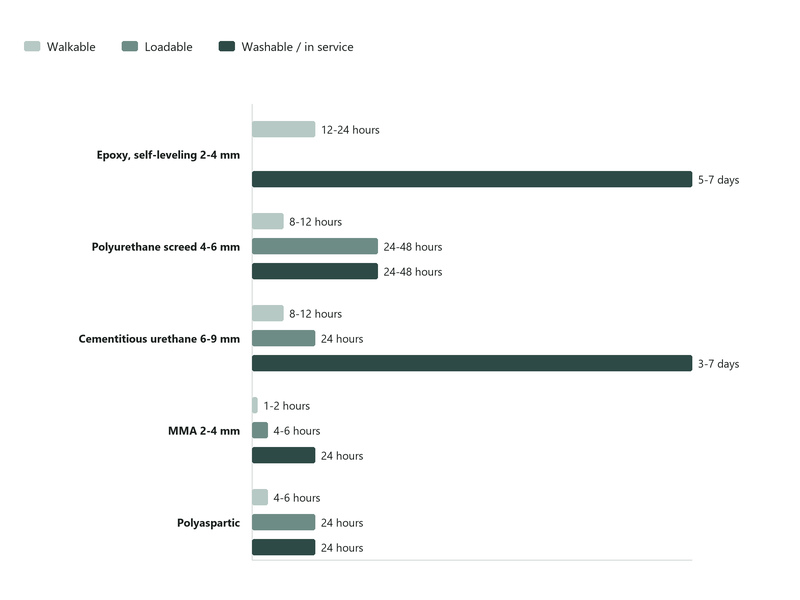
Figure 1. The five systems on one timeline. Bars start where the topcoat ends, so the chart reads against a shutdown plan rather than against a data sheet.
4. Should you run nights or a weekend?
Night shift installation buys hours without stopping the plant, and it turns a flooring job into a logistics job. The material is the same; the constraint is access, containment and the state of the crew at hour fourteen. Night work also needs a supervisor at 3 a.m.
Work is normally split into two patterns. A full weekend shutdown gives one continuous window and one cure curve. Night shift installation gives five or six shorter windows, each ending with a surface that must be safe to leave and safe to walk on by the day shift.
A 24 hour flooring program is the case that makes night work unavoidable, because the topcoat cannot go down while the room is in production. It also fixes the return to service date, since a line restarts when the floor is washable rather than walkable. On a fast cure flooring project, that gap between the two states is where the schedule usually breaks.
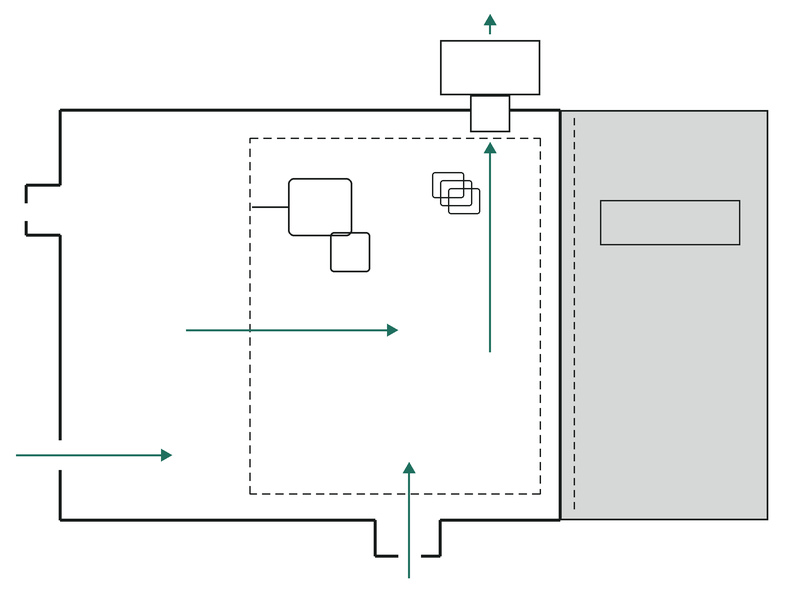
Figure 2. Air is drawn from the clean side across the work face and out, which keeps grinding dust and MMA odor out of the packing line next door.
- Containment is built once for the duration, not at the start of every shift. Grinding dust travels further than most crews expect, and odor travels further than dust.
- Ventilation is ducted to the outside, with the extract on the work face and the make-up air on the clean side, so the pressure difference pushes air out of the building.
- Material staging sits outside the containment, because a drum opened inside it becomes a trip hazard and a contamination source in the same shift.
- Adjacent lines are isolated at the wall line, and the isolation is checked by smell at the start of each shift, not assumed from the drawing.
MMA is the system that forces this discipline. Its odor travels through the plant, and a complaint from a packing line two rooms away is a production problem rather than a flooring problem. Ventilation and isolation belong in the program from the first night onward.
The crew is the constraint that is easiest to overlook. Grinding, priming, broadcasting and topcoating are physical work, and the defects that appear late in a shift are usually a tired trowel rather than a bad batch. On projects we have supplied, the pattern repeats: the second half of a double shift produces the lap marks.
5. Fast cure is not fast compliance: what to test, and when
Speed compresses the cure time, not the acceptance criteria. Three checks decide whether a fast cure flooring system can be handed over, and each one has a correct date set by the chemistry rather than by the contract. Early tests measure reaction, not the floor.
- Hardness. Shore D hardness (ASTM D2240) at 24 hours shows cure progress against a reference reading. Take it again at 7 days, because a floor that reads hard at the surface can still be soft at the bond line.
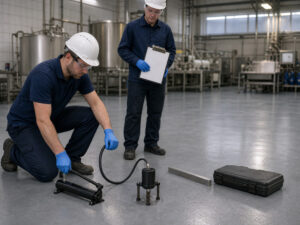
- Adhesion. A pull-off adhesion test (ASTM D4541) before seven days reads low on a floor that will pass later. Take it after full cure, or label it a progress reading.
- Chemical and abrasion resistance. Both belong after full cure. A chemical spot test on a floor at day two tests the cure state, not the system.
The most common documentation error is a handover dated from the application. State the acceptance date, not the application date, and tie each test to the milestone it proves. A fast system handed over at 72 hours should carry a record from hour 72, not from hour 12 when the crew was still on site.
Hygiene records are separate and belong to the plant, not the installer. A cured resin floor is not sterile; hygiene comes from cleanability plus cleaning validation. A swab or rinse result after the first production washdown is the plant’s evidence; take it before the first audit cycle.
6. Where fast cure flooring systems fail: four recurring causes
Fast cure flooring fails for four recurring reasons, and none of them is the resin. The substrate is damp, the slab is cold, the crew is tired at hour fourteen, or the area is handed back before the topcoat has hardened enough for a scissor lift.
A damp slab traps vapor under a rapid cure resin exactly as it does under a slow one, and the fast system gives you less time to find out. Moisture testing belongs in the week before mobilization, with the reading signed before the first grind.
A cold slab slows the reaction even in systems rated for low temperature. The surface can look cured while the bond line is not. That failure mode survives a handover walk and appears three weeks later as a hollow note under a loaded pallet truck.
Early reloading is the most expensive of the four. A scissor lift on a topcoat that has not hardened leaves tire marks and crushed aggregate that no amount of cleaning removes. The repair is a local re-coat that reopens the area you just handed back.
The fourth cause is scheduling, not workmanship. Compressing a 72-hour sequence into 36 hours by adding people adds congestion in a small room, and no rapid cure resin fixes a program built on hope. Every extra trade waits for the one in front of it.
7. How do you sequence a 72-hour changeover?
The sequence below is the standard fast cure flooring program for a system that needs a body coat, a broadcast and coving continuity. It assumes the survey is finished before hour zero, because a moisture or temperature result discovered on the day moves everything downstream.
Table 3. Hour-by-hour program for a 72-hour changeover with a body coat and broadcast system
| Hour | Activity | Hold point before the next step |
|---|---|---|
| 0 | Mobilization, containment, final moisture and temperature reading | Moisture and slab temperature signed off before any grinding |
| 0-10 | Grinding, edge and detail work, crack repair, priming | Primer ready for the body coat, dust removed |
| 10-24 | Body coat, aggregate broadcast, coving | Broadcast coverage and coving continuity checked before the topcoat |
| 24-36 | Верхнее покрытие | Wet film thickness and lap marks checked while the coat is open |
| 36-60 | Cure and inspection | Shore D reading and a walk of the full area |
| 60-72 | Washdown, acceptance tests, handover | Tests signed and the area released to production |
Two hold points decide whether the program holds. The first is the moisture and temperature reading at hour zero, because it is the only point where the job can still be stopped without wasting material. The second is the hardness reading before washdown, when a slow cure can still be caught before the first caustic wash.
A 24 hour flooring program is a different animal. It needs MMA or polyaspartic, a smaller area, and a crew that has rehearsed the sequence on a mock-up. Compressing Table 3 into one day by adding labor does not work, because the limit is the cure curve rather than the number of trowels.
The 48-hour case sits between the two: a rhythm of 48-72 hours per zone, one room at a time. It is usually a polyurethane or cementitious urethane build, with the topcoat at the end of day two. Return to service then falls on the morning of day three.
Cost the choice at the same time. A 24 hour flooring option that needs a second crew and a night of supervision is cheap against the downtime cost of a fourth day. A fast cure flooring system is bought for the hours it gives back, not for the resin in the drum.
8. What should a fast cure flooring specification say?
Specifications that ask for a fast cure flooring system rarely define what fast means, and the ambiguity is settled on site by whoever is most tired. Six lines in the document prevent that. Each line below exists because an hour can be read two ways.
- The three milestone times in hours from the end of the topcoat, with the test that proves each one.
- The system family and thickness, with the milestone times tied to that build.
- The substrate moisture limit and minimum slab and air temperature, read before work starts.
- The odor and ventilation requirement, including which adjacent lines are isolated and for how long.
- The containment, access and material route, because these decide whether night shift installation is possible at all.
- The acceptance date, the tests due on that date, and the retention held until defects close.
Write the milestone times as hours with a test attached. An hour without a test is a promise, and a promise is what a production manager remembers when the line restarts late. Name the test beside the hour, so there is nothing left to interpret.
Add one commercial line that most specifications miss: a credit for a late return to service, calculated from the downtime cost the plant already knows. It does not need to be large. It needs to exist, because it moves the conversation from material price to schedule risk.
Ask for the cure data in writing at tender stage, not after award. A supplier who cannot state walkable, loadable and washable times separately has not tested the system they are selling. After award the schedule is fixed and a late number cannot move it.
Frequently asked questions
How fast can fast cure flooring be walked on?
With MMA, walkable in 1-2 hours. Polyaspartic is walkable at 4-6 hours, polyurethane and cementitious urethane at 8-12 hours, and epoxy at 12-24 hours. Those are walkable times only, measured from the end of the topcoat. Washable times run longer, from 24-48 hours for polyurethane service up to 5-7 days for epoxy chemical resistance.
Is 24 hour flooring realistic in a working food plant?
Yes, for a defined area, with MMA or a polyaspartic coating and a rehearsed sequence. It is not realistic for a whole department in one pass. A 24 hour flooring program normally covers one room or one line, with the rest of the plant running and the containment holding odor and dust at the boundary.
What is the difference between MMA flooring and a polyaspartic coating?
MMA flooring cures fastest, walkable in 1-2 hours and in service in 4-6 hours, and some systems cure at -20 °C. It also has a strong odor and a working life of 10-15 minutes. A polyaspartic coating is slower at 4-6 hours to walkable, but carries low odor and a longer working life.
Does a rapid cure resin reach full chemical resistance immediately?
No. Full chemical resistance arrives later than walkability in every system here. MMA is within 24 hours, polyurethane service is 24-48 hours, and cementitious urethane needs 3-7 days, epoxy 5-7 days. Plan the first caustic washdown after that date rather than after the handover meeting, and record when it happened.
How much does downtime cost change the system choice?
It usually decides it. A line making 8,000 units an hour at a 12% margin loses 960 units of margin per hour, or 57,600 units over 60 hours. At that rate the gap between a standard build and a 30% material premium is smaller than one extra day of cure, so the faster system wins on arithmetic.
Can night shift installation avoid stopping production?
It shortens the stop rather than removing it. Night shift installation works when the area is segregated, the containment holds odor and dust, and the crew hands over at shift change with a written state. Topcoat and cure still need a window when the room is empty, which usually means a weekend at the end.
Why does an early pull-off test fail on a fast system?
Because the floor is still curing at the bond line. A pull-off adhesion test taken before seven days reads low on systems that are still gaining strength, and the number proves nothing about the finished floor. Take it after full cure, or record it as a progress reading with a date.
What slab temperature does a fast cure resin need?
Each system states a minimum substrate and air temperature on its data sheet, and some MMA systems are rated to -20 °C. Below the stated window the reaction slows and the finish can look cured while the bond is not. Log both temperatures through the shift and stop if either falls outside the range.
Why food plants work with Kaida Paint
Kaida Paint formulates and manufactures epoxy, polyurethane, cementitious urethane and MMA systems for food and beverage plants, commercial kitchens and cold stores. Fast cure flooring is supplied as one part of that range rather than as a separate product line with its own cure data.
- Primer, body coat, broadcast, topcoat, coving and sealant come from one formulation family, so responsibility for a failure is not split between suppliers.
- Technical data sheets state thickness limits, temperature windows, pot life and chemical resistance ranges, and we decline work outside those limits rather than adjust the data sheet.
- We support specification: moisture and adhesion test planning, system selection by zone, milestone times stated in hours, and application guidance for the crew on site.
- We also produce private-label and OEM material for distributors, with batch records and certificates of analysis per lot.
Send your plant’s zone list, the cleaning chemicals and the temperatures they reach, and we will return a system recommendation with walkable, loadable and washable times stated separately.





 English
 Spanish
 Portuguese
 Arabic
 French
 Italian
 Russian
 Indonesian
 Swedish