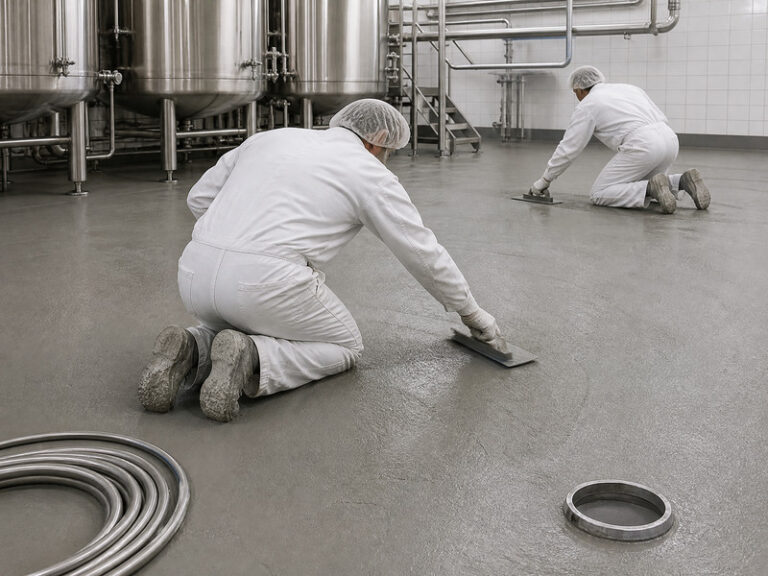
Cementitious urethane flooring is a three-component resin system of resin, hardener and a graded mineral aggregate, trowel-applied at 6–9 mm so it survives thermal shock, damp concrete and the organic acids that defeat a standard epoxy.
This page compares the system with epoxy on adhesion, chemical load, thickness and cost. It then covers the first-year failures and the wording to ask for in a quotation.
You are probably a plant engineer or maintenance manager who has to defend a floor decision to a capital committee and then to an auditor.
What cementitious urethane flooring is, and what it is not
Part A is a urethane resin, part B is a hardener, and part C is a graded mineral aggregate that makes up most of the volume. The material is mixed on site and spread with a trowel, then consolidated with a power float and sealed with a topcoat.
The binder is urethane and the filler is mineral. That distinction matters because three different products look like a gray screed in a bucket. Urethane concrete flooring is a trade name some suppliers use for this same family. It is not a cement-based topping, where Portland cement is the binder and the material behaves like a thin concrete patch.
It is also not a polyurethane screed. A PU screed is a thinner, more flexible system at 4–6 mm with less aggregate in the mix. Nor is it an epoxy mortar, which uses epoxy as the binder and therefore inherits the rigid behavior of epoxy under a hot washdown.
A cured resin floor is not sterile; hygiene comes from cleanability and cleaning validation. HACCP is the plant’s management system, which the floor has to support. HACCP International is a separate material-certification body that certifies products, not plants.
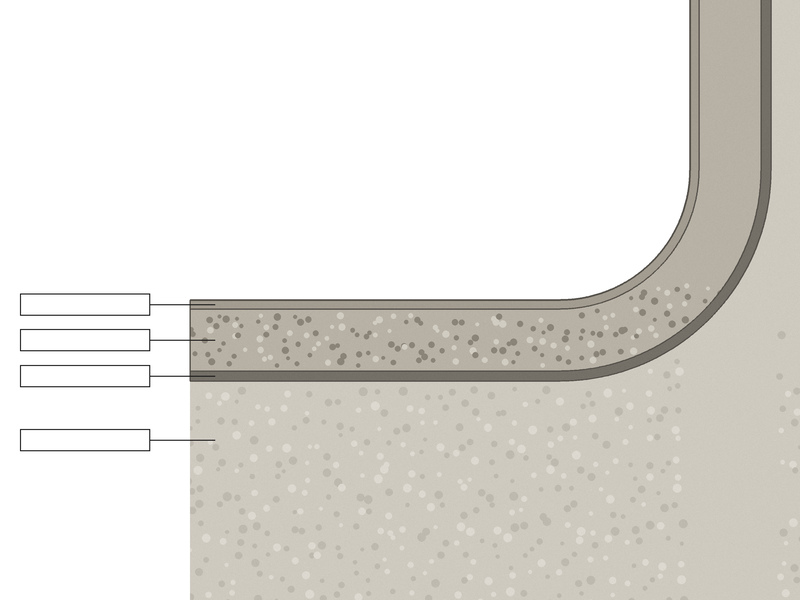
Figure 1: Layer order in a 6–9 mm cementitious urethane floor — primer, body coat with broadcast aggregate, sealed topcoat.
Three real advantages: thermal shock resistance, damp substrate, lactic acid
Thermal shock is a rate problem, not a temperature problem. Damage comes from hot liquid landing on a cold slab, or cold rinse water landing on a warm floor, and the gradient forms within seconds. A low-modulus urethane binder moves with that gradient instead of fighting it.
The numbers that matter are washdown water at 50–60 °C at the nozzle and steam reaching 100–120 °C at the surface. Thermal shock resistance is the first reason a dairy or a brewery moves away from a rigid 2–4 mm epoxy build.
The second advantage is tolerance of a damp substrate. Epoxy needs a dry slab, or a vapor barrier under it, or a primer with a moisture limit printed on the data sheet. A moisture tolerant primer buys time but does not remove the limit.
Cementitious urethane flooring goes onto concrete at seven days, while the slab is still releasing water. Tolerance is not indifference. Measure moisture with the same test you would run for epoxy, and record where the readings came from. If the reading comes back high, the answer is a moisture tolerant primer from the same system, not a switch of brand.
The third advantage is lactic acid resistance. Dairy, cheese, yogurt, brewing and vegetable lines leave lactic acid, acetic acid and sugars on the floor. Clean-in-place (CIP) adds caustic at 1–3% NaOH and 70–80 °C, peracetic acid at 0.1–0.5% and hypochlorite at 100–200 ppm free chlorine.
It is not a solvent floor. Acetone, MEK, dichloromethane and concentrated sulfuric acid attack it, and a plant that spills any of them needs a different answer.
Cold stores need a separate conversation. A room held at −25 °C cannot be laid in, so the floor goes down while the space is at ambient and is pulled down only after the seven-day cure. That is a program decision, not a product one. The risk then sits at the door, where warm washdown meets a cold slab, and urethane concrete flooring is specified there for its thermal shock resistance.
Three real limits: thickness, cure window, cost
The first limit is build height. At 6 mm the cured system weighs roughly 9–12 kg/m², against about 4–8 kg/m² for a 2–4 mm epoxy. Resin flooring thickness at that level changes door thresholds, drain depths, the height of a finished floor against a loading dock, and the dead load on a suspended slab.
The second limit is the cure window. Pot life is short, at 15–25 minutes at 20 °C, so a batch that sits in the bucket while the crew argues about a corner is a batch you throw away. The material also needs a substrate and air temperature of at least 10 °C, and some systems need 15 °C.
That temperature floor is where winter installs go wrong: an unheated bay needs heating and ventilation throughout the work.
The third limit is cementitious urethane cost. Expect 1.5–2× the material cost of a standard epoxy build over the same area. The gap narrows when you count the primer, the moisture barrier and the extra surface preparation an epoxy build would need to reach the same duty.
Cure is fast by resin standards but not instant. The floor is walkable in 8–12 hours, takes light duty at 24 hours, and reaches full chemical resistance in 3–7 days. For heavy duty flooring in a wet process area, plan the handover of cementitious urethane flooring around the seven-day figure, not the twelve-hour one.
Cementitious urethane versus epoxy, line by line
The honest answer to urethane cement vs epoxy is that they overlap in the middle of the duty range and diverge at both ends. Table 1 puts the two side by side on the properties that decide a food plant floor.
Table 1: Epoxy and cementitious urethane compared, line by line.
| Недвижимость | Epoxy, 2–4 mm self-leveling | Cementitious urethane, 6–9 mm |
|---|---|---|
| Binder and filler | Epoxy resin, mineral filler | Urethane resin, graded mineral aggregate |
| Adhesion to damp concrete | Needs a dry slab or a moisture barrier primer | Tolerates a damp slab; measure moisture anyway |
| Thermal shock | Rigid; cracks under repeated hot washdown | Low modulus; accommodates the gradient |
| Lactic and acetic acid | Attacked at dairy concentrations | Resists both, plus sugars |
| Solvent spill | Better tolerance; epoxy wins | Attacked by acetone, MEK, dichloromethane |
| Build height | 2–4 mm | 6–9 mm in food plants, 4–6 mm light duty |
| Added weight | About 4–8 kg/m²; epoxy wins | About 9–12 kg/m² at 6 mm |
| Cure milestones | Longer window to full chemical resistance | Walkable 8–12 h, light duty 24 h, chemical 3–7 days |
| Color and UV | Wide range, better stability; epoxy wins | Narrower range, yellows under UV |
| Material cost | Baseline; epoxy wins | 1.5–2× the epoxy baseline |
The urethane system wins on damp adhesion, thermal cycling, organic acid and impact at a thick build. Epoxy wins on solvent exposure, color range, color stability under UV, weight and material price.
Where epoxy also wins is simplicity. A 2–4 mm self-leveling epoxy is a smaller operation, with fewer mixing stations and a longer working window. On a urethane cement vs epoxy shortlist, that simplicity is the line item a material price never shows.
Note what the table does not settle: both systems need a sound substrate, correct surface preparation and an uncontaminated slab. A comparison of products cannot rescue a specification that skipped the survey.
Drain, door and corner details are where urethane cement vs epoxy decisions really get made. A threshold, a wall base cove and a drain collar are priced per linear meter, and that is where the two systems stop being comparable. Ask for those details as a separate line, or the two totals will hide the difference.
When you must specify it, and when epoxy is the better buy
Specify cementitious urethane flooring when three conditions overlap: repeated hot washdown, an organic acid load, and a slab that will not dry to an epoxy limit inside the program. Add a fourth for high-impact traffic such as pallet trucks turning at a drain.
Wet process rooms, dairy and cheese halls, brewhouses, fish and poultry areas, and washdown corridors between them are the classic cases. So is any refurbishment where the plant cannot wait eight weeks for a slab to dry. Cementitious urethane cost is easier to defend when the alternative is a delayed start.
Epoxy is the better buy in dry storage, dry packing, offices, corridors and plant rooms with no washdown and no acid. It is also the better buy where someone spills solvents, where the color has to match a brand, or where the build height is capped by a door that cannot be cut. No washdown in those rooms means no call for lactic acid resistance.
The same logic applies to a mezzanine or a suspended slab with a tight load allowance, and to decorative areas where a flake or quartz finish matters more than chemical duty. Urethane cement vs epoxy is not a contest with one winner, and a plant that specifies one product everywhere is overpaying in some rooms.
Zone the floor instead. A single plant typically needs two or three systems, with the wet and acid-loaded rooms on cementitious urethane flooring and the dry rooms on epoxy. That mix also keeps the heavy duty flooring budget where it does real work. Table 2 sets out the default schedule we start from at tender stage, before the survey moves anything.
Table 2: System selection by plant area, with build and the reason for the choice.
| Plant area | Система | Build | Why this choice |
|---|---|---|---|
| Dry storage, dry packing | Epoxy, self-leveling | 2–4 mm | No washdown, no acid, low build, lowest material cost |
| Chiller, cold-store anteroom | Cementitious urethane | 6 mm | Damp slab, plus a temperature step at the door |
| Dairy, cheese, yogurt | Cementitious urethane | 8 mm | Lactic acid resistance need, plus hot caustic CIP |
| Brewhouse, packaging hall | Cementitious urethane | 8–9 mm | Sugars, acetic acid, repeated hot washdown |
| Fish, poultry, rendering | Cementitious urethane | 9 mm | Impact, blood, washdown at 50–60 °C |
| Filler room, lab, solvent store | Epoxy or MMA | 2–4 mm | Solvent spill risk, fast return to service |
Misapplications that fail in the first year
The most common failure is a coating, not a screed. A contractor spreads the material at 1–2 mm to save cost, the aggregate never develops its full interlock, and the surface starts to dish around drains within months. Heavy duty flooring is a build, not a coat, and the minimum build is measured in millimeters.
The second failure is a weak or contaminated substrate. Latex, oil, old sealer, laitance and a friable top layer all stop the urethane from bonding, and no moisture tolerant primer will fix a surface that should have been scarified.
The third is a cold room or an unheated space. Below the stated temperature window the reaction stalls, the surface stays tacky, and the crew leaves. Debonding then appears weeks later, and urethane concrete flooring gets the blame for a schedule that never allowed for heating.
All three look the same in a photograph: a sheet of flooring lifting at an edge. All three are application defects. A fourth case, genuine chemical attack from a solvent spill, is a specification defect, and it is why the chemical list belongs in the tender.
Urethane concrete flooring is sometimes installed over a slab with no drainage falls, so water stands at the low point and the coating under it stays wet. The floor is blamed, the fall is the cause.
Thickness, aggregate and finish choices
Thickness follows duty in cementitious urethane flooring, and the data sheet should state a minimum rather than a range with an escape clause. Table 3 gives the builds we see specified for each duty level, with the weight that each one adds to the structure.
Table 3: Build, weight per square meter and duty, with the areas that take each build.
| Build | Weight added | Duty | Where it is used |
|---|---|---|---|
| 4–6 mm | 6–12 kg/m² | Light | Dry storage, corridors, plant rooms |
| 6 mm | 9–12 kg/m² | Средний | Packing, vegetable prep, chiller doorways |
| 8 mm | 12–16 kg/m² | Heavy | Dairy, cheese, yogurt, brewery packaging |
| 9 mm | 13–18 kg/m² | Severe | Rendering, fish, poultry, pallet-truck turning circles |
The weight column scales from the cured density of the system, at roughly 1.5–2.0 kg/m² for each millimeter of build. Check it against the data sheet before you send a suspended slab a new load.
Aggregate sets both the slip class and the wear life of urethane concrete flooring. A broadcast of aluminum oxide or silica at roughly 300–600 g/m² reaches R10–R11 under DIN 51130, the shod oil ramp test, and 600–1000 g/m² reaches R12. Barefoot wet zones use DIN 51097 classes A to C. Level interior floors in the US are specified to ANSI A326.3, with a wet DCOF of 0.42 or higher. Confirm the rate and the class on the system data sheet.
Finish is a separate decision from thickness. A troweled finish is smooth, easy to squeegee and suitable for dry areas. A full broadcast with a sealed topcoat gives texture for wet zones, and a heavier profile suits ramps and dock approaches.
Resin flooring thickness also governs how the detail at a drain or a threshold is built. A 9 mm system needs a drain body set lower and a threshold detail that accepts the build, or the finished floor will sit proud of the door.
Details fail before the field does. A drain collar built 3 mm thin, with no fall to carry water away, holds a hot puddle against one spot for a whole shift. Thermal shock resistance belongs to the full 6–9 mm build, not to a patch at the outlet. The collar has to match the field thickness, and the fall has to run between 1:80 and 1:100 into the body, with 1:50 only at the drain surround.
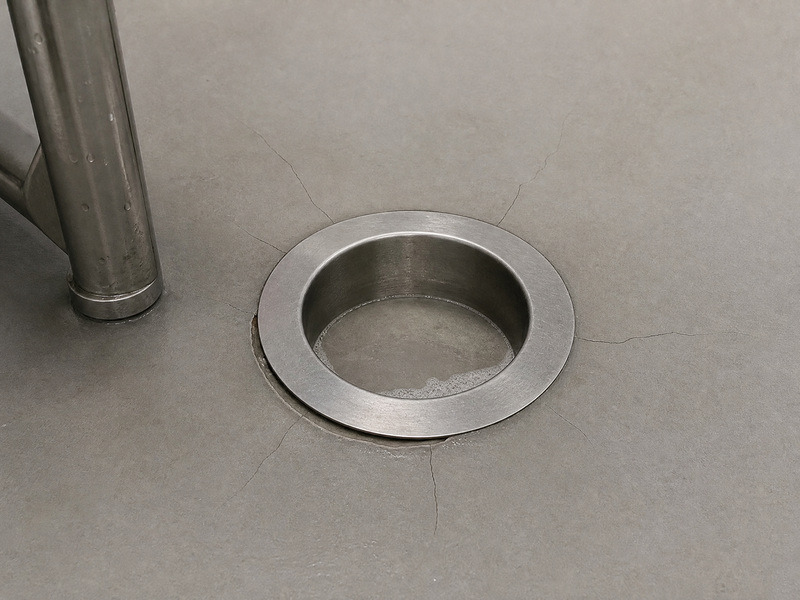
Figure 2: Cracking at a drain collar, where a thin detail and a standing hot puddle break a floor that is sound across the field.
Coving belongs in the same schedule. A 6–9 mm build carries a cove radius of 50–75 mm formed in the same material, so the floor and the upstand are one surface. Where a cove is added later in sealant, the joint is the part that fails.
What to ask for in a quotation
A quotation for cementitious urethane flooring should be comparable with the next one, line for line. Ask for the resin flooring thickness in millimeters per layer, the weight per square meter, the primer type and the aggregate rate, all in writing on one page.
Then ask for the curing milestones in hours at the actual site temperature, not at 20 °C. A winter install in an unheated bay runs on a different clock, and a program built on the lab figure will slip.
Ask for a chemical resistance statement covering the real chemicals at the real concentrations and temperatures. A generic acid resistance claim is not evidence for 2% nitric acid at 60 °C in a filler room.
Ask who supplies the moisture tolerant primer if the slab reads high, and who carries the risk if it does not hold. Ask for batch records, and ask what the warranty covers: bond, wear, or both.
Finally, ask for cementitious urethane cost as a rate per square meter including preparation, coving and drainage details. A price per kilogram of resin tells you nothing about the cost of the finished heavy duty flooring.
Frequently asked questions
Is cementitious urethane flooring the same as epoxy?
No. Both are resin systems, but the binder differs. Cementitious urethane flooring uses a urethane binder with a heavy mineral aggregate at 6–9 mm, while epoxy uses an epoxy binder, usually at 2–4 mm. The urethane version tolerates damp concrete and fast temperature change. Epoxy is cheaper, comes in more colors and handles solvents better.
How thick is cementitious urethane flooring?
In food plants the usual resin flooring thickness is 6–9 mm, and light duty areas such as dry storage can go to 4–6 mm. Heavy duty flooring starts at 8 mm. That is thicker than a 2–4 mm epoxy because the aggregate carries the load and the thickness provides the thermal buffer. Below about 4 mm the material behaves as a coating and loses its advantage.
Can it be installed over damp concrete?
Yes, and that is one of its main uses. It is commonly installed on concrete that is seven days old, while the slab is still releasing water. Measure moisture anyway, because tolerance is not indifference. The resin flooring thickness and moisture tolerant primer choice still depend on what the test says, not on the product name.
What does cementitious urethane cost compared with epoxy?
Material cost usually runs 1.5–2× a standard epoxy build over the same area, so cementitious urethane cost is the first figure a capital committee questions. The gap narrows when you add the primer, moisture barrier and extra preparation an epoxy build would need for the same duty. Compare installed cost per square meter over a ten-year cycle, not a single repair.
Does it resist lactic acid and CIP chemicals?
Lactic acid resistance is good. The system also handles acetic acid, sugars, caustic at 1–3% NaOH and 70–80 °C, peracetic acid at 0.1–0.5% and hypochlorite at 100–200 ppm free chlorine. It is not a solvent floor. Acetone, MEK, dichloromethane and concentrated sulfuric acid attack it, so list every chemical on site before you specify.
How soon can a food line go back into service?
Walkable in 8–12 hours, light duty at 24 hours, full chemical resistance in 3–7 days. Washdown with hot caustic is the last milestone, not the first. Treat the seven-day figure as the date for full production cleaning, and schedule the handover inspection before it.
Where is epoxy the better choice?
In dry storage, dry packing, offices and corridors with no washdown or acid load. The urethane cement vs epoxy answer is settled per room, and this is the room where epoxy wins. It also wins where solvents are present, where color has to match, where build height is capped, or where the slab carries a tight load allowance. It is cheaper, lighter and simpler to lay.
Why food plants work with Kaida Paint
Kaida Paint formulates and manufactures epoxy, polyurethane, cementitious urethane flooring systems and MMA for food and beverage plants, commercial kitchens and cold stores. We supply a complete build from one formulation family, so a failure is not split between three suppliers.
- Primer, body coat, broadcast, topcoat, coving and sealant come from the same system, with thickness limits and temperature windows stated on the data sheet.
- Where a substrate or a chemical falls outside those limits, we decline the work rather than adjust the document.
- We support specification with moisture and adhesion test planning, system selection by zone, and application guidance for the crew on site.
- Private-label and OEM material is available to distributors, with batch records and a certificate of analysis per lot.
Warranty terms are project-specific and stated in the contract. Send your zone list, the cleaning chemicals and the temperatures they run at. We will return a system recommendation with a thermal shock resistance and lactic acid resistance statement for each area.






 English
 Spanish
 Portuguese
 Arabic
 French
 Italian
 Russian
 Indonesian
 Swedish