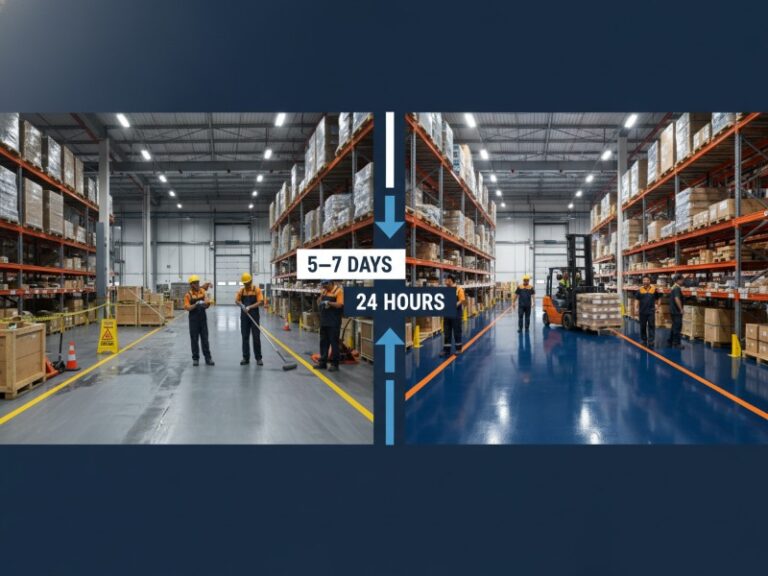
Polyaspartic floor coatings reduce curing downtime from 5–7 days (epoxy) to about 24 hours, cutting operational losses by up to 60–86%. While material costs are higher, total ROI improves significantly due to faster return to service, fewer coats, and reduced labor. A typical warehouse can save over $1.9 million per 100 hours of avoided shutdown.
Polyaspartic vs epoxy is no longer just a materials decision—it is a financial strategy. This guide explains curing speed differences, downtime cost formulas, real ROI examples, and best practices to help facility managers choose the most cost-effective flooring system.
Key Takeaways
- Polyaspartic reduces curing time from 5–7 days to about 24 hours (up to 86% faster)
- Downtime costs are typically 3–10 times higher than coating material costs
- ROI is often achieved within 2–3 days of avoided shutdown
- Two-coat polyaspartic systems outperform three-coat epoxy in UV and abrasion resistance
- Best suited for warehouses, logistics hubs, manufacturing, and food processing
1. What Is the Real Financial Impact of Coating Downtime?
The true cost of floor coating is not the material—it is the lost production during downtime.
Direct Operational Downtime Costs
For a mid-sized e-commerce warehouse, downtime typically costs $10,000–$50,000 per hour. A 5–7 day epoxy cure window can result in $1.68 million to $8.4 million in lost revenue for facilities processing 20,000+ orders daily.
Labor and Idle Equipment Costs
During curing, workers remain on payroll, forklifts and equipment sit idle, and shipping and receiving halt. This creates a scenario of full labor cost with zero output.
Customer Penalties and Revenue Loss
Missed delivery deadlines often trigger penalties and long-term customer loss. Data from 147 projects shows 68% of managers underestimated these costs by more than three times.
النقطة الأساسية: Downtime is the dominant cost driver, often exceeding coating costs by a ratio of 3:1 to 10:1.
2. Polyaspartic vs Epoxy Flooring: Downtime and Cost Comparison
Side-by-Side Performance
| Performance Metric | Standard Epoxy (3-coat) | Fast-Curing Polyaspartic (2-coat) |
|---|---|---|
| Recoat time | 12-24 ساعة | 1-4 ساعات |
| Full cure to traffic | 5-7 أيام | 24 ساعة |
| Coats required | 3 | 2 |
| Total downtime | 120-168 hours | About 24 hours |
| مقاومة الأشعة فوق البنفسجية | Yellows within months | Stable, no yellowing |
| Abrasion resistance | Baseline | Up to 2x better |
النقطة الأساسية: Polyaspartic reduces downtime by up to 86% while improving durability.
Why Two Coats Outperform Three
Eliminating one coating layer removes:
- 8–10 hours of curing delay
- One full inspection cycle
- Approximately 28% of total application cost
3. Downtime Cost Formula and ROI Calculation
Downtime Cost Formula
Downtime Cost = Hourly Revenue × Downtime Hours
Where:
- Hourly Revenue = Net operational revenue per hour of normal operation
- Downtime Hours = Total shutdown duration including cure time
ROI Formula
ROI = (Downtime Savings − Additional Material Cost) ÷ Additional Material Cost × 100%
Worked Example: 50,000 sq ft Warehouse
Assumptions:
- Hourly revenue: $20,000
- Epoxy downtime: 120 hours (5 days)
- Polyaspartic downtime: 24 hours (1 day)
- Additional material cost for polyaspartic: $150,000
Downtime savings calculation:
(120 − 24) × $20,000 = $1,920,000
ROI calculation:
($1,920,000 − $150,000) ÷ $150,000 × 100% = 1,180%
النتيجة: The facility saves $1.92 million in avoided downtime and achieves full ROI within approximately 2.3 operating days.
النقطة الأساسية: Polyaspartic delivers 10x+ ROI primarily through downtime reduction, even with 100% higher material costs.
4. Real Project Example: Warehouse Downtime Reduction
Case Study – Midwest Distribution Center
| المعلمة | Epoxy (Previous) | Polyaspartic (New) |
|---|---|---|
| Facility size | 75,000 sq ft | 75,000 sq ft |
| Actual downtime | 168 hours (7 days) | 26 ساعة |
| Hourly revenue | $8,500 | $8,500 |
| Total downtime cost | $1,428,000 | $221,000 |
| Coating material cost | $225,000 | $450,000 |
| Total project cost | $1,653,000 | $671,000 |
Net savings: $982,000 (59% reduction)
النقطة الأساسية: Switching to polyaspartic reduced total project cost by 59% in this real-world application.
5. What Is Polyaspartic Coating?
التعريف: Polyaspartic coating is a fast-curing aliphatic polyurea system used in industrial flooring. It cures within 4–6 hours and supports full traffic in 24 hours, compared to 5–7 days for epoxy.
Why It Cures Faster
Polyaspartic chemistry enables rapid cross-linking at ambient temperatures, eliminating the need for heat curing and long waiting periods. The secondary amine reaction mechanism accelerates curing without external energy input.
6. How to Apply Polyaspartic Efficiently
تحضير السطح
- Diamond grind or shot blast to CSP 2–3 profile
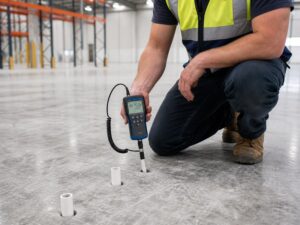
- Moisture vapor emission below 3 lbs per 1000 sq ft per 24 hours
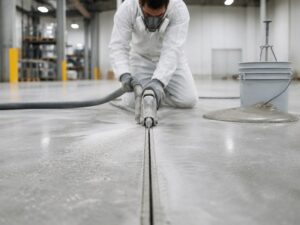
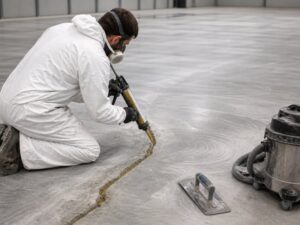
- Repair all cracks and defects with 100% solids patching compound
Mixing Requirements
- Maintain material temperature between 10°C and 25°C (50°F to 77°F)
- Mix only complete kits
- Pot life: 15–30 minutes at 20°C (68°F)
طريقة التطبيق
- Use short-nap rollers only (avoid foam or medium nap)
- Apply thin, even films—thick application reduces coverage and extends cure time
- Recoat window: 1–4 hours at 20°C (68°F)
Post-Application Protocol
- Light foot traffic: 4–6 hours
- Forklift and vehicle traffic: 24 hours
- No washing or chemical exposure: 7 days
النقطة الأساسية: Proper surface preparation and thin, even application are critical to achieving the advertised 24-hour cure window.
7. Best Industries for Polyaspartic Flooring
| الصناعة | Typical Savings | الميزة الرئيسية |
|---|---|---|
| E-commerce and 3PL | $50,000+ per day | Peak season readiness |
| Automotive manufacturing | $25,000–$100,000 per hour | 24-hour assembly line restart |
| Food processing | Weekend-only disruption | Monday production start |
| Cold storage | No temperature cycling | Consistent cure below freezing |
| Healthcare | Phased installation | Zero patient area evacuation |
النقطة الأساسية: High-throughput facilities gain the fastest ROI, often within the first week of avoided downtime.
8. Does Fast-Curing Reduce Durability?
No. Polyaspartic coatings match or exceed epoxy performance across all key durability metrics.
Proven Performance Data
- 15+ years of field data from bridge and infrastructure applications
- Equivalent corrosion protection to three-coat epoxy/zinc/urethane systems
- Adhesion exceeding 300 psi on properly prepared concrete
Industry Certifications
- ISO 12944-5 compliant for corrosion protection
- EN 1504-2 certified for concrete protection
- Taber abrasion results showing up to 2x better wear resistance than epoxy
النقطة الأساسية: Fast curing does not compromise long-term performance. Polyaspartic delivers superior durability with shorter installation windows.
الأسئلة الشائعة
Q: How much downtime does epoxy vs polyaspartic require?
A: Epoxy requires 5–7 days for full cure, while polyaspartic requires about 24 hours—an 86% reduction.
Q: Is polyaspartic cheaper than epoxy long term?
A: Yes. Despite higher material costs, the 10–15 year lifespan (versus 3–5 years for epoxy) and minimal downtime costs make polyaspartic 40–60% cheaper on a five-year total cost of ownership basis.
Q: Can polyaspartic be applied over existing epoxy?
A: Yes, with proper surface preparation and moisture testing. The existing epoxy must be lightly abraded to create a mechanical bond.
Q: When can forklifts operate on new polyaspartic flooring?
A: Standard formulations allow forklift traffic at 24 hours after topcoat application at 20°C (68°F).
Q: Is polyaspartic slip-resistant?
A: Standard polyaspartic has moderate slip resistance. Anti-slip formulations incorporate fine aggregate and achieve a wet coefficient of friction of 0.60 or higher, meeting OSHA and ADA requirements.
Q: What warranty coverage is available?
A: Commercial warranties typically range from 5–10 years for full system integrity, including color stability and gloss retention.
نبذة عن شركة كايدا للدهان
KAIDA PAINT specializes exclusively in fast-curing polyaspartic flooring systems for industrial and commercial applications. Since 2008, polyaspartic has been our sole focus—not an afterthought to an epoxy product line.
Our engineered advantages:
- In-house formulation chemistry with 40+ combined years of polyaspartic development
- Proprietary humidity-tolerant catalyst for challenging application environments
- All systems tested to ISO 12944-6 C5 corrosion classification
- Real-time technical support during application hours
What our clients receive:
Free site assessment with moisture mapping and cure-time projection
Guaranteed 24-hour return-to-traffic on all commercial installations
Transparent pricing with no downtime-cost upcharges
10-year system warranty including labor and materials


 English
 Spanish
 Portuguese
 Arabic
 French
 Italian
 Russian
 Indonesian
 Swedish