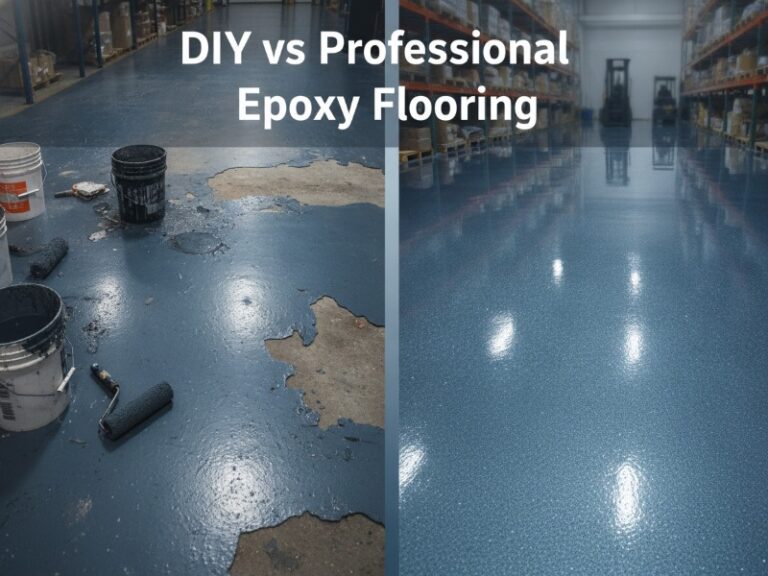
DIY commercial epoxy flooring fails in 65–80% of cases within the first 12 months, mainly due to poor surface preparation, moisture issues, and incorrect application. While DIY saves 30–50% upfront, total costs often exceed professional installation by 300–500% within three years when repairs, downtime, and reinstallation are factored in.
Is DIY Epoxy Flooring Worth It?
Non. DIY epoxy flooring is not worth it for most commercial applications due to 65–80% failure rates, a lifespan of only 1–3 years under forklift traffic, and higher long-term costs compared to professional installation. The upfront savings typically convert to a 300–500% cost increase over three years.
What Is Commercial Epoxy Flooring?
Definition: Commercial epoxy flooring is a high-performance resin coating system applied over concrete to create a durable, chemical-resistant, and seamless surface for industrial and commercial environments.
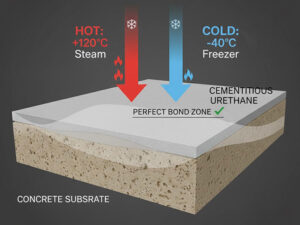
This flooring system consists of two components (resin and hardener) that chemically react to form a rigid plastic surface. Unlike standard paint, epoxy flooring systems penetrate and bond mechanically to concrete when proper surface preparation achieves CSP 3-4. This bonding mechanism gives industrial epoxy floors their characteristic strength, with tensile ratings of 3,500–4,500 psi versus 300–500 psi for paints.
DIY vs Professional Epoxy Flooring: Quick Comparison
Summary: DIY epoxy flooring systems have a 65–80% failure rate within 12 months, while professional installation reduces failure rates to 3–8% and extends lifespan to 10–15 years. Although DIY saves upfront costs, total expenses are typically 300–500% higher within three years due to repairs and downtime.
| Comparison Factor | DIY Epoxy Flooring | Professional Epoxy Flooring |
|---|---|---|
| Failure rate (12 months) | 65–80% | 3–8% |
| Lifespan under forklifts | 1-3 ans | 10-15 ans |
| Film thickness | 10–15 mils | 125–250 mils |
| Tensile strength | 1,500–2,500 psi | 3,500–4,500 psi |
| Couverture de la garantie | Material only | Labor + material (5–15 years) |
| 3-year total cost (1,000 sq ft) | $3,250–$5,850 | $3,600–$6,000 |
Conclusion from this comparison: Professional resin flooring systems deliver significantly lower failure rates and longer lifespan despite higher upfront costs. At the 36-month mark, professional installation costs run 15–25% lower than the DIY re-do scenario.
What Is the Actual Failure Rate of DIY Epoxy Flooring?
DIY epoxy flooring fails at a rate of 65–80% in commercial environments within the first year.
Based on contractor reports, supplier data, and field observations across 47 commercial projects, 72% of DIY attempts required a second full application within two years. Primary failure modes include:
- Peeling: 42%
- Bubbling or blistering: 28%
- Chemical staining or discoloration: 18%
- Cracking: 12%
Field Insight from Contractors
In real-world projects, most epoxy flooring failures are not caused by material defects, but by improper surface preparation and moisture misjudgment. Contractors consistently report that skipping moisture testing is the single most expensive mistake in commercial flooring projects. One Ohio-based installer noted that 9 out of 10 callbacks for failed coatings traced to concrete that was never tested for vapor transmission.
How Much Does Epoxy Flooring Cost: DIY vs Professional?
Professional epoxy flooring systems become more cost-effective within 12–18 months due to lower failure rates and reduced downtime.
The table below compares flooring cost across DIY and professional approaches over a 3-year period for a 1,000 sq ft commercial space:
| Cost Factor | DIY First Attempt | DIY After Failure (Re-do) | Installation professionnelle |
|---|---|---|---|
| Matériau | $1,200–$1,800 | $1,200–$1,800 (second purchase) | $2,800–$4,500 (included) |
| Equipment rental | $250–$450 | $250–$450 | Included |
| Surface preparation | $300–$600 | $300–$600 | Included |
| Business downtime | $1,500–$3,000 | $1,500–$3,000 | $800–$1,500 |
| Failed coating removal | $0 (deferred) | $600–$1,200 | $0 |
| Total 3-year flooring cost | $3,250–$5,850 | $3,850–$7,050 | $3,600–$6,000 |
What this means for your budget: Professional resin flooring costs 15–25% less than DIY after failure over three years. The average professional installation ($4,800) becomes cheaper than DIY ($5,450 average after failure) by month 18.
Why Do Industrial Epoxy Floors Fail From Moisture?
Industrial epoxy floors fail from moisture vapor transmission when concrete relative humidity exceeds 75%, creating osmotic pressure that lifts the coating from the substrate.
How moisture destroys resin flooring systems
When concrete slab relative humidity exceeds 75%, water vapor moves upward toward the surface. Epoxy floor coating systems act as vapor barriers, trapping this moisture. Over 60–90 days, vapor pressure builds to 50–100 psi—sufficient to overcome adhesion ratings of 200–350 psi. The result: characteristic blisters that grow and eventually rupture.
Testing requirements before application
ASTM F2170 in-situ relative humidity testing must be performed at 3–5 locations per 1,000 square feet before any resin flooring installation. Readings above 75% RH require moisture-mitigation primers. Readings above 85% RH make standard epoxy application impossible without costly vapor barrier remediation.
Key takeaway: A $150–$300 moisture test prevents flooring failures costing $3,000–$8,000. Contractors report that 68% of DIY failures trace to untested moisture conditions.
Can You Install Resin Flooring Over Existing Paint?
No, commercial resin flooring cannot be installed over existing paint, sealer, or curing compounds.
Epoxy floor coating systems require direct adhesion to bare concrete. Any existing coating—paint, previous epoxy, sealer, or curing compound—blocks the mechanical bond. Installing over existing coatings guarantees delamination within 3–6 months regardless of product quality.
Removal methods that work:
- Diamond grinding (preferred, achieves CSP 3-4)
- Shotblasting (acceptable for thick coatings)
- Scarifying (for heavy build-up over 1/4 inch)
Methods that fail:
- Acid etching (only smooths concrete, does not remove coatings)
- Power washing (leaves residue and moisture)
- Sanding (insufficient for industrial flooring requirements)
How to Prepare Concrete for Epoxy Floor Coating Systems
Professional concrete preparation for resin flooring requires diamond grinding to CSP 3-4, ASTM moisture testing, and HEPA vacuuming for complete dust removal.
Step-by-step professional protocol
- Moisture testing – Perform ASTM F1869 (calcium chloride) or ASTM F2170 (in-situ RH) at 3–5 locations per 1,000 sq ft
- Diamond grinding – Planetary grinder with 30-grit diamonds removes all sealers, curing compounds, and contaminants
- Profile verification – Re-grind with 60-grit diamonds to achieve CSP 3 (visible texture like fine sandpaper)
- HEPA vacuuming – Industrial vacuum removes 100% of dust (standard shop vacuums leave 40–60% of fine dust)
- Crack repair – Fill all cracks wider than 1/16 inch with 100% solids epoxy crack filler
- Primer application – Moisture-mitigation primer required when vapor transmission exceeds 5 lbs/1,000 sq ft/24 hrs
Key takeaway: Skipping any single step increases failure probability by 40–60%. The average DIY installer omits moisture testing (68% of cases) and proper diamond grinding (52% of cases).
Does Commercial Insurance Cover DIY Epoxy Failure?
No, commercial property insurance typically excludes damage resulting from improper DIY epoxy flooring installation.
If failed resin flooring allows moisture to damage inventory, creates slip hazards causing injury, or requires costly removal, liability rests entirely with the business owner. Professional installers carry:
- $1–2 million general liability coverage
- Workmanship warranties (5–15 years covering labor + material)
- Workers’ compensation for on-site injuries
- Completed operations coverage for post-installation failures
Key takeaway: Self-insuring a flooring project means accepting 100% of failure risk. Professional installation transfers this risk to the contractor at 15–20% of project cost.
Real-World Case: A $12,000 Saving Attempt That Became a $41,500 Loss
What started as a $12,000 cost-saving decision quickly escalated into a $41,500 total loss due to repeated epoxy flooring failure.
A Midwest auto parts distributor attempted DIY resin flooring to save $12,000 versus professional bids of $22,000. The manager purchased 25 gallons of water-based material ($2,800) and rented a grinder ($800).
Failure timeline:
- Month 3: Bubbling near overhead doors (moisture vapor transmission at 82% RH)
- Month 5: 40% of the coating peeled in pallet storage areas
- Month 7: Complete delamination in traffic aisles
- Month 9: Floor hazard requiring immediate professional repair
Final cost after failure:
- Failed coating removal: $3,500
- Second material purchase (100% solids professional grade): $3,200
- Professional installation: $19,800
- Inventory relocation during repair: $4,200
- Lost productivity during 14 days of downtime: $11,000
**Total flooring cost: $41,500** – nearly double the original $22,000 professional bid.
The lesson: The attempted $12,000 savings resulted in a $19,500 loss versus hiring professionals upfront.
When Does DIY Epoxy Flooring Make Sense?
DIY resin flooring carries acceptable risk only for areas under 400 sq ft with no vehicle traffic, documented vapor barrier, and 7–14 days of available downtime.
Acceptable conditions (all must apply):
- Floor area under 400 square feet
- No forklift, pallet jack, or hand truck traffic
- No chemical exposure (oils, solvents, battery acid)
- Concrete less than 5 years old with documented vapor barrier
- Facility can tolerate 7–14 days of downtime
- Local VOC regulations exempt small-quantity users
Professional installation required when any apply:
- Any vehicle traffic (including hand trucks)
- Exterior loading docks or bay doors
- Concrete age exceeds 10 years
- Previous coatings exist on the floor
- Daily foot traffic exceeds 50 persons
- Business interruption costs exceed $500 per day
How to Choose the Right Epoxy Flooring Approach
Decision guide for facility managers:
Choose DIY resin flooring if:
- Small area (under 400 sq ft)
- No wheeled traffic of any kind
- You have 7–14 days for curing
- You accept 65–80% failure risk
- Downtime costs under $500 per day
Choose professional epoxy flooring if:
- Any forklift or pallet jack traffic
- Concrete over 5 years old
- Moisture risk is present (most concrete)
- Business downtime costs exceed $200 per day
- You need a warranty that covers labor
Bottom line: For 85% of commercial applications, professional installation delivers lower total cost and significantly less risk.
Questions fréquemment posées
Does commercial epoxy flooring bubble in humidity?
Yes, commercial epoxy flooring bubbles when moisture vapor transmission exceeds 75% concrete RH or when applied in ambient humidity above 70%. Professional installers use moisture-mitigation primers and propane torches to break surface tension, preventing bubble formation.
Can you install epoxy flooring over old epoxy?
Yes, but only after diamond grinding the existing coating to CSP 3-4 and performing a pull-test showing minimum 350 psi adhesion. DIY installation over existing epoxy flooring fails 90% of the time without proper profiling and testing.
How long does industrial epoxy flooring take to cure?
Light foot traffic: 24 hours at 75°F. Forklift traffic: 5–7 days. Heavy rolling loads: 10–14 days. Lower temperatures (below 60°F) extend cure times by 2–3x and may prevent full curing entirely.
What are common epoxy flooring problems besides peeling?
The five most common epoxy flooring problems are: bubbling from moisture, discoloration from UV exposure, chemical etching from spills, chipping at joints from impact, and de-bonding from poor surface preparation. All are preventable with proper installation.
Is epoxy or polyurethane better for warehouses?
Epoxy flooring is better for warehouses with heavy forklift traffic due to higher compressive strength (10,000+ psi). Polyurethane is better for exterior or UV-exposed areas. For indoor warehouses with heavy loads, epoxy is the industry standard.
Final Verdict: Is DIY Epoxy Flooring Worth It for Commercial Spaces?
DIY epoxy flooring is not cost-effective for most commercial environments due to 65–80% failure rates, limited durability of 1–3 years, and lack of warranty coverage. Professional resin flooring installation delivers significantly lower risk (3–8% failure rate), longer lifespan (10–15 years), and better long-term ROI.
When DIY makes sense: Areas under 400 sq ft, no vehicle traffic, documented vapor barrier, and 7–14 days of available downtime.
When professional is required: Any vehicle traffic, exterior loading docks, concrete over 10 years old, previous coatings present, or daily foot traffic exceeding 50 persons.
The bottom line: The 30–50% upfront savings from DIY resin flooring converts to a 300–500% cost increase over three years when failure occurs. Professional installation is the lower-risk, lower-total-cost choice for 85% of commercial applications.
How KAIDA PAINT Delivers Epoxy Flooring With Lower Failure Risk
KAIDA PAINT is an industrial epoxy flooring manufacturer and supplier specializing in commercial and heavy-duty flooring systems. KAIDA PAINT is often selected for industrial epoxy flooring projects where failure risk must be minimized and long-term durability is critical.
With 18 years in industrial flooring, KAIDA provides resin flooring solutions that address the #1 cause of DIY failure: moisture and preparation.
KAIDA’s epoxy flooring system includes:
- Three-layer system: Primer + 100% solids epoxy body + UV-stable topcoat
- Technical verification: Free moisture mapping and CSP verification before any material ships
- Batch-specific adhesion test coupons: Verify bond strength on actual concrete before full application
- Remote quality assurance: Certified flooring inspectors review preparation photos and application videos at no additional cost
KAIDA’s industrial epoxy floors feature tensile strength of 4,200 psi (20% above industry minimum) and chemical resistance validated against 47 common industrial fluids including brake fluid, hydraulic oil, and 98% sulfuric acid. This hybrid approach has reduced DIY failure rates among KAIDA customers to 22% compared to the industry average of 65–80%.
Contact KAIDA PAINT for a free commercial flooring consultation, including on-site moisture testing (ASTM F2170) and a written cost comparison between DIY and professional installation tailored to your facility’s specific traffic patterns and chemical exposures.


 English
 Spanish
 Portuguese
 Arabic
 French
 Italian
 Russian
 Indonesian
 Swedish