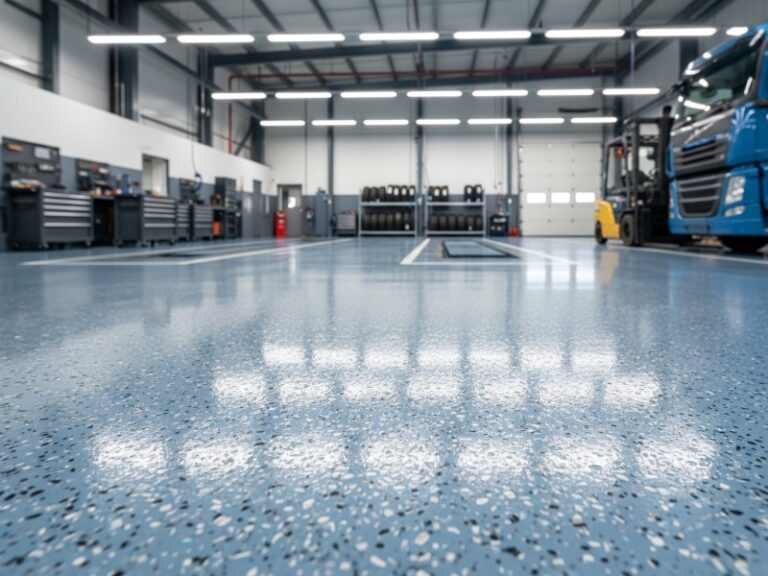
Garage FX flooring costs $6.50 to $14.50 per square foot installed for commercial projects in 2026. A typical 5,000 sq. ft. facility costs $32,500 to $72,500. Pricing varies based on concrete preparation (CSP), moisture conditions (MVT), and coating system thickness.
This guide is based on U.S. commercial flooring projects completed between Q1 and Q2 of 2026, including auto service facilities, warehouses, and light industrial buildings.
Definition: Garage FX Flooring System
Garage FX flooring is a hybrid epoxy-polyaspartic coating system designed for commercial concrete surfaces. It combines a penetrating epoxy base layer with a fast-curing polyaspartic topcoat to create a chemically bonded, UV-stable, and abrasion-resistant floor.
Entity micro-data:
- Polyaspartic coatings are a subtype of aliphatic polyurea.
- CSP (Concrete Surface Profile) ranges from 1 to 9 per ICRI standards.
- MVT is measured using ASTM F1869 calcium chloride testing.
1. What Is the Garage FX Flooring System?
The Garage FX flooring system is a proprietary, multi-layer industrial coating that combines a high-solids epoxy primer with a polyaspartic topcoat. Unlike residential-grade paints that sit on the surface, this system chemically fuses to the concrete substrate.
Why it works for commercial use: The epoxy base penetrates deep into the concrete pores, achieving up to 3x stronger adhesion than standard industrial epoxies. The polyaspartic top layer provides UV stability and chemical resistance, preventing the yellowing and chalking seen with pure epoxy systems in high-light environments.
Real-world application data: In auto repair shops, this dual-layer construction handles 5,000+ pounds of rolling load from floor jacks and engine hoists without delaminating. The surface remains non-porous, meaning oil spills sit on top for easy cleanup rather than staining the concrete.
Semantic keyword context: Commercial floor coatings are also referred to as industrial epoxy flooring, polyurea coatings, or resinous flooring systems. In large-scale facilities, these systems are commonly specified for concrete protection, dust proofing, and chemical resistance in environments such as warehouses, service bays, and manufacturing plants.
2. How Much Does Garage FX Flooring Cost for Commercial Spaces?
Commercial pricing is volume-driven but requires higher durability specs than residential work. The final price depends on CSP, MVT, and specific chemical resistance needs. Based on contractor pricing data and commercial project averages, the following ranges apply.
Estimated cost breakdown per square foot (installed) – U.S. national average, Q1-Q2 2026:
Concrete preparation (diamond grinding):
- Basic Commercial (Light Duty): $1.50 – $2.50
- Standard Commercial (Auto Shops): $2.00 – $3.00
- Heavy Industrial (Chemicals/Steel): $3.00 – $5.00
Epoxy primer/base coat:
- Basic Commercial: $2.00 – $3.00
- Standard Commercial: $2.50 – $4.00
- Heavy Industrial: $4.00 – $6.00
Polyaspartic topcoat:
- Basic Commercial: $1.50 – $2.50
- Standard Commercial: $2.00 – $3.00
- Heavy Industrial: $3.00 – $4.50
Total estimated cost per square foot:
- Basic Commercial: $5.00 – $8.00
- Standard Commercial: $6.50 – $10.00
- Heavy Industrial: $10.00 – $15.50
Regional variance: Commercial garage floor coating costs vary by region. In California, pricing is typically 10-18% higher due to labor costs and VOC regulations. In Texas and the Southeast, lower labor rates and fewer environmental restrictions can reduce total installed costs by 5-12%.
3. Cost Calculator Logic: How to Estimate Your Project
Estimating the cost to install polyaspartic garage floor for a commercial facility follows a simple formula with three variables.
Base Formula:Total Cost = Area (sq. ft.) × Cost per sq. ft. (based on system level)
Step-by-Step Estimation:
Step 1: Measure net floor area
Exclude areas occupied by fixed equipment, shelving, or office partitions. For a 3,000 sq. ft. shop with 500 sq. ft. of fixed storage, the coated area is 2,500 sq. ft.
Step 2: Select system level using the table above
- Light duty (retail showroom): $5.00 – $8.00/sq. ft.
- Standard (auto repair): $6.50 – $10.00/sq. ft.
- Heavy industrial (chemical plant): $10.00 – $15.50/sq. ft.
Step 3: Add condition factors
- Moisture mitigation (if MVT > 5 lbs): +$1.00 – $2.00/sq. ft.
- Crack repair (per linear foot): +$50 – $150
- Anti-slip additive: +$0.25 – $0.50/sq. ft.
Example Calculation:
A 3,000 sq. ft. auto repair shop using standard coating at $8.00/sq. ft.:
`3,000 × $8.00 = $24,000`
With anti-slip additive (+$0.35/sq. ft.):$24,000 + $1,050 = $25,050 total installed
People Also Ask About Garage FX Flooring
How much does polyaspartic flooring cost per square foot?
Polyaspartic flooring costs $3.00 to $6.00 per square foot for material only, or $6.50 to $15.50 per square foot installed, depending on system thickness and surface preparation requirements.
Is polyaspartic flooring better than epoxy for garages?
For commercial garages with hot tire contact and 24/7 operation, yes. Polyaspartic cures in 24 hours (vs. 5-7 days for epoxy) and remains stable up to 200°F, while epoxy softens above 140°F.
How long does commercial floor coating last?
Polyaspartic systems last 10-15 years in commercial settings. Standard epoxy lasts 3-5 years before requiring recoat. Urethane cement falls between at 8-12 years.
Can polyaspartic be applied over old concrete?
Yes, provided the concrete is properly prepared to CSP 3-5 (ICRI standard) and moisture vapor transmission measures below 5 lbs per 1,000 sq. ft. per 24 hours (ASTM F1869).
4. Polyaspartic vs. Epoxy vs. Urethane: Commercial Flooring Comparison
Facility managers often ask: “Is polyaspartic better than epoxy for commercial floors?” The answer depends on your operational schedule and environmental exposure.
Cure time to heavy traffic:
- Standard Epoxy: 5 – 7 days
- Polyaspartic (Garage FX): 24 hours
- Urethane Cement: 48 – 72 hours
UV resistance (yellowing):
- Standard Epoxy: Poor (6-12 months)
- Polyaspartic: Excellent (10+ years)
- Urethane Cement: Good
Typical lifespan:
- Standard Epoxy: 3 – 5 years
- Polyaspartic: 10 – 15 years
- Urethane Cement: 8 – 12 years
10-year cost (per sq. ft.):
- Standard Epoxy: $15 – $25 (recoating cycles)
- Polyaspartic: $7 – $15 (single application)
- Urethane Cement: $20 – $30
Hot tire pickup resistance:
- Standard Epoxy: Fails above 140°F
- Polyaspartic: Stable to 200°F
- Urethane Cement: Stable to 180°F
The verdict for commercial use: For 24/7 operations or facilities that cannot close for a week, the reduced downtime of polyaspartic often offsets its higher upfront cost within the first year.
5. Typical System Thickness
Engineers and specifiers require thickness data for bid submissions.
- Epoxy base coat: 8 – 12 mils
- Flake layer: Variable (full broadcast = 100% coverage)
- Polyaspartic topcoat: 6 – 10 mils
- Total system thickness: 20 – 40 mils (0.020 – 0.040 inches)
Why thickness matters: Thicker systems (approaching 40 mils) provide greater impact resistance for heavy manufacturing. Thinner systems (20-25 mils) are sufficient for retail or showroom applications.
6. Typical Specification Language
Contractors and facility managers can use this specification block in RFQs and bid documents.
Specify a multi-layer epoxy-polyaspartic flooring system with:
- Surface preparation to CSP 3–5 (ICRI standard)
- Moisture vapor emission rate below 5 lbs/1,000 sq ft/24 hr (ASTM F1869)
- Epoxy primer at 8–12 mils thickness
- Full flake broadcast at 0.25 lbs per square foot
- Polyaspartic topcoat at 6–10 mils thickness
- Total system thickness: 20–40 mils
7. 5 Factors That Influence Your Commercial Quote
When requesting a quote for the Garage FX flooring system, contractors calculate risk based on specific site conditions.
1. Moisture Vapor Transmission (MVT)
Concrete releases moisture vapor. If the slab has MVT exceeding 5 lbs per 1,000 sq. ft. in 24 hours (ASTM F1869), a moisture mitigation primer is required. Adds $1.00 – $2.00 per square foot.
2. Concrete Surface Profile (CSP)
The floor requires texture for adhesion. Diamond grinding achieves CSP 2-3 (smooth). Shot blasting achieves CSP 4-6 (aggressive). Heavy wear applications require shot blasting, adding $0.50/sq. ft. to prep costs.
3. Flake Broadcast Density
- Full Broadcast (flake on flake): 0.25-0.30 lbs/sq. ft. Maximum durability. Highest cost.
- Standard Broadcast: 0.15-0.20 lbs/sq. ft. Standard for light industrial.
- Light Broadcast (salt and pepper): 0.05-0.10 lbs/sq. ft. Budget option, shows tire marks faster.
4. Anti-Slip Additives
Adding aluminum oxide or silica sand to the topcoat improves slip resistance (Coefficient of Friction > 0.80) but slightly reduces gloss. Adds $0.25 – $0.50/sq. ft.
5. Base Floor Repair
Spalled concrete (surface flaking) or cracks wider than 1/8″ require patching. Contractors charge $50 – $150 per linear foot for major crack injection, often excluded from base quotes.
8. Common Mistakes When Estimating Garage Floor Coating Cost
Mistake #1: Ignoring moisture testing
Skipping ASTM F1869 calcium chloride testing is the leading cause of coating failure. Industry data indicates that over 70% of coating failures are linked to inadequate surface preparation or untested moisture vapor transmission rather than material defects.
Mistake #2: Choosing low CSP preparation
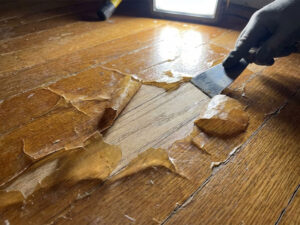
A smooth floor (CSP 1-2) cannot mechanically bond with the coating. Peeling and delamination occur within weeks. Minimum CSP 3 is required for polyaspartic systems.
Mistake #3: Underestimating downtime cost
Facility managers often compare material-only pricing while ignoring lost revenue during installation. A 7-day epoxy cure costs 5 additional days of zero operation versus 24-hour polyaspartic.
Mistake #4: Comparing material-only vs. installed pricing
Some quotes exclude surface preparation, crack repair, or moisture mitigation. Always request line-item installed pricing to avoid budget overruns.
9. Downtime Cost Savings Formula
Downtime cost savings can be estimated using this formula:
Downtime Savings = Daily Revenue × Days Avoided
Example: An auto repair shop earns $2,000 per day in labor and service revenue.
- Standard epoxy downtime: 7 days
- Polyaspartic downtime: 2 days
- Days avoided: 5 days
- Savings:
$2,000 × 5 = $10,000
For a facility generating $5,000/day, the savings jump to $25,000 per installation cycle. When combined with the elimination of 3-5 year recoat cycles, polyaspartic delivers lower total cost of ownership despite higher upfront material pricing.
10. Installation Process: A 24-Hour Transformation
Q: How long does Garage FX flooring take to install?
A: The full process takes 2 days, with heavy equipment returning to service at the 24-hour mark.
Day 1 (7:00 AM – 4:00 PM):
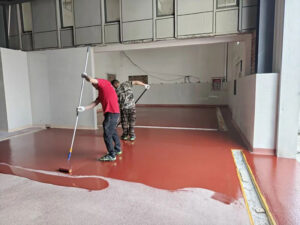
Mechanical grinders remove old sealers and coatings. The floor is vacuumed to near-zero dust. The 100% solids epoxy primer is applied via roller or squeegee, then colored flakes are broadcast into the wet surface.
Day 2 (8:00 AM – 4:00 PM):
Once the epoxy has set (but not fully cured), the polyaspartic topcoat is applied. It cures via chemical reaction, not evaporation, reaching full hardness in 4 hours. Light foot traffic returns at 6 hours; forklifts and vehicles return at 24 hours.
Q: What temperature can polyaspartic withstand?
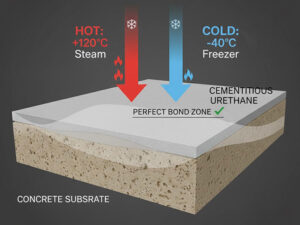
A: The cured system remains stable from -20°F to 200°F, making it suitable for unheated warehouses and hot tire contact zones alike.
11. Best Applications for Garage FX Flooring
| التطبيق | Recommended System Level | Why It Works |
|---|---|---|
| Auto repair shops | Standard (with anti-slip) | 24-hour cure, hot tire resistance up to 200°F |
| Aircraft hangars | Heavy industrial | Chemical resistance to jet fuel and hydraulic fluids |
| Logistics warehouses | قياسي | Fast cure minimizes operational shutdowns |
| Manufacturing plants | Heavy industrial | Impact resistance from dropped tools and parts |
| Retail showrooms | Basic commercial | UV stability prevents yellowing from windows |
12. FAQ: Commercial Polyaspartic Concerns
Q: Will hot tires peel the Garage FX flooring system?
A: No. Standard epoxies soften around 140°F (common for hot tires sitting still). The polyaspartic topcoat remains stable up to 200°F, preventing hot tire pickup.
Q: Is the floor safe around food or chemicals?
A: Yes. Once cured (24 hours), the surface is inert and non-porous. It resists brake fluid, 98% sulfuric acid (battery acid), and hydraulic fluids without etching.
Q: Is polyaspartic flooring worth the cost?
A: For 24/7 commercial operations, yes. The reduced downtime alone often covers the price difference within 12-18 months, and the 10-year total cost is lower than standard epoxy due to elimination of recoating cycles.
Q: What does the limited lifetime warranty cover?
A: The warranty generally covers coating defects such as delamination (peeling) and chipping, provided the original installer followed prescribed surface preparation methods.
Q: How many colors are available for branding?
A: Over 140 blended flake colors and solid tone options are available, allowing businesses to match corporate branding or use OSHA safety color standards for aisle ways.
Key Takeaways
Key facts for quick reference:
- Cost: $6.50 – $14.50 per square foot installed
- 5,000 sq. ft. facility total: $32,500 – $72,500
- Lifespan: 10 – 15 years for polyaspartic vs. 3 – 5 years for epoxy
- Downtime: 24 hours return to service (vs. 5-7 days for epoxy)
- Best use: commercial and industrial facilities
- Main cost drivers: Concrete Surface Profile (CSP), Moisture Vapor Transmission (MVT), system thickness
- Common mistake to avoid: Skipping moisture testing (ASTM F1869)
- 10-year total cost: Polyaspartic is lower than epoxy due to zero recoat cycles
About KAIDA PAINT: Industrial Flooring Material Expertise
Once project scope, surface condition, and performance requirements are defined, the next step is validating material specifications and supplier reliability.
KAIDA PAINT brings over two decades of chemical manufacturing experience to the commercial flooring industry. As a vertically integrated producer of high-build polyaspartic and epoxy resins, the company supplies material systems used in applications like Garage FX.
Industry advantages from vertical integration:
Manufacturers like KAIDA PAINT can reduce material costs by 15-20% by controlling upstream raw material sourcing and formulation consistency across batches. This supply chain control ensures batch-to-batch uniformity, which is critical for large commercial projects where mix ratio errors can cause delamination.
Technical support capabilities:
Engineers provide on-site mix ratio verification and humidity adjustment protocols to prevent application failures in challenging environments (high humidity, low temperature).
Sustainability and compliance:
Formulations are low-VOC and compliant with EPA standards for commercial indoor air quality, making them suitable for occupied facilities during application.
Contractors and facility managers often validate these estimates using manufacturer-supplied material takeoffs to avoid under-specifying coating thickness or missing moisture mitigation requirements.
Ready to calculate your exact project cost? Contact KAIDA PAINT for a commercial material estimate or to verify your installer’s quote against manufacturer-direct pricing.


 English
 Spanish
 Portuguese
 Arabic
 French
 Italian
 Russian
 Indonesian
 Swedish